


School Year Groups in England by Age: Key Stages, Year 4 and What Comes Next
Key Stage 2 in England is Years 3 to 6, ages 7 to 11. Find each year group and its normal age range, understand the England assessment timetable, and see how school-year cut-offs work.
 Elspeth Marlow
- 14 min read
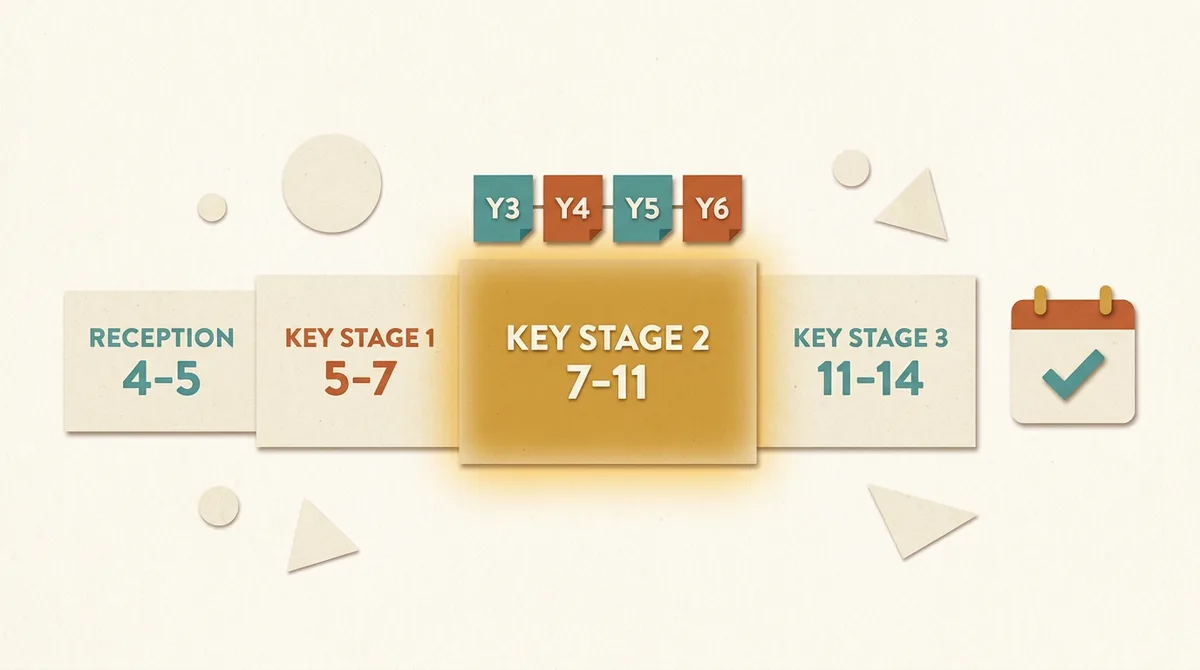
Most parents look this up for a small reason. A club form asks for a key stage. A newsletter mentions upper Key Stage 2. A relative asks what age Year 4 is and you realise you are not completely sure. The year-group and assessment chart below describes England; Wales, Scotland and Northern Ireland organise school years differently.
The short version is easy. In England, Key Stage 2 is Years 3, 4, 5 and 6, and covers ages 7 to 11. Year 4 sits in the middle of it, with the normal age range of 8 to 9.
The more useful version is a walkthrough, in order. It starts with the normal age cohort, runs through statutory assessments in England, and ends with the secondary-school application timetable. A child's agreed placement outside the normal age group can change the year they attend.
The quick answer: year group, age and key stage
- Key Stage 2 is Years 3 to 6, for children aged 7 to 11. Years 3 and 4 are often called lower Key Stage 2; Years 5 and 6 are upper Key Stage 2.
- Year 4 children are 8 or 9 during the school year. The oldest turn 9 in the September the year begins. The youngest turn 9 in the August it ends.
- Year 6 is still Key Stage 2, not Key Stage 3. Key Stage 3 begins in Year 7, at secondary school.
- These key stages describe England: EYFS ages birth to 5, KS1 ages 5 to 7, KS2 ages 7 to 11, KS3 ages 11 to 14 and KS4 ages 14 to 16, per GOV.UK. Post-16 education is often called sixth form or Key Stage 5, but KS5 is not one of the statutory national-curriculum key stages.
Every year group from Reception to Year 13
Ages below are the age a child turns during that school year in the normal England cohort, usually 1 September to 31 August. A school or admission authority may agree a different year group in individual cases. Assessments listed are for state-funded schools in England; arrangements at independent schools can differ.
Early Years Foundation Stage: nursery and Reception (ages 3 to 5)
- Nursery, ages 3 to 4. No national school assessment is listed here.
- Reception, ages 4 to 5. The Reception Baseline Assessment takes place in the first 6 weeks, and the Early Years Foundation Stage Profile is completed between April and June, usually in Reception. These are assessments, not national test papers.
Key Stage 1 (ages 5 to 7)
- Year 1, ages 5 to 6. Phonics screening check in June: the child reads 40 words aloud to a teacher. The check includes real words and pseudo-words.
- Year 2, ages 6 to 7. National curriculum tests and teacher assessments are optional, at the school's discretion. If your school uses them, ask how results will be shared and used.
Key Stage 2 (ages 7 to 11)
- Year 3, ages 7 to 8. No statutory assessment.
- Year 4, ages 8 to 9. Multiplication tables check: 25 onscreen questions on tables up to 12, in a two-week window in June.
- Year 5, ages 9 to 10. No statutory assessment.
- Year 6, ages 10 to 11. KS2 tests in English reading, English grammar/punctuation/spelling and maths, usually in May, under four hours in total. Writing and science are reported as teacher assessment, not tests.
Key Stage 3 (ages 11 to 14)
- Year 7, ages 11 to 12. Year 8, ages 12 to 13. Year 9, ages 13 to 14. No national tests.
Key Stage 4 (ages 14 to 16)
- Year 10, ages 14 to 15. Year 11, ages 15 to 16. Most pupils take GCSEs or other national tests during Year 11.
Post-16, often called sixth form or Key Stage 5 (ages 16 to 18)
- Year 12, ages 16 to 17. Year 13, ages 17 to 18. Post-16 qualifications vary; A levels, T Levels and other courses are available.
The assessment detail above comes from GOV.UK's overview of the national curriculum and its Key Stage 1 and 2 guidance. Worth noting because several council and tuition pages still say otherwise: Year 2 national tests became optional from the 2023/24 academic year. Check with your school whether it uses any optional tests or teacher assessments.
Use the England school-year tool below for the usual cohort year group and key calendar milestones from Reception to Year 7. Selective-test dates vary by area.
This part of the guide works out your child's year group and key school dates from their date of birth. It works in your browser.
Why 1 September decides your child's year group
In England, children born from 1 September in one year to 31 August the following year are normally educated together in a single year group. This is the usual cohort pattern, not a guarantee of an individual placement: parents can ask the admission authority about starting or moving outside the normal age group.
A worked example. Two children are in the same Year 4 class in autumn 2026. Amara was born on 3 September 2017. Ben was born on 20 August 2018. In October 2026 Amara is 9 years and 1 month. Ben is 8 years and 2 months. They sit at the same table, work through the same curriculum, and are almost a year apart. That gap is a normal result of the cohort dates. Children of the same age can also be educated in different year groups where an out-of-age-group placement has been agreed.
Separately, a child must be in full-time education by compulsory school age, which is 31 December, 31 March or 31 August following their fifth birthday, whichever comes first. Many children start Reception full-time in the September after their fourth birthday; the admission authority can advise about an individual child's start date.
What summer born actually means
Summer-born children are those born from 1 April to 31 August. They do not have to start school until the September after their fifth birthday, a full year after they could first have started.
One admissions detail matters if you are considering a delayed start. If you delay the start and do not formally request admission outside the normal age group, your child starts school in Year 1 rather than Reception, and skips Reception entirely. If you want your child to start in Reception a year later, that is a request to the admission authority and it has to be made deliberately. The DfE's advice for parents of summer-born children sets out how the request works.
Key Stage 2 up close: Years 3 to 6
Key Stage 2 is the longest stage in a child's school life so far: four years, from age 7 to age 11.
Maintained schools in England must follow the national curriculum, subject to statutory rules and exceptions. Academies are not required to follow it but must teach a broad and balanced curriculum, including English, maths and science. Independent schools must meet the independent-school standards. Individual schools can organise and sequence teaching differently.
In England, compulsory KS1 and KS2 national-curriculum subjects include English, maths, science, design and technology, history, geography, art and design, music, physical education (including swimming), computing and, at KS2, ancient and modern foreign languages. Schools choose their own sequence, so the first language lesson is not necessarily in Year 3.
The practical shape of the four years:
- Year 3. The first year of juniors. There is no statutory national assessment in this year.
- Year 4. Pupils take the multiplication tables check in June.
- Year 5. Content gets denser. In selective areas this is the year families start looking at secondary options in earnest.
- Year 6. Secondary applications in the autumn, KS2 tests in May, transition in the summer.
Year 4 in detail: ages 8 to 9
In England, the Year 4 national curriculum expects pupils to memorise multiplication tables up to and including 12 x 12, and to recall multiplication and division facts. See the primary mathematics programme of study.
Year 4 maths also introduces equivalent fractions, counting in hundredths, adding and subtracting fractions with the same denominator, decimal equivalents of tenths and hundredths, rounding decimals to the nearest whole number, and money problems to two decimal places.
A worked example of how those two strands meet, of the kind a Year 4 book is full of:
A school orders 7 packs of paintbrushes. Each pack costs £1.25 and holds 6 brushes. How much is the order, and how many brushes arrive?
7 x £1.25 = £8.75. 7 x 6 = 42 brushes.
The calculation uses multiplication facts alongside a money calculation. The statutory check is intended to assess fluent recall of times tables and help schools identify pupils who may need additional support.
The multiplication tables check itself is deliberately low-stakes. It is onscreen, 25 questions, with 3 practice questions first and 6 seconds per question. On average, the check should take no longer than 5 minutes. Schools must run it in a two-week window in June. There is no pass mark, and your child's teacher will share the score with you. Schools can use results to identify pupils who may need additional support. We have written a fuller walkthrough in the multiplication tables check explained, and a topic-by-topic guide to the Year 4 maths curriculum.
The dates: statutory assessments to 2028
Many pages still publish 2024 SATs dates. Here is the forward timetable published by the Standards and Testing Agency in primary assessments: future dates. The STA says future assessment arrangements are under review. Arrangements for 2026 to 2027 remain unchanged.
2026/27
- KS2 tests: Monday 10 May to Thursday 13 May 2027.
- Multiplication tables check: two-week window from Monday 7 June 2027.
- Phonics screening check: one-week window from Monday 14 June 2027.
- Optional KS1 tests: recommended during May 2027.
2027/28
- KS2 tests: Monday 8 May to Thursday 11 May 2028.
- Multiplication tables check: two-week window from Monday 5 June 2028.
- Phonics screening check: one-week window from Monday 12 June 2028.
For 2027, the KS2 test week runs in this published order: grammar, punctuation and spelling Papers 1 and 2 on the Monday, reading on the Tuesday, maths Papers 1 and 2 on the Wednesday, maths Paper 3 on the Thursday. Schools can view results online from Tuesday 6 July 2027; the 2027 key stage 2 assessment and reporting arrangements give this date for schools.
How to read a scaled score without panic
KS2 results come back as scaled scores from 80 to 120. A score of 100 or more means your child is working at or above the expected standard for the key stage. A score below 100 means they have not met the expected standard. The school sends your child’s results to you.
Context helps. In England's provisional 2025/26 results, 63% of pupils met the expected standard in reading, writing and maths combined. By subject, the figures were 75% in reading, 73% in writing, 75% in maths and 74% in grammar, punctuation and spelling. Average scaled scores were 106 in reading, 105 in maths and 105 in grammar, punctuation and spelling. Nine per cent reached the higher standard in all three of reading, writing and maths. These provisional results cover Year 6 pupils assessed in summer 2026 and are due to be revised in December 2026, according to the Department for Education release.
A scaled score of 103 is above the expected standard of 100. For context, the 2026 national average scaled scores were 106 in reading, 105 in maths and 105 in grammar, punctuation and spelling. These scores describe separate assessments, not an overall ranking of a child.
Year 6 to Year 7: the transfer timeline
Use the year-group dates to distinguish a test deadline from the following September's school entry.
For September 2027 entry in England, the national closing dates are 31 October 2026 for secondary applications and 15 January 2027 for primary applications. National offer days are 1 March 2027 and 16 April 2027 respectively. Local authorities coordinate applications, and late applications are handled under the relevant local scheme. Check your home authority's instructions and dates. See GOV.UK's how to apply page and Sutton Council's 2027 application dates.
Selective test registration, test dates and result dates vary by school and area. For example, North Yorkshire Council says Ripon Grammar School's test for September 2027 entry was held on 12 September 2026, and results would be issued no later than 16 October 2026. The council page lists two tests, one with 32 verbal-reasoning questions in 20 minutes. Other schools use different calendars, so check the school's current policy and your home authority's application timetable. Registration can have a separate deadline from the council application. We have a general walkthrough in how to register for the 11 plus.
For a child in the usual cohort, September of Year 6 is two years after the start of Year 4 and about 14 months after its July end. Check the target school's actual dates.
Year groups elsewhere in the UK
Key stages as described here are an England structure.
- Wales. The Curriculum for Wales is a 3-to-16 continuum with five progression steps, broadly linked to expectations at ages 5, 8, 11, 14 and 16. It no longer uses the old key-stage structure. School year labels and birthday cut-offs should be checked with the school and local authority.
- Scotland. Primary years are P1 to P7, followed by S1 to S6 at secondary. Curriculum for Excellence uses levels (early, first, second and so on) rather than key stages. Children usually start school aged 4½ to 5½; the usual start date depends on their birthday, and entry can be deferred.
- Northern Ireland. Primary years are P1 to P7, with Key Stage 2 covering P5 to P7. Children usually start school in the September after turning four, except those born from 2 July to 31 August, who usually start in the September after turning five. Parents may request deferral for eligible children born from 1 April to 1 July under the School Age (Northern Ireland) Act 2022.
If you are comparing schools across nations, compare by age rather than by year number.
Questions parents ask
What age is Key Stage 2?
In England, KS2 covers Years 3 to 6 and the normal age range is 7 to 11. A child's precise age depends on their birthday and any agreed out-of-age-group placement.
Is Year 6 Key Stage 2 or Key Stage 3?
Key Stage 2. Year 6 is the final year of KS2 and of primary school. Key Stage 3 starts in Year 7.
What are Key Stage 2 SATs?
In England, these are the national curriculum tests at the end of Year 6 in English reading, English grammar, punctuation and spelling, and maths. They take under four hours in total and are usually in May. There is no writing or science test; both are reported through teacher assessment. Writing is reported as working towards, working at, or working at greater depth within the expected standard. Science is reported simply as met or not met.
What is the difference between KS2 and KS3?
In England, KS2 is primary, Years 3 to 6, and ends with national tests and teacher assessments. KS3 is Years 7 to 9; there are no national curriculum tests at the end of KS3. Schools may use their own assessments.
What years are KS2 in order?
Year 3, Year 4, Year 5, Year 6. Years 3 and 4 are lower KS2, Years 5 and 6 are upper KS2.
If you are weighing a grammar school
For selective-school planning, establish your child’s entry year and then check the school’s current registration, test and application dates. A year-group chart explains age and progression; it does not determine an individual school’s timetable.
Nothing about Year 4 needs to change because of that. Reading widely, solid tables and confident arithmetic are the whole foundation, and they are the same things the school is already working on. If you want to see what a sensible, low-pressure version looks like, we set it out in starting 11 plus preparation in Year 4. When you do reach the point of wanting practice on paper, our printable paper tests are designed to be worked through at a kitchen table, with answers, and nothing more dramatic than that.
Topics
- key stage 2
- year 4
- school years
- primary
- sats
- admissions