

How to Register for the 11 Plus
Eleven plus registration is not one process but three, and the body that runs it depends entirely on where you live. This guide routes you to the right form, the right window and the second deadline that decides whether a pass turns into a place.
 Elspeth Marlow
- 14 min read

Most guides to 11 plus registration open by telling you that dates vary by region, and then stop. That is true, and it is also useless, because the reason dates vary is not administrative untidiness. It is that three completely different kinds of organisation run the process in different parts of England, and until you know which one covers your address you cannot fill in anything at all. You are not looking for a date. You are looking for a branch.
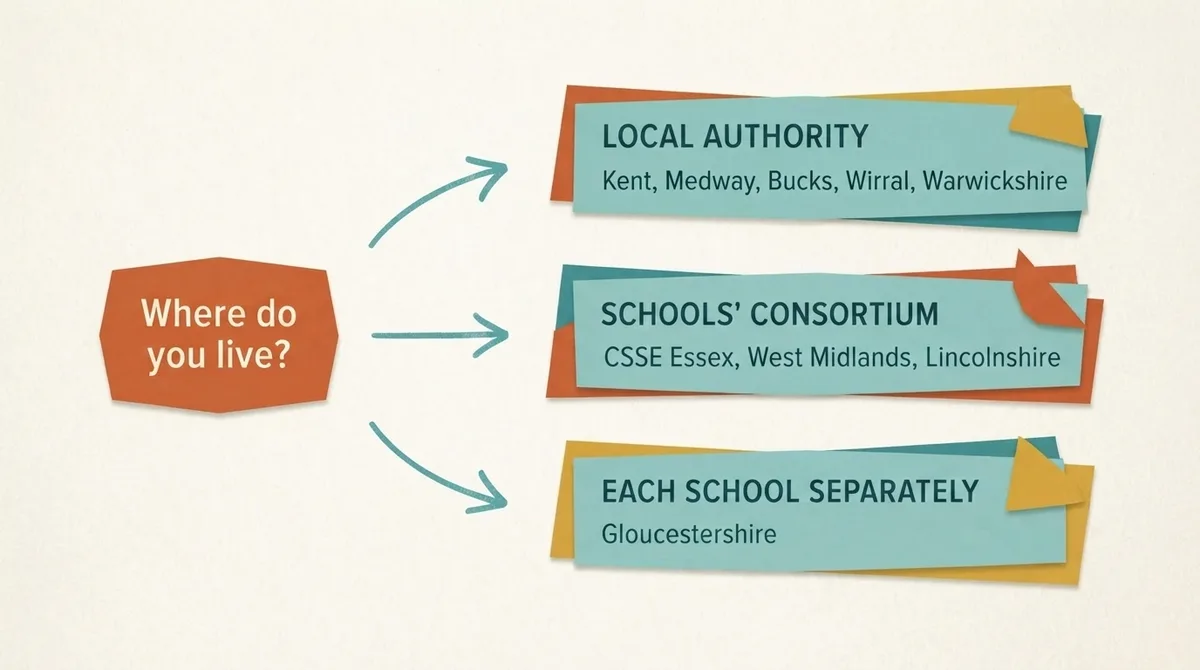
Here is the shape of it. In some areas the local authority registers your child (Kent, Medway, Buckinghamshire, Warwickshire, Wirral, Redbridge). In others a consortium of schools does it collectively, with one form covering many schools (CSSE in Essex, the West Midlands grammar schools, the Lincolnshire consortium). And in at least one county the council explicitly does not run the test at all, so you register with each individual school. Gloucestershire County Council states plainly that "the registration for, and administration of, the Admissions Entrance Test is all carried out by the Gloucestershire grammar schools themselves".
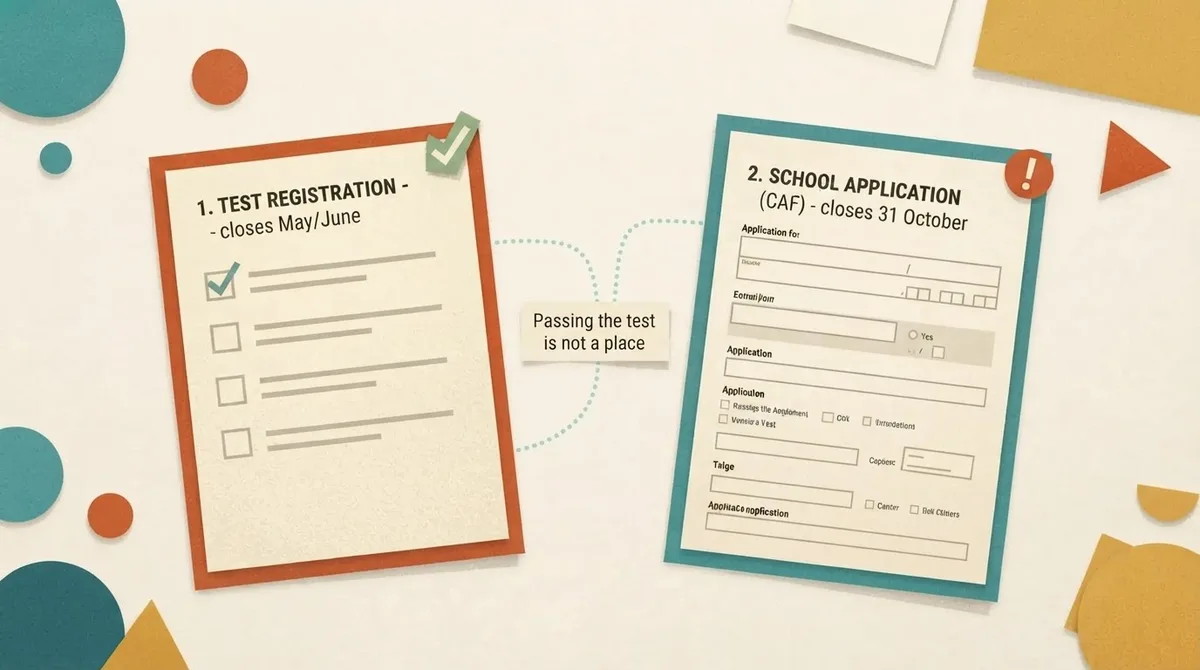
There is a second thing nobody says loudly enough, and it costs families places every single year. Registering for the test and passing the test does not get your child into a grammar school. That is a separate form, submitted to your home local authority, with a national deadline of 31 October. This guide walks the whole cycle in order, from the spring the registration windows open to the offer that lands on 1 March, and flags the two dates in between that quietly catch people out.
What 11 plus registration actually means
Registering for the 11 plus means telling whoever runs the selective test in your area that your child intends to sit it, before that area's cut-off. It reserves a seat, generates a candidate number, and triggers the invitation letter or email telling you where and when to turn up. It is not an application for a school place.
That distinction is the whole ball game. Registration is a test booking. The application for a school place is a different document, on a different timetable, run by a different part of the system. Plenty of families do the first and assume it implies the second. It does not, and the consequences are not recoverable in November.
It is also worth knowing what registration does not decide. It does not commit you to accepting a grammar place, it does not usually cost anything in the state sector, and in most areas it does not lock your child into one school. What it does lock is your entry into a testing window that, in several counties, has no second sitting and no appeals route for a missed form.
The two forms that decide the outcome
Direct answer: Every selective admission needs two separate submissions. First, a test registration with the body running the exam, usually closing between May and early July of Year 5. Second, your secondary school application, submitted to your home council by 31 October of Year 6, naming the grammar schools you want in preference order.
GOV.UK sets the second date nationally: "You must apply for a secondary school place by 31 October", with councils sending offers on 1 March. It also settles the question parents ask most often about crossing boundaries: "You apply through your local council even if you're applying for schools in another council area or you've just moved to England" (gov.uk).
The clearest first-party statement of the failure mode comes from Gloucestershire, which says that "obtaining a qualifying rank on the Entrance Test is not an automatic offer of a place" and then, unambiguously, that "your child will not be offered a place in a grammar school if it has not been listed on your secondary school application form" (gloucestershire.gov.uk). Wirral confirms the same mechanism from the other direction: it advises including at least one grammar school on the application, and notes that where a child does not meet the standard, the grammar preference is simply withdrawn and the rest of your list still stands. In other words, naming a grammar school costs you nothing if the score does not come through, and omitting one costs you everything if it does.
Who registers your child: council, consortium or school
Direct answer: Check your county before anything else. Local authorities run registration in Kent, Medway, Buckinghamshire, Warwickshire, Wirral and several London boroughs. Schools' consortia run it in Essex (CSSE), the West Midlands and Lincolnshire. In Gloucestershire, the seven grammar schools handle it themselves and the council does not.
The council branch is the most familiar. You create an account on a council portal, complete a short online form during a fixed window, and receive an automated confirmation. Warwickshire, for example, has parents register through a Parent Portal account and sends a confirmation email on submission (warwickshire.gov.uk).
The consortium branch means one registration covers a group of schools. CSSE administers a single Essex test for ten schools including King Edward VI, Colchester Royal, both Westcliff High schools, both Southend High schools, Colchester County High for Girls, St Bernard's, St Thomas More and Shoeburyness (csse.org.uk). The West Midlands Grammar Schools consortium works similarly across Birmingham, Walsall and Wolverhampton schools, and Lincolnshire runs a consortium arrangement with some schools also taking their own entries.
The school branch is the one that surprises people. In Gloucestershire you deal directly with Pate's, Denmark Road, Ribston Hall, Sir Thomas Rich's, The Crypt, Marling or Stroud High. There is a common test window, but the registration relationship is with the schools. If your area is not covered above, our guide to grammar schools in the UK by area is the fastest way to identify which body applies to you, and the 11 plus exam explained pillar covers how the tests themselves differ once you know.
The registration calendar, milestone by milestone
The cycle is more predictable than the date spread suggests. Below is the sequence as it plays out for entry in September 2027, taken from official pages. Dates shown are for 2027 entry and were correct at the time of writing. Always confirm on the linked council or consortium page, because windows move by a week or two each cycle and some counties change their portal entirely.
Which cycle is yours depends on your child's birthday. Enter their date of birth below to see their school year now, and the terms when they would register for the 11+ and sit it.
This part of the guide works out a child's school year in England from their date of birth, and when they sit the 11+. It works in your browser.
Spring of Year 5 (April to May): windows open.
- Buckinghamshire: registration opened 1 May 2026
- Warwickshire: opens 7 May each year for Year 5 children
- Medway: opened Monday 18 May 2026
- Gloucestershire: opened noon on 18 May 2026
Late spring to summer of Year 5 (June to July): windows close. This is the cliff edge.
- Wirral: closed 12 noon on 1 June 2026
- Buckinghamshire: closed 3pm on 2 June 2026
- Medway: closed Friday 12 June 2026
- Gloucestershire: closed noon on 26 June 2026
- Warwickshire: closes 30 June each year
- Birmingham and the West Midlands consortium: closed 4pm on Friday 26 June 2026, with late registrations not accepted
- Kent: registration closed 1 July 2026
Summer (July to August): confirmations and invitations. Buckinghamshire emailed test invitations by 7 August 2026. Most authorities issue candidate details and venue information in this window, and this is when you should chase if nothing has arrived.
Early autumn of Year 6 (September): the tests. Buckinghamshire ran a familiarisation practice test on 8 September 2026 and the transfer test on 10 September 2026. Gloucestershire's entrance test was Saturday 12 September 2026. Wirral assessed on 15 September 2026. CSSE sits its Essex test on Saturday 19 September 2026.
October: results, then the application. Buckinghamshire released results on 9 October 2026. Most areas publish in mid to late October, deliberately before the national application deadline of 31 October 2026 so you can name schools with the score in front of you. Our guide to 11 plus results day and your options covers how to read the letter.
1 March: national offer day. Councils send secondary offers, and you accept or decline by the date on the letter.
For a fuller regional breakdown including areas not listed here, see our companion guide to 11 plus exam dates and registration deadlines by region.
To check the registration window for your area, choose it below. Each area links to the council or consortium page where you register.
This part of the guide looks up which 11+ test your area uses. It works in your browser.
How to register, step by step
Direct answer: Identify the registering body, create an account on its portal during the open window, enter your child's details and current school, name any schools required, flag access arrangement needs, submit, and save the confirmation email. Most forms take under twenty minutes if you have the details ready.
Have these to hand before you start:
- Your child's full legal name, date of birth and, where asked, their unique pupil number from their current school
- Your home address with proof, since catchment and priority often hinge on it
- Your child's current primary school name and, in some areas, its DfE number
- An email address you check daily, because invitations and access arrangement decisions arrive by email and not by post
- Any medical or SEN documentation you may need for access arrangements, ready to send separately
- In consortium and school-run areas, the list of schools you want your child considered for
Then submit early rather than on the closing morning. Several counties close at noon or 3pm rather than midnight, and a portal that is busy at 11:40am on the last day is not an exceptional circumstance anyone will accept.
If you live out of county or out of borough
Direct answer: You can almost always sit another area's test as an out-of-county candidate, but you must register yourself rather than relying on automatic entry, and distance may still cost you a place even with a qualifying score. Your school application still goes to your home council.
Buckinghamshire is the trap worth naming. The council states that "children who attend a state-funded primary school in Buckinghamshire do not need to register as they are entered for the test automatically", which means everyone else must act, and it warns explicitly that "Milton Keynes is not in Buckinghamshire; if your child attends school in Milton Keynes and you'd like them to sit the test, you must register them" (buckinghamshire.gov.uk). Families who assume the automatic route applies to them discover in August that no invitation is coming.
Medway is honest about the other risk, warning that "if you do not live very close to Medway, you may not be able to get a place at a Medway school" (medway.gov.uk). A pass is a threshold, not a queue position. Where a school is oversubscribed with qualified candidates, distance decides, and travelling in from outside is a genuine gamble rather than a formality. Sitting two areas' tests is common and legitimate, but check the test dates do not clash before you commit to both.
Access arrangements and their separate deadline
Direct answer: Access arrangements such as extra time, coloured overlays or a separate room are requested on a different form with a different deadline, often after registration has already closed, and almost always require the school to submit evidence rather than the parent.
Access-arrangement requests can have an earlier deadline than registration. The pattern across authorities is consistent: talk to your child's SENCO before you register, not after.
- Medway requires parents to speak to the child's school before the registration close, and the school must then submit the formal request by Monday 22 June 2026, ten days after registration itself closed on 12 June. Children with an EHCP or a PCAR receive 25% additional time automatically. Every other request needs supporting evidence (medway.gov.uk).
- CSSE set its own cut-off for Essex, stating that "the deadline for receipt all requests and supporting documentation was 26th June" (csse.org.uk).
- Warwickshire uses an entirely separate testing arrangements form, emailed with supporting documentation to the council's 11 plus address rather than submitted through the registration portal.
Three lessons follow. The request is usually the school's to make, so the SENCO needs weeks of notice, not days. Evidence means dated professional documentation, not a parental description. And a diagnosis alone does not guarantee an arrangement: only EHCP and PCAR holders get anything automatically in Medway, and everyone else is assessed on what the school can prove.
Missing the deadline
Direct answer: Most authorities refuse late registrations outright. The one exception that recurs is a genuine house move into the area after the close, evidenced. Assume there is no safety net, because in several counties there provably is not.
Medway is the blunt end of the spectrum: "registrations after the closing date cannot be accepted. There are no exceptions to this." Birmingham likewise does not accept late registrations. Wirral states that it cannot accept forms after 1 June, with the sole exception of a child who moved to Wirral after the closing date, and adds that the assessment "can only be taken once", so an absent child is offered another session but never a resit.
Buckinghamshire leaves a narrow door open, saying it "will not normally accept a late registration for testing unless you have exceptional reasons for not registering before the deadline", and treats evidenced relocation into the county as the standard qualifying reason (buckinghamshire.gov.uk).
If you have genuinely missed it, contact the admissions team the same day, put the circumstances in writing, and start preparing the alternative route in parallel: your non-selective preferences on the 31 October form, plus any in-year or Year 7 casual admission process the schools operate.
Your registration checklist
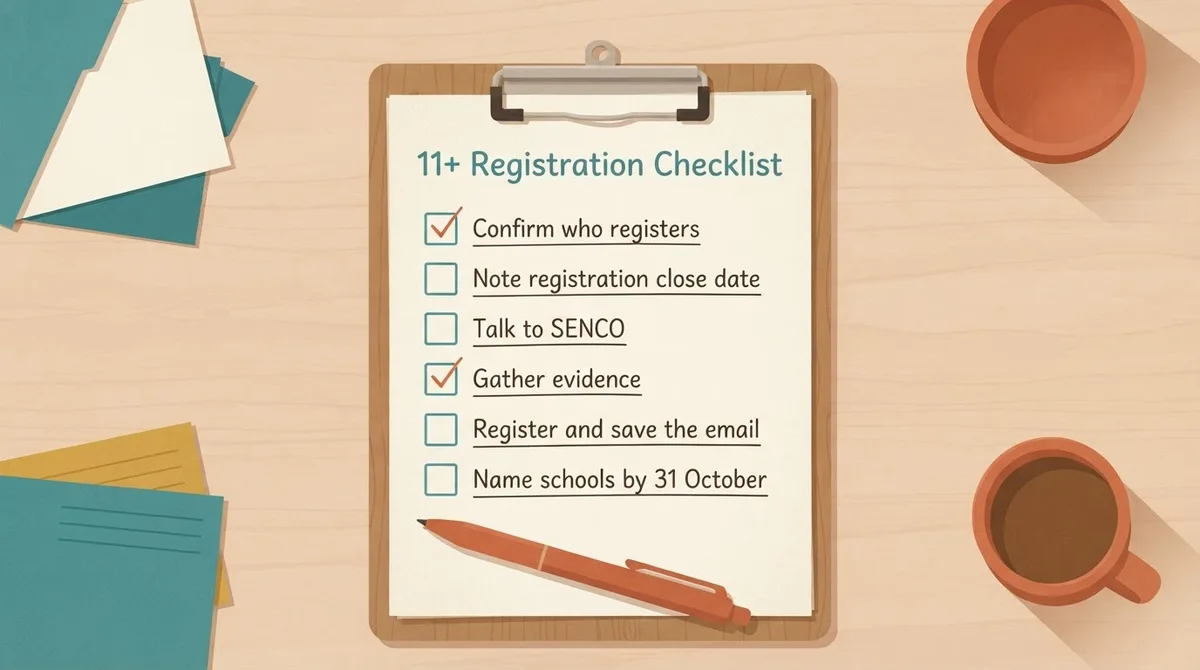
Copy or print these six lines and work through them in order:
- Identify the registering body. Council, consortium or individual school. Write the exact web address down.
- Write the registration close date on the calendar, including the time. Noon and 3pm closes are common. Set a reminder two weeks before.
- Book the SENCO conversation now if access arrangements might apply, and ask who submits the request and by when.
- Gather address proof, the pupil number and an email you check daily before opening the form.
- Register, then save the confirmation email into a folder. If nothing arrives within a day, chase it.
- Diarise 31 October and name every grammar school you would accept, in true preference order, on your home council's application.
Between registration in the summer and the test in September sits the preparation window, and it is shorter than most families expect. If you want that time structured rather than improvised, a personalised exam plan turns the gap between your child's current level and the paper they will actually sit into a weekly sequence.
Frequently asked questions
How do I register my child for the 11 plus? Find out whether your local authority, a schools' consortium or the individual schools run the test where you live, then complete that body's online registration form inside its published window, usually between April and early July of Year 5.
When can I register for the Kent Test? Kent's window typically opens in early summer and closed on 1 July for 2027 entry. Kent County Council publishes the exact dates each cycle on its register for the Kent Test page, and our Kent Test guide covers the format.
Is there a fee? State selective tests are generally free to register for. Independent school entrance exams and some consortium arrangements charge, so check the specific body's page.
Can my child sit more than one area's test? Yes, provided the dates do not clash and you register separately with each body. Your school application still goes to your home council.
What if we move house after registering? Tell both the test administrator and your home council immediately. A move changes your catchment position and, in a small number of areas, is the one accepted reason for a late registration.
Does a qualifying score guarantee a place? No. It makes your child eligible to be considered, after which oversubscription criteria such as distance and sibling priority decide. And it counts for nothing at all unless the school is named on your 31 October application.
Topics
- 11 plus
- registration
- admissions
- deadlines
- grammar schools