


The Multiplication Tables Check Explained for Parents
Understand the Year 4 multiplication tables check, published dates, the national average and how questions are chosen. Includes an optional practice sequence.
 Elspeth Marlow
- 15 min read
If a letter has come home about the multiplication tables check, the useful summary is short. Your child will sit 25 on-screen multiplication questions in June of Year 4, with six seconds to answer each one. The check takes under five minutes on average. There is no pass mark, and the Department for Education does not publish comparative results by school. The score is one piece of information for the school, not a decision about your child's future.
The official assessment framework sets out the test’s content and sampling rules.
So this guide walks the school year in order: what the curriculum already asked for in September, how the 25 questions are actually chosen, the practice window in late April, the June dates through to 2028, what happens in the room, and how the score reaches you. It uses the verified national average (21.0 out of 25) so you have something real to measure against, and it ends with an optional practice sequence to adapt around your child.
First, what the check actually is
The multiplication tables check (MTC) is an online, on-screen digital assessment taken by pupils at the end of Year 4, focused on the fluent recall of multiplication facts. Under standard administration it takes each pupil less than five minutes.
It is narrower than parents expect. It assesses instant recall of multiplication facts and nothing else. Division facts, word problems and multiplication used in a wider context are still assessed through the Key Stage 1 and Key Stage 2 mathematics assessments, not here. The check is a fluency snapshot, not a maths exam.
It has been statutory since the 2021/22 academic year. All eligible Year 4 pupils registered at maintained schools, special schools or academies (including free schools) in England are required to take it. It ran as a voluntary check in 2018/19 and as a national voluntary roll-out in 2020/21, which is why some parents of older children have never heard of it. All of this comes from the Standards and Testing Agency assessment framework.
September: what the curriculum had already asked for
The check does not add new content. It checks content that was already due.
The national curriculum programmes of study for mathematics require pupils to recall and use multiplication and division facts for the 2, 5 and 10 tables in Year 2, the 3, 4 and 8 tables in Year 3, and multiplication and division facts for tables up to 12 x 12 in Year 4. It says plainly that by the end of Year 4 pupils should have memorised their multiplication tables up to and including the 12 multiplication table, and show precision and fluency in their work.
The curriculum describes what pupils should learn by the end of each year, not what every child will already recall at the start of Year 4. Some pupils will still be building fluency with facts taught earlier, and the programme expects the full set up to 12 x 12 to be memorised by the end of Year 4. Use your child's current recall to decide what to revisit rather than assuming that only five tables will be new to them.
Which tables come up, and how often
This is the part no ranking page explains properly, and it turns "practise your tables" into a precise target.
Items are selected from the 121 items that make up the 2 to 12 multiplication tables. The one times table is not included in the check, although it may appear in the practice questions. Within each form of 25 questions, the assessment framework fixes how many items each table can supply:
- The 6, 7, 8, 9 and 12 tables: minimum 2 items each, maximum 4 items each.
- The 3, 4, 5 and 11 tables: minimum 1 item each, maximum 3 items each.
- The 2 and 10 tables: minimum 0 items each, maximum 2 items each.
Multiply that out and you get the most useful number in the whole framework. Between 10 and 20 of the 25 marks come from the 6, 7, 8, 9 and 12 tables alone, because the Standards and Testing Agency has determined these to be the most difficult tables. The 2s and 10s together can supply as few as zero marks.
Four more rules are worth knowing. Each form contains a minimum of 18 and a maximum of 22 Key Stage 2 items, and a minimum of 3 and a maximum of 7 Key Stage 1 items (the 2, 5 and 10 tables). Each question appears only once in a form. A fact and its reversal never appear in the same form, so if 7 x 6 comes up, 6 x 7 will not. No form shares more than 30 per cent of its items with any other form. This limits overlap between forms; it does not make a restart a useful practice strategy.
Late April: the try it out practice check
Schools get an official familiarisation route. Pupils could use the "try it out" practice check from Monday 27 April 2026, using a school-generated PIN, until the check period ended on 19 June.
The important caveat: that PIN is generated by the school, so this is something your child's teacher runs in class, not something you can set up at home. If you want your child to have seen the interface before June, the question to ask at parents' evening is simply whether the class will be doing the try it out check, not whether you can have a login.
Schools also have rules for the room itself, set out in the administration guidance. Pupils must not have a pen or pencil, paper, calculator, mobile phone, smart watch or anything else that could give an advantage, and wall displays showing multiplication facts should be taken down. Nobody is expected to work anything out. The framework defines the check as a measure of fluent recall, not general mathematical understanding.
The June window: 2026, 2027 and 2028 dates
In 2026, schools had to administer the check within the two-week period Monday 1 June to Friday 12 June. There is then a further week, Monday 15 June to Friday 19 June, for pupils who were absent or affected by technical problems.
Looking further ahead, primary assessment future dates confirm schools must administer the check within the two-week period from Monday 7 June 2027, with Monday 21 June to Friday 25 June for absent pupils or technical delays (2027 assessment and reporting arrangements), and within the two-week period from Monday 5 June 2028. If you also have a Year 6 child, note that the 2027 Key Stage 2 SATs run from Monday 10 May to Thursday 13 May 2027, so the two do not collide.
You will sometimes see the window described as three weeks. That is loose. It is a two-week administration window plus a third catch-up week, and most schools use a single morning inside the first fortnight. Schools choose their own day and do not have to tell you which one it is, so do not build your week around it.
In the room: what your child sees, step by step
Every form has 25 questions worth one mark each, all in the same format: n1 x n2 = [box]. Before those begin, your child answers three practice questions, which do not count.
Then the rhythm starts. A question appears. Six seconds begin the moment it appears. Your child can press enter as soon as they have typed the answer, or wait for the time to expire. Either way there is a three-second pause before the next question. That gives 25 lots of nine seconds, or three minutes and 45 seconds of question time, which is why the whole session including instructions still sits under five minutes.
Answers can be entered by keyboard, by mouse using the on-screen number pad, or by touchscreen. Whichever your child's school uses, they will have practised it.
Two details are worth passing on to your child. Items are not ordered by difficulty, so a hard question at number three means nothing about the rest. And the six-second limit is not arbitrary: it came from Standards and Testing Agency research in which 1,124 pupils trialled three different time limits. The framework says the check is designed to assess fluent recall; it does not test calculation strategies.
Access arrangements, restarts and pupils who do not sit it
Access arrangements exist and schools decide them, based on how your child normally works. They include an audio version of the questions, colour contrast changes, a question pause, a larger font size, an audible alert and removing the on-screen number pad.
The six-second response period cannot be extended. A separate access arrangement lets a pupil choose when to move on between questions, with a 30-minute overall limit. If your child needs an arrangement, discuss it with the school and try it in the familiarisation check. The score is information for the teacher, not a verdict on your child.
A pupil can have a maximum of three attempts, which matters if a device fails partway through. And some pupils should not take the check at all. The 2027 Key Stage 2 assessment and reporting arrangements list the categories: pupils absent for the entire three-week period, pupils who cannot access it even with access arrangements, pupils working below the Year 2 expectation for multiplication tables who are considered unable to answer the easiest questions, pupils who have just arrived in England with English as an additional language, and pupils who were incorrectly registered.
The score, and what 21.0 out of 25 actually means
A total score out of 25 is reported to each school at the end of the window. Schools could access pupil results in the MTC service from Monday 22 June 2026.
Schools then have a statutory duty. The 2027 key stage 2 assessment and reporting arrangements say headteachers must report to parents by the end of the summer term either their child's score, including for pupils who have since left the school, or the reason their child did not participate or has not received a result. If the summer term ends and you have heard nothing, you are entitled to ask. The Department for Education does not publish school-level results, and there is no expected standard or pass mark, with no reported standard beyond the number and percentage of pupils achieving full marks.
So what is a good score? Use the national picture. In 2024/25 the national average attainment score was 21.0 out of 25, up from 20.6 the year before, and 37 per cent of eligible pupils scored full marks, which was the most common single mark. Around 629,947 pupils in state-funded mainstream schools took the check. Disadvantaged pupils averaged 19.3 against 21.7 for non-disadvantaged pupils, boys averaged 21.2 and girls 20.7, and by region London was highest at 21.7 while the South East and East of England were lowest at 20.7. Those figures were published on 20 November 2025, with the next release due in November 2026.
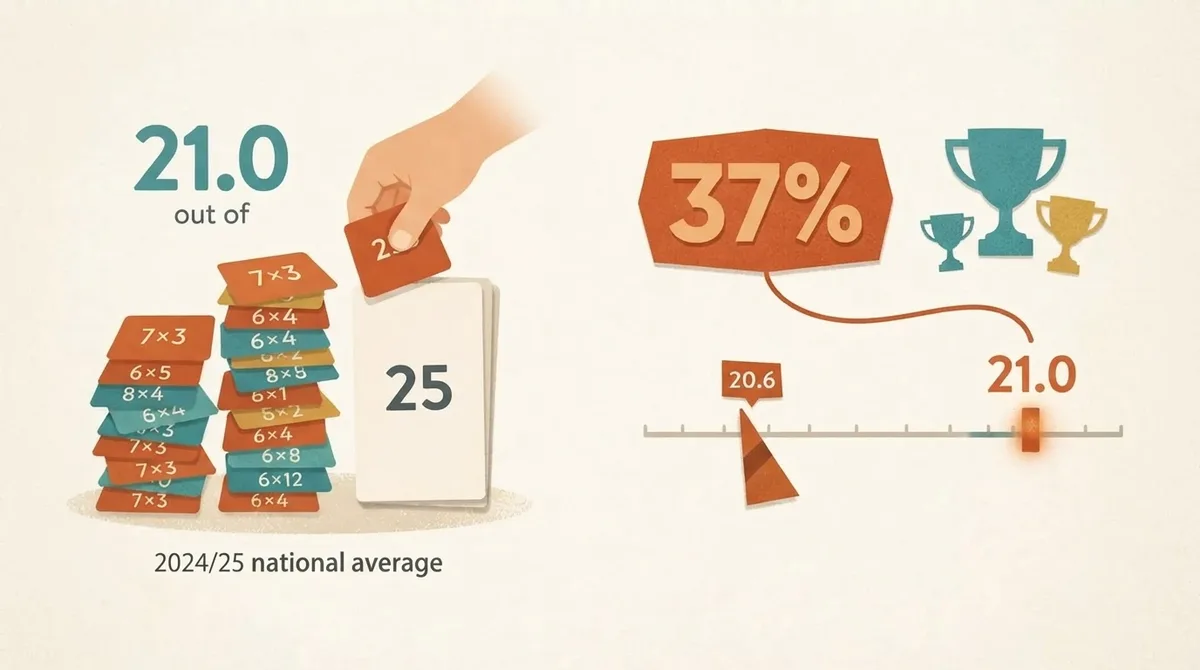
The reported national mean is 21.0 out of 25. This is a group-level summary, not a required score or a judgement about an individual child. A score of 17 does not show which facts a pupil found difficult or why. The framework says the check can help schools identify pupils who may need additional support, but is not intended as a diagnostic tool. Teachers can use the score alongside other evidence when planning support.
Can my child practise at home? What is and is not available
The official check is accessed through schools. The pupil site at pupil.multiplication-tables-check.service.gov.uk requires a school-issued password and PIN, so there is no parent login or home version of the real check.
Here are a few low-cost options to try at home:
- Verbal recall in the gaps. Walking to school, six facts, mixed tables, no warning. Recall under mild time pressure is the exact skill being checked.
- A hand-drawn grid. Write the numbers 2 to 12 down the side and along the top of a piece of paper, then fill in one row a day. Eleven rows cover the 121 facts in the 2 to 12 tables.
- Sort facts into known and slow. The facts a child finds slow will vary. Note the ones they are still working out, then choose a small set to revisit.
- Six-second self-checking. Say a fact, count three slow breaths, answer. No stopwatch needed and no app required.
Be wary of anything that claims to be the check itself. The practice round below is ours, not the official one: it uses the same six second timing and leans towards the harder tables the way the real check does, it runs in your browser, and the result is not saved by the drill.
This part of the guide is a short timed practice. It loads in your browser.
An optional practice sequence
This is one optional plan, not official guidance on how long a child should practise. It gives extra attention to the 6s, 7s, 8s, 9s and 12s because the framework allows more questions from those tables.
- Start with facts your child is still learning. You might begin with a short mixed check of the 2s, 5s and 10s, then include other tables as needed. This suggested order is not a curriculum requirement or a promise about confidence.
- Next: revisit the 8s if they are not yet recalled readily. The curriculum introduces them in Year 3, but pupils may still be learning them in Year 4.
- Then: include the 11s and mixed recall. Adjust the amount and pace to your child.
- During a break: keep practice optional and brief if it suits your family; retention varies, so check what your child still recalls afterwards.
- Continue: include 6s where useful. A known fact such as 3 x 7 can help derive 6 x 7, though the check assesses recall rather than working.
- Keep reviewing: include 7s and any other facts your child is still working out. There is no evidence that one table will take a fixed number of weeks.
- Mix in 9s alongside other facts. Patterns can help explain products, but they do not make every fact instantly retrievable for every pupil.
- Build a mixed set that includes 12s and facts from other tables.
- If useful, practise the format with a short timed round and check with the teacher if you have concerns about your child’s progress or access needs.
- Near the check: follow the school’s guidance and keep routines manageable. There is no need to add intensive practice solely because the check is approaching.
For an anxious child, say three things and stop: it takes less than five minutes, nobody passes or fails it, and it gives your teacher information about your multiplication recall. If practice itself has become a battleground, the reset in our guide to what to do when a child resists practice applies just as well at eight as at ten, and a short practice session is one option if it fits your child and family.
Frequently asked questions about the multiplication tables check
How do I prepare for an MTC check?
There is no required preparation plan. If you choose to practise, short mixed recall sessions are one option; the framework allows more questions from the 6, 7, 8, 9 and 12 tables. No preparation is required by the school, and the official parent guidance is that your child does not need to revise for it. Practising is about fluency for Year 5 maths, not about the check.
Is there a pass mark for the multiplication check?
No. There is no expected standard threshold for the MTC and no pass mark. The only reported standard beyond the raw score is the number and percentage of pupils who achieve full marks.
What is the guidance for the multiplication tables check in 2026?
Schools had to administer it within the two-week period Monday 1 June to Friday 12 June 2026, with Monday 15 June to Friday 19 June available for absence or technical problems. The try it out practice check opened on Monday 27 April 2026, and schools could access results from Monday 22 June 2026.
What is a good MTC score?
There is no expected standard or pass mark. The 2024/25 average was 21.0 out of 25 and 37 per cent of pupils scored full marks. A score on its own does not identify which facts a pupil knows or the support they may need.
What is the average MTC score?
The latest figures available when this article was reviewed are for 2024/25: the average was 21.0 out of 25 and 37 per cent of pupils scored full marks. Check the Department for Education statistics page for the latest release before relying on a year-specific comparison.
How to improve MTC results?
Identify the specific facts your child hesitates on and use those to guide practice. Keep some mixed questions in the routine so they continue to meet facts they already recall.
The Year 4 check measures multiplication recall, rather than predicting an entrance-test result. For selective entry, check the target school’s current content and calendar and plan from those requirements. For planning guidance, see starting 11+ preparation in Year 4.
Topics
- multiplication tables check
- year 4
- primary maths
- times tables
- parent guide