


Multiplication Tables Check Practice: Why Knowing the Tables Is Not Enough
The six-second response window prioritises quick recall. A child who can chant the tables may still need to practise recalling facts out of order.
 Elspeth Marlow
- 14 min read
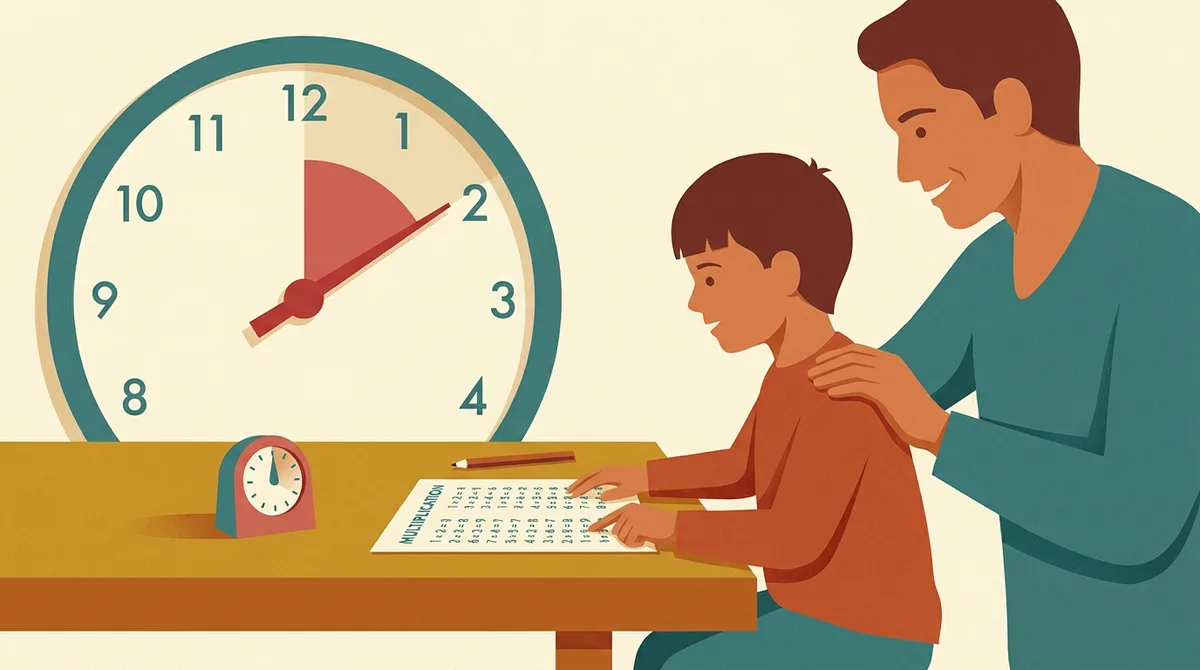
The multiplication tables check contains 25 questions, with six seconds for each response. That format tests quick recall of individual facts, so reciting a table in order does not by itself show how quickly each fact can be retrieved.
This is a practice guide, with a free printable timed sheet and a practice check that runs on this page at the real six second pace. Rehearsing against a clock does matter, but you can use it to practise recalling facts out of order and then review any answers that took longer: noticing which facts a child recalls readily and which they are still working out.
Your child can chant the tables. The check can still catch them out.
For example, a child might answer seven times six by counting on: seven, fourteen, twenty-one, twenty-eight, thirty-five, forty-two. That is a correct way to work out the fact, but if it takes longer than the six-second response period, the answer will not be entered in time.
Chanting is a sequence. The check asks for one fact, pulled out of order, with no run-up. Those are different ways to practise the facts, so being able to chant a table does not by itself show how quickly a child can recall each fact out of order.
The assessment framework is blunt about what it measures. It says the check "only assesses the instant recall of multiplication facts" and that answering at speed is key to assessing fluent recall. Not understanding. Not method. Retrieval.
What the check is, and when it happens
The multiplication tables check is a key stage 2 assessment taken at the end of Year 4. It has been statutory since 2021/22 for all eligible Year 4 pupils in maintained schools, special schools and academies (including free schools) in England.
It is an on-screen digital assessment, automatically scored, taking under five minutes per pupil under standard administration. There are 25 questions, each worth one mark, all in the form n1 x n2 = box, and they are not ordered by difficulty. Your child answers three practice questions first. The six seconds start the moment a question appears, and after each answer there is a three second pause. Calculators are removed from the room, and so is any wall display showing answers.
The school receives a total score out of 25. There is no pass mark. Results are published nationally and by local authority, not as a public comparison between schools, and the school reports each pupil’s result to their parents.
Dates are fixed well ahead. The 2026 window ran from Monday 1 June to Friday 12 June, with 15 to 19 June held back for absence or technical delays. Schools must administer the check within the two-week period from Monday 7 June 2027, and from Monday 5 June 2028. Schools can use a "try it out" area from April; ask whether your child’s class will use it. For the full format walkthrough see the multiplication tables check explained, and for the morning itself, the Year 4 times tables test on the day.
Where the six seconds came from, and what it is really testing
The six-second limit is not a round number someone picked. It came out of research by the Standards and Testing Agency in which 1,124 pupils took part and three time limits were trialled. Six seconds was chosen because it was judged long enough to recall an answer and type it in, and deliberately not long enough to work it out.
That changes what you practise. The short response window prioritises recall. Doubling, counting on and deriving a fact from a neighbour are useful mathematical strategies, but may take too long for the six-second response period. A child who reaches 8 x 7 by thinking "8 x 6 is 48, and one more eight is 56" is using a valid strategy; whether it fits the time depends on how quickly they can work it out.
Ofsted's mathematics research review lands in the same place. It notes that pupils who cannot quickly recall maths facts struggle with calculations because their working memory is overloaded, and that they should develop automatic recall rather than rely on derivation or guesswork. It adds the part parents most need to hear: the younger the pupil and the lower the level of overall skill, the more time and the greater the number of repetitions needed to reach automaticity. Our reading: short, regular repetitions, not one long Sunday.
A useful practice question is whether your child can recall facts out of order within the check’s six-second response window.
Which tables come up most: the official construction rules
Most pages tell you to focus on the hard ones. The framework tells you exactly which, and in what proportion, which turns vague advice into a revision order.
Questions are drawn from the 121 items that make up the 2 to 12 tables. The one times table is excluded, except as a practice question. Per check form:
- The 6, 7, 8, 9 and 12 tables each contribute a minimum of 2 and a maximum of 4 questions. These five are weighted most heavily because they have been determined to be the most difficult.
- The 3, 4, 5 and 11 tables each contribute a minimum of 1 and a maximum of 3.
- The 2 and 10 tables each contribute a minimum of 0 and a maximum of 2.
- Between 18 and 22 of the 25 questions come from the 88 key stage 2 items, with only 3 to 7 from the 33 key stage 1 items (the 2, 5 and 10 tables).
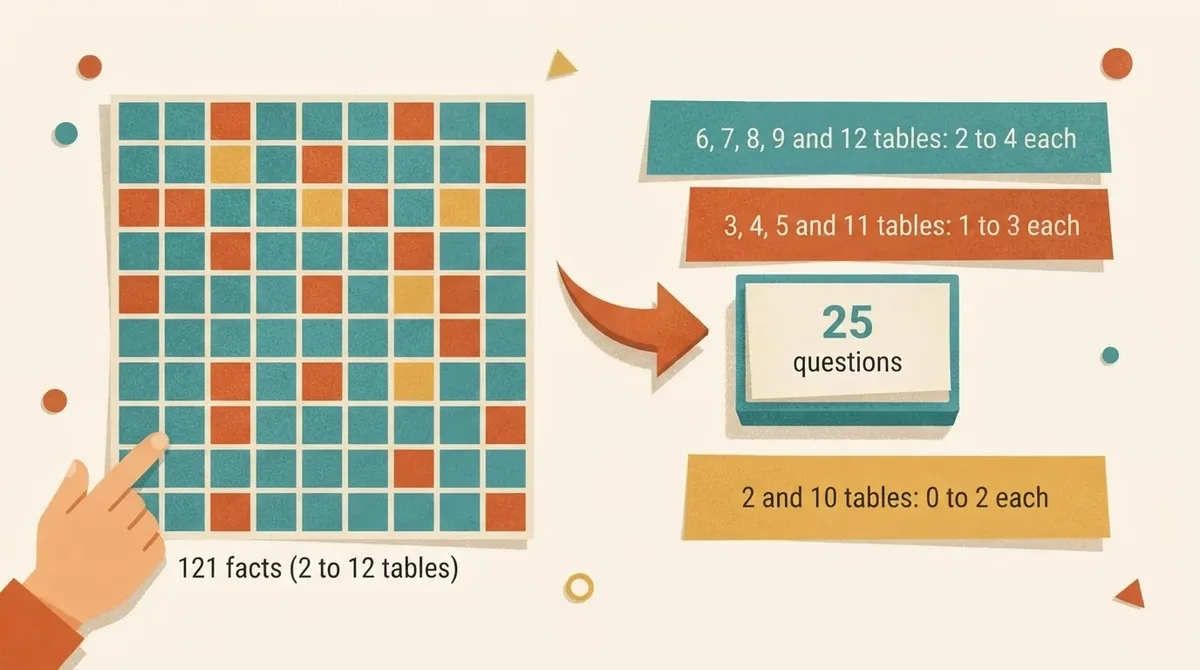
Two more rules matter. Each question appears only once in a form, and reversals do not appear in the same form: if 3 x 8 is on the paper, 8 x 3 will not be. So there is no free second bite. The fact has to be retrievable from whichever direction it arrives.
The consequence: between 10 and 20 of the 25 questions are drawn from the 6, 7, 8, 9 and 12 tables. If revision time is limited, you may choose to include these alongside the other tables, based on your child's recall. The 2, 5 and 10 tables are worth at most seven questions between them; they are introduced earlier in the curriculum, but pupils may still need to practise them. The Year 4 maths curriculum builds on the 2, 5 and 10 tables from Year 2 and the 3, 4 and 8 tables from Year 3.
What counts as a good score
There is no pass mark, so "good" has to be relative. The national figures, published every November, give you that.
In 2025 the mean score in England was 21.0 out of 25, up from 20.6 in 2024, and 37% of eligible pupils scored full marks, up from 34%. Around 629,947 pupils in state-funded mainstream schools completed the check; 96% of eligible pupils took it. Boys averaged 21.2 and girls 20.7; disadvantaged pupils averaged 19.3 against 21.7 for everyone else. The mean has risen every year since the check became statutory, from 19.8 in 2022, and full marks from 27%. The 2026 statistics are due in November 2026.
The 2025 mean was 21.0, but the check has no pass mark. A score does not show which facts were missed or why. Full marks was achieved by 37% of eligible pupils, so it was common but not typical.
An optional short, spaced practice routine
Retrieving an answer from memory more closely resembles the check than simply rereading a multiplication table. Ofsted's mathematics review also discusses low-stakes recall practice. The routine below is one possible way to organise practice; its timings and sequence are suggestions, not a proven dosage for every child.
Three ideas to consider:
- Recall before checking. Your child can try to say or write the answer before looking. Rereading a table is a different activity, and does not show whether a fact can be recalled.
- Try mixed order. Chanting practises a sequence; shuffled facts let a child practise retrieving individual answers.
- Weight the slow ones. Already-instant facts need no practice. Three-second facts do.
A ten-minute daily routine, week by week
This example assumes a spring-term start. The week counts, timings and practice frequency are illustrative. Adjust or stop if the routine does not suit your child.
Day 1: notice which facts are quick and which need more work
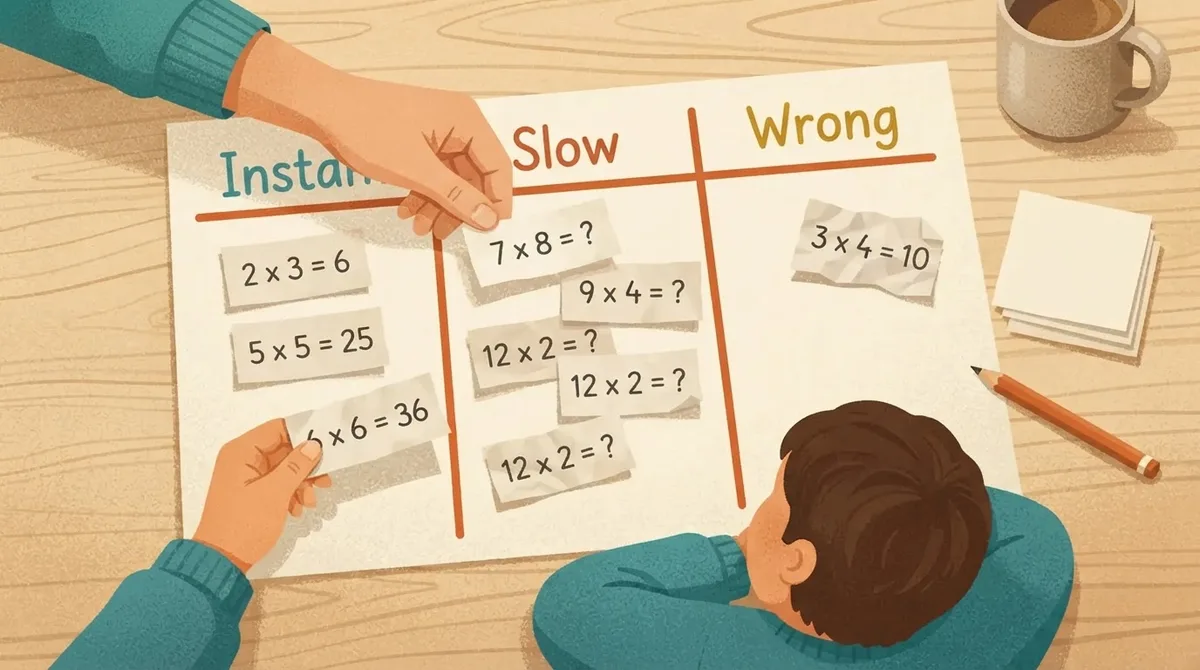
Most parents test for right and wrong, which misses what the check measures. Make a stack of paper slips, one fact per slip, starting with the 6, 7, 8, 9 and 12 tables. Show one at a time and sort the answer into three piles:
- Quick recall. It arrived without counting or using another fact to work it out.
- Worked out. Correct, but you could see it being worked out, or you heard counting.
- Wrong or blank.
These piles are informal observations, not a diagnosis. They can help you choose what to revisit, since a total score alone does not show how a child arrived at an answer. Write the slow and wrong facts onto a list, then choose a manageable set to practise. The list is a planning aid, not a complete programme for every child.
Example: choose a small set to revisit
Choose a manageable set of facts your child is still working out. The size and timing below are examples, not a recommended dose. For example:
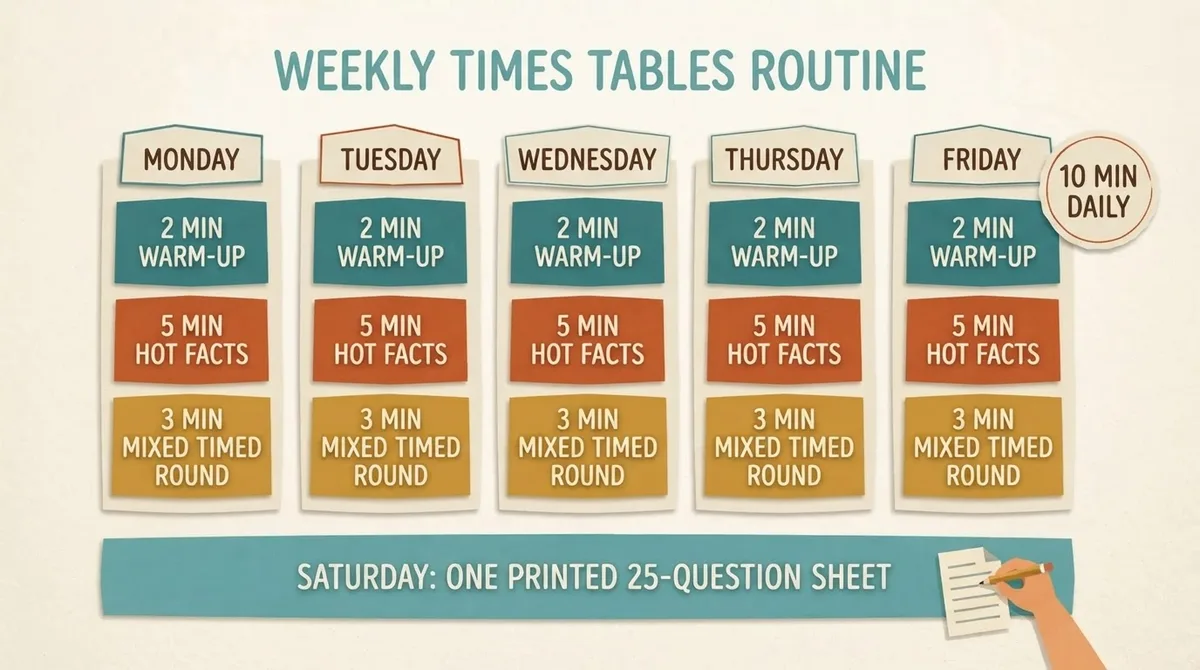
- Two minutes warm-up. Ten facts your child already has instantly. Starting on facts they own sets the pace and the mood.
- Five minutes on hot facts. Say the fact, say the answer, cover it, retrieve it. Shuffle and go again. Then reverse them: if you have been doing 7 x 8, ask 8 x 7. The check may give either.
- Three minutes mixed. Pull ten slips from the whole deck, including the hot facts, and call them out with roughly a five second gap. No teaching in this round. If it does not come, move on.
When it suits your child, revisit the selected facts on a different day. You can change the list based on what they recall, without treating a single check as a diagnosis.
If useful: try a timed round
If you continue the routine, you could add an occasional timed round. Keep it optional and follow your child’s response. The practice check below is useful here because it reproduces the six second cutoff and the three second pause, and lists the slow facts at the end; the printable sheets further down do the same job on paper. You can record the score and number of blanks as descriptive information. Neither result identifies the cause: a blank could reflect recall, timing, understanding, attention or another factor. Discuss repeated concerns with the teacher.
This part of the guide is a short timed practice. It loads in your browser.
Near the check
Follow the school’s guidance and keep any practice manageable. There is no need to introduce intensive or unfamiliar practice solely because the check is approaching.
The school can use the "try it out" area to familiarise pupils with the interface. Ask whether the class will use it. Keep the usual sleep and meal routine; this guide does not establish a special revision rule for check week.
Print a timed sheet that mirrors the 25-question format
Paper cannot reproduce a hard six second cutoff. It can reproduce the shape, which is what the diagnosis step needs, so these sheets run 25 questions against a single 2 minutes 30 seconds clock (an average of six seconds each).
All four sheets are built to the framework's own construction rules: 2 to 4 questions from each of the 6, 7, 8, 9 and 12 tables, 1 to 3 from the 3, 4, 5 and 11 tables, 0 to 2 from the 2 and 10 tables, 18 to 22 from the key stage 2 items, no repeats, no reversals within a sheet and no more than 30% overlap between sheets. Answer keys and a score, time and blanks box are included.
Download the printable MTC timed practice sheets (PDF)
Use one a week, not one a day. The sheet is a practice activity, not a diagnostic measure. Other practice can happen between sheets if it suits your child.
If the timer is the problem: what not to do, and what help exists
Some children freeze the moment a clock appears. The parental instinct is to drill harder, because drilling is the bit you control. It usually makes the next session worse.
Ofsted’s mathematics review discusses the relationship between secure knowledge and confidence, but it cannot tell you why a particular child is anxious. If a timed round causes distress, pause it and ask what feels difficult. You might return to untimed practice or seek advice from the teacher; repeated timed exposure is not a universal remedy.
If timed practice is distressing, pause it and ask the teacher for advice. The score is not a pass/fail result or an admissions test. It has no pass mark and does not determine selective school admission.
If the difficulty is access rather than nerves, the administration guidance lists several options. These include colour contrast settings (yellow on black, black on blue, black on peach, blue on cream), adjusted font size, a pause between questions with a manual "next" button, removing the on-screen number pad, input assistance where an adult types an answer the pupil dictates, an audio version with text-to-speech, and an audible time alert. The six-second response period cannot be extended, but the manual-next arrangement has a 30-minute overall limit. Schools can trial arrangements in the "try it out" area from April, which is when to ask, not June.
Speak to the class teacher or SENCo in the spring term if your child has a visual impairment, a motor difficulty affecting typing or a processing need. These arrangements are not automatic. Someone has to set them.
Questions Year 4 parents ask
Do I need to prepare my child? The Standards and Testing Agency's parent leaflet says no, you do not need to do anything additional, and that teachers may ask you to practise tables at home as usual practice. That is a fair statement of the school's expectations, and a slightly unsatisfying one if you have just watched your child count up to 42. A short recall activity may fit within usual practice, if that suits your child.
What is it for? To determine whether a Year 4 pupil can fluently recall multiplication tables. The framework says results can help schools identify pupils who may need additional support, but the check is not intended as a diagnostic tool. It is not a selection test; schools receive the results and report them to parents.
How long does it take to learn a fact for quick recall? It varies by child and by fact. Use the plan as a suggested routine, then adjust the number of facts and practice days to suit your child.
Should we use an app instead? Features vary. If you use one, check whether it shows individual answers or only a total score. Treat any practice result as one observation rather than a diagnosis.
Build recall for the Year 4 check without treating its practice score as an admission forecast. If selective entry is relevant, use the school’s current specification and dates to decide what preparation comes next. For planning guidance, see starting 11 plus preparation in Year 4, progress tracking.
Topics
- multiplication tables check
- year 4
- times tables
- maths
- printables