


The Year 4 Times Tables Test: What Happens on the Day
A parent guide to the multiplication tables check in England: who takes it, the 2027 dates, what the current guidance says, and how results are shared.
 Elspeth Marlow
- 7 min read

The “Year 4 times tables test” is officially called the multiplication tables check, or MTC. It is an on-screen check in England that assesses pupils’ fluent recall of multiplication facts up to 12 × 12. It has 25 timed questions and no pass mark.
This guide uses the 2027 arrangements published by the Department for Education and the Standards and Testing Agency. Some screen and access details come from the current administration guidance for 2026. That guidance page says it will be updated for 2027 in April, so check it again nearer the check if those details matter to your child.
Who takes the check?
Participation is statutory for Year 4 pupils at maintained schools, academies (including free schools) and special schools in England. The headteacher can decide that a pupil should not take it and must record the reason. The 2027 arrangements list circumstances such as being unable to access the check with available arrangements, working below the Year 2 multiplication-table expectation and being unable to answer the easiest questions, or arriving during the check period with English as an additional language and too little time to establish the pupil’s current standard. The decision is made by the headteacher.
The MTC is designed to check whether pupils can fluently recall their multiplication tables. The MTC assessment framework says that although the check will help schools to identify pupils who require additional support, it is not intended as a diagnostic tool. A school may use the result as one source of information when considering whether a pupil needs additional support. The published participation rules apply to the school types listed above; independent schools are not included in this statutory requirement.
When is the 2027 check?
For the 2026 to 2027 academic year, schools must administer the MTC in the two-week period beginning Monday 7 June 2027. The 2027 arrangements give a further period, Monday 21 to Friday 25 June, for pupils who were absent in the first two weeks or where technical problems caused delay. The school chooses the day and how to organise pupils within the published period.
The current future-dates page lists these later periods too:
- 2028 MTC: within the two-week period beginning 5 June 2028.
- 2029 MTC: within the two-week period beginning 4 June 2029.
The same page lists the end-of-Key-Stage-2 test week as 14 to 17 May 2029. That is the currently published date for the Year 4 cohort in the 2026 to 2027 academic year to take their Year 6 tests. Assessment arrangements beyond 2026 to 2027 are under review, so check the official page for changes.
See GOV.UK’s primary assessment dates and the 2027 Key Stage 2 assessment and reporting arrangements.
Does a child need to revise?
The Department for Education’s information for parents says parents do not need to do anything additional to prepare. As part of usual practice, teachers may ask families to practise times tables. Schools can use the “try it out” area to familiarise pupils with the check and any access arrangements. The 2027 arrangements say the area is available from 26 April 2027.
There is no required home routine. If your child wants to practise, use the kind of recall practice their teacher recommends and keep it comfortable. The 2027 administration guide will provide the final operational details when it is published.
What does the check look like?
The 2027 arrangements confirm an on-screen check with 25 timed questions. The currently published parent information and 2026 administration guidance describe three practice questions first, then six seconds for each scored question. The 2026 administration guidance also describes a three-second pause between questions, and says the pupil can enter an answer by keyboard, touchscreen or mouse. The school chooses the device and input method based on pupils’ normal classroom practice. Check the MTC administration guidance for its 2027 update before relying on those operational details for the next cycle.
Under the currently published guidance, the question is shown as a multiplication fact with an answer box. Only numeric inputs count as answers. A pupil can press Enter to move on sooner or wait for the six seconds to end; the displayed answer is accepted. The current guide says pupils cannot correct an answer after moving on. These are the published details for the 2026 cycle, and the administration page says its guidance will be updated for 2027 in April.
The six-second limit is intended to allow a pupil to recall and enter a fact while limiting time to work it out. It does not show whether a pupil can use a method in a longer calculation. The MTC does not assess division facts, word problems or the strategies a pupil uses to calculate.
Which questions can come up?
The assessment framework specifies questions from the 2 to 12 multiplication tables. It sets a range for how many items from each table can appear in a check form:
- the 6, 7, 8, 9 and 12 tables each contribute between 2 and 4 questions
- the 3, 4, 5 and 11 tables each contribute between 1 and 3 questions
- the 2 and 10 tables each contribute between 0 and 2 questions
- the 2, 5 and 10 tables together contribute 3 to 7 questions, leaving 18 to 22 from the Year 3 and Year 4 tables
The framework says the 6, 7, 8, 9 and 12 tables are emphasised because they were identified as the most difficult tables. No child’s exact set of questions can be inferred from these ranges. The framework also says a table is determined by the first factor, so a question such as 3 × 8 belongs to the 3 table. Reversed facts do not appear together in the same form.
The practice round below uses timed multiplication questions, but it generates its own question set. Its table balance and questions are not an official MTC form, so use the result only as a record of that practice round.
This part of the guide is a short timed practice. It loads in your browser.
Access arrangements
The 2027 arrangements say a range of access arrangements will be available and should be tried in the “try it out” area. The current administration guidance, published for 2026, lists colour contrast, adjustable font size, a “Next” button between questions, removal of the on-screen number pad, input assistance, an audio version and an audible time alert. The guide says the “Next” button changes the pause between questions, not the six seconds allowed for an answer. It also says additional time cannot be given. Check the updated 2027 guidance for the current settings and instructions.
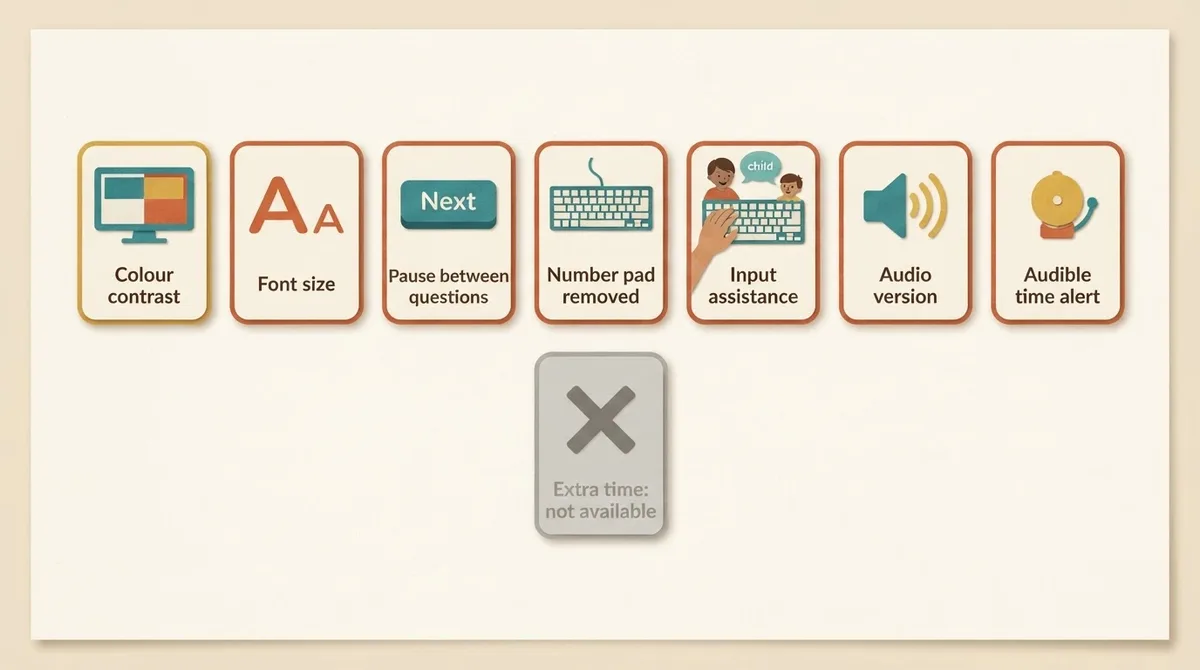
If you have a concern about access, talk to the school before the test period. The official parent information says teachers should make sure any arrangements are suitable before the check.
What does the score mean?
The school receives a total score out of 25 for each pupil who completed the check. There is no pass mark or expected-standard threshold. A higher score indicates more fluent recall on this check, but the score alone does not identify which facts a pupil knows or diagnose why an answer was missed.
National results are published as statistics, but school-level results are not published publicly. The 2027 arrangements say results are shared securely with schools and other education bodies, including Ofsted. The school reports the pupil’s score to parents, or the reason for non-participation or for not receiving a result, by the end of the summer term. Schools can access 2027 results from Monday 28 June once their required records are complete and the headteacher’s declaration form has been submitted.
For a result or access concern, ask the teacher what the school has observed in class and what support is available. One total score is not a diagnosis or a full account of a pupil’s mathematics.
For the wider Year 4 programme, see the Year 4 maths curriculum guide. It covers multiplication and division facts as part of the national curriculum, alongside other maths learning.
If you are considering a grammar school, the MTC is a separate assessment with a different purpose. Check the current entrance-test content and dates for the schools you have in mind. For planning guidance, see starting 11+ preparation in Year 4.
Topics
- year 4
- times tables
- mtc
- primary maths
- parents