


Accelerated Reader Explained: ZPD, Book Levels and Quiz Scores
A sourced British guide to Accelerated Reader for Year 4 parents: what the Star Reading test reports, what the ZPD range means, why an ATOS book level is not a reading age, and what the quiz percentages really are.
 Elspeth Marlow
- 10 min read
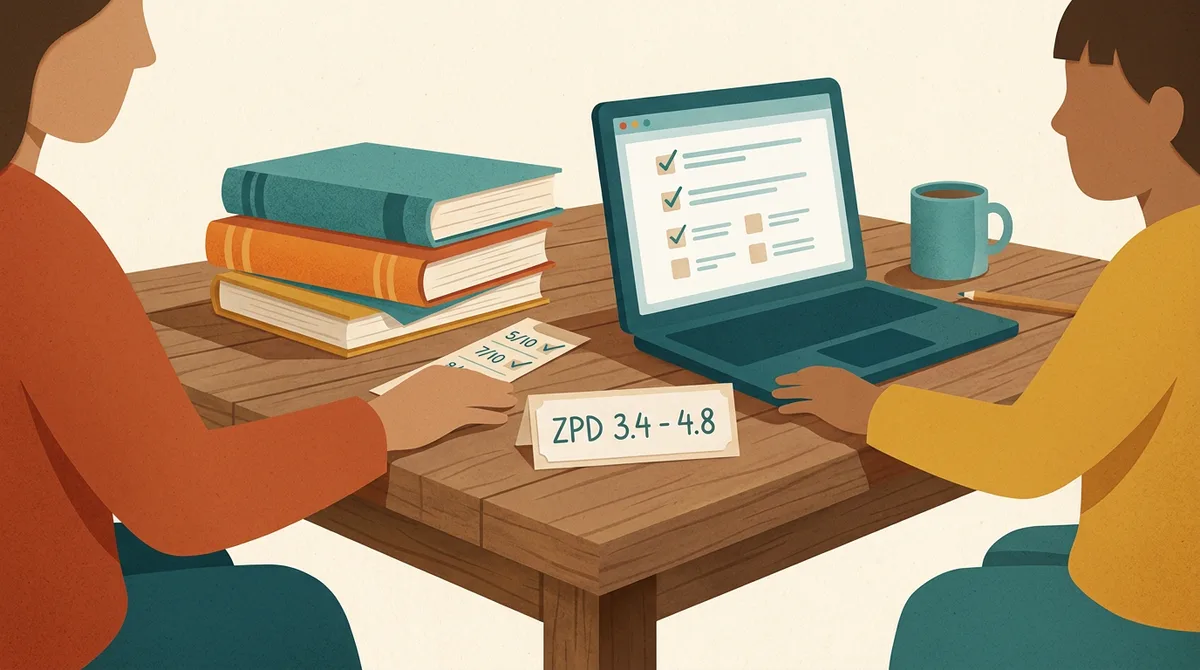
Your child comes home with a bookmark showing two numbers, such as 3.4 and 4.8. A library book has a sticker that says 4.2 MY, and a printout shows a quiz score and points. What do the different numbers mean?
Accelerated Reader is a reading practice and monitoring programme from Renaissance. A pupil reads a book and may take a computer quiz about it; the school can use the results to monitor reading practice. The programme may show different measures, so it helps to separate the book's text difficulty, a pupil's suggested reading range and any separate assessment scores.
This guide explains the main measures and what UK research has found. Schools choose how to use the programme, so ask your child's school which tests, ranges and targets it uses.
Star Reading: one separate assessment
Some schools use the separate Star Reading assessment to help set a pupil's reading range. A school can use other information and decide how it organises reading practice, so ask which process it follows.
Star Reading is computer-adaptive: it adjusts question difficulty in response to a pupil's answers. Renaissance says its skills reports align with the National Curriculum, and lists five measures in Star Reading reports: Reading age in years and months, Zone of Proximal Development, Norm-Referenced Standardised Score, Percentile Rank and Scaled Score. These are outputs of Star Reading, not all of Accelerated Reader.
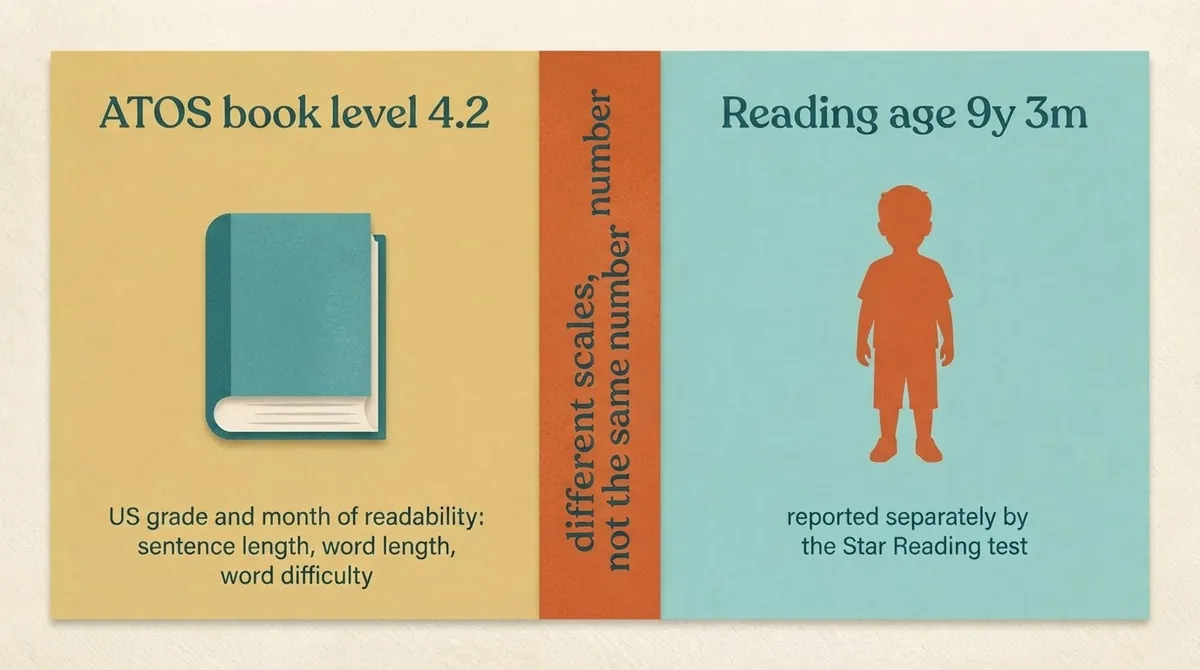
Star Reading can report a reading age in years and months. That is separate from the ATOS book level printed on some book labels. For context on age-equivalent scores, see our guide to reading age explained.
Schools decide whether and when to repeat Star Reading. If the reported range changes, ask the school how it was set and whether a teacher has reviewed it.
The bookmark: what that pair of numbers means
The two numbers on the bookmark are the Zone of Proximal Development, always written as a range.
Renaissance defines the ZPD in Accelerated Reader as "a range of book levels that are not too challenging and not too easy, depending upon a student's reading level". Star Reading suggests the range from which a pupil should select books for best growth. Crucially, Renaissance itself says the ZPD is approximate, because success with a particular book also depends on the child's interest in it and their prior knowledge of the subject, and that teachers should use professional judgement to adjust the level of books read.
That is a useful caution: the range is a guide, not a guarantee that every book within it will suit a pupil. Interest and prior knowledge matter too.
So a ZPD of 3.4 to 4.8 is a suggested range of book difficulty levels. It does not guarantee that every book in that range will be easy or suitable.
The sticker: why an ATOS book level of 4.2 is not a reading age
This distinction can prevent a common misunderstanding.
The number on some book labels is its ATOS level. ATOS is a readability formula. Renaissance says it uses average sentence length, average word length and word difficulty, and reports on a US grade-level scale. In that scale, the number after the point indicates a month within the grade. ATOS estimates text difficulty; it does not show whether the content suits a particular child. Do not convert an ATOS level into an English school year or reading age.
So three separate scales are on the table:
- ATOS book level (for example 4.2): a US grade-and-month readability figure describing the text.
- ZPD (for example 3.4 to 4.8): a suggested range of book levels for your child. A school may set this using Star Reading or other reading information.
- Reading age (for example 9 years 3 months): a separate output of Star Reading, on a completely different scale, describing your child.
An ATOS level of 4.2 is not a reading age of four years and two months. It is a book-text measure, not a measure of the child's age or attainment. If your school also uses coloured book bands, that is another system, which we explain in book bands explained.
Interest levels: choosing suitable books
Catalogued AR books may have an interest level alongside the book level. It describes content and age appropriateness rather than text difficulty. Renaissance lists four: Lower Years for ages 5 to 8, Middle Years for ages 9 to 13, Middle Years+ for age 12 and above, and Upper Years for age 14 and above. The interest level reflects publisher recommendations and Renaissance professionals' judgement; a teacher, librarian or parent decides whether a title suits an individual pupil.
| Interest label | Publisher's broad content guidance |
|---|---|
| LY: Lower Years | Ages 5 to 8 |
| MY: Middle Years | Ages 9 to 13 |
| MY+: Middle Years+ | Age 12 and above |
| UY: Upper Years | Age 14 and above |
Year 4 usually spans ages 8 and 9, crossing the LY and MY age bands. These are broad suitability labels, not rules assigning a child to one row.
A Year 4 child in England is usually 8 or 9 and sits in lower key stage 2, per gov.uk's national curriculum pages. Interest levels are broad content guidance, not a reading-age measure or a rule that decides which books a child can read.
These measures do not give a national Year 4 book-level target. Ask how the school has set your child's range, and use the interest label alongside the actual book's content rather than converting a child's age into an ATOS level.
Renaissance's 2026 What Kids Are Reading release describes 23,585,022 Accelerated Reader quizzes taken by 1,080,672 pupils in UK and Ireland schools during 2024 to 2025. It reports average quiz accuracy of 92% for pupils' favourite books, compared with 76% across all their reading. These are descriptive records from participating programme users. They are not national reading-age norms or proof that choosing favourite books caused higher scores.
The quiz: pass marks, average percent correct, and points
Quiz settings and school targets are different things. Check the target and pass settings your school uses.
Renaissance's current documentation lists default passing scores of 60 per cent for 3-, 5- or 10-question Reading Practice, Other Reading and Article quizzes, and 70 per cent for a 20-question quiz. These are defaults: settings can be changed by the school. Renaissance says the higher threshold for 20-question quizzes is intended to help check that pupils read the full book.
Three different things are being conflated, so separate them:
- The pass mark. The software default above. It decides whether this quiz counts.
- Average percentage correct. The programme can report an average across quizzes. Current Renaissance help recommends an 80% average-percent-correct goal in its configurable goal models, with options from 85% to 90%. Schools choose their settings. This goal is separate from a single quiz's pass mark.
- Your school's own target. A target is a school setting, not the quiz pass mark. Ask how it is used before treating one score as evidence about reading ability.
Points are another measure of completed reading practice. Renaissance says possible points for a Reading Practice Quiz are calculated using the book's ATOS level and word count; points earned depend on quiz performance. Points are not a direct measure of reading ability or book quality.
When a quiz result raises a question
If a score or book choice raises a question, start by discussing it with your child and school.
The quiz was failed. One quiz score does not explain why a child found a book difficult. Ask what they remember, whether the book interested them, and whether they would like to discuss a passage together. The teacher can interpret a pattern of results in context.
The level looks too low. Ask how the school selected the range and whether the book's interest level is suitable. An ATOS level, interest level or reading age alone does not tell you whether the whole system or book choice is right for your child.
They are stuck on one series. A familiar series can be enjoyable. The National Curriculum also asks pupils to discuss a wide range of fiction, poetry, plays, non-fiction and reference books, and says they should continue to hear whole books read aloud. You can offer other choices without turning reading at home into a quiz.
Nothing in range is any good. Try the free AR BookFinder search for titles with quizzes, and ask the school whether it can help find suitable options. A range is a guide, and the school can advise on its settings.
Can my child quiz at home?
Home quizzing depends on the school's login and access settings.
Renaissance Home Connect lets pupils and parents see reading progress, but quizzes are not available through Home Connect. A pupil may be able to quiz from home if the school allows access to Renaissance there. Ask the school what it permits and follow its expectations for independent quizzing.
The school can provide a Home Connect login so families can view quiz scores and reading-practice progress. Availability and the details shown depend on school setup.
What the UK evidence actually says
Consider both what the programme measures and what it leaves out.
The Education Endowment Foundation ran the largest randomised controlled trial of AR to date: 181 primary schools, 6,116 Year 5 pupils and 6,311 Year 4 pupils. Children who began AR in Year 4 or Year 5 made, on average, no additional progress in reading compared with children in comparison schools. The finding carries the EEF's top security rating of 5 out of 5 padlocks. It was evaluated by RAND and the University of Cambridge, at an average cost of around £48 per pupil per year over three years.
An earlier EEF efficacy trial with secondary pupils found the opposite: Year 7 pupils offered AR made 3 months' additional progress, and 5 months for pupils eligible for free school meals. The EEF suggests AR may be more promising as a targeted intervention for Year 7 pupils reading below age expectations.
The primary trial found no additional average reading progress in its two year groups, while the earlier secondary trial had a different result. These studies do not establish how the programme works in every school or for every pupil. The National Literacy Trust's 2026 report separately tracks reported reading enjoyment and frequency. Its survey findings do not measure an individual child's attainment or the effect of Accelerated Reader.
Reading together, visiting a library and talking about books can complement school reading practice. A quiz score does not capture every part of a child's relationship with reading.
After Year 4
An Accelerated Reader level or quiz score does not predict an 11+ result. Keep reading widely, and check the target school's test, registration and application dates separately. For planning guidance, see starting 11+ preparation in Year 4 and when to start 11+ preparation.
Topics
- accelerated reader
- reading
- year 4
- primary
- parent guide