


Book Bands Explained: Colours, Levels and What Comes After Them
Understand book band colours, browse Oxford's approximate school-year guide and see why Collins Big Cat levels and reading-age scores need separate interpretation.
 Elspeth Marlow
- 9 min read

You look up a book-band chart and find another with different year-group guidance. Some charts give age ranges, while a reading-age assessment reports a test score using its own reference sample. These labels answer different questions, so comparing them can make book choice seem more confusing than it is.
Publisher charts can differ because they describe different reading schemes. Book bands are a colour convention used by many schemes, not a national curriculum measure or a reading-age score. The statutory national curriculum English programmes of study do not set a book-band ladder. Oxford and Collins use their own level sequences, so check which publisher and series a chart describes.
Use the named publisher guide below to explore colours and levels, then check which scheme school uses. Oxford and Collins have their own level sequences: combining them into one universal age chart would hide those differences. The later sections explain how to discuss book choice and what may replace colour bands.
Step 1: Understand what a band is, and what it is not
Oxford describes book bands as colours that indicate a reading book’s difficulty. A band labels a book or group of books; a school’s choice of book also considers the pupil and what they are learning. The Department for Education’s reading framework says it is not mandatory for schools to use a programme from its list. Schools can therefore use different schemes and book-selection approaches.
If you want the most useful single sentence in this whole topic, it is on page 89 of the DfE reading framework, under "Organising book stock":
Public libraries and bookshops do not colour-band their books.
The framework suggests schools organise library stock around factors such as age range, format and interest. This is guidance about library organisation, not a rule that a school must stop using reading schemes.
Step 2: Browse a named publisher guide
Oxford's parent guide links its own colour chart. It calls the information a guide only. The linked chart is dated 2019; the lookup below follows that chart, not an invented average of several publishers.
For example, Oxford's 2019 chart shows Grey with Levels 12 to 14 across Years 3 and 4, Dark Blue with Levels 15 and 16 in Year 4, and Dark Red with Levels 17 to 20 across Years 5 and 6. Oxford's current level pages put Level 15 in Year 4 and Level 16 in Years 4 and 5, so the lookup shows Dark Blue for both years. The overlaps are deliberate. Its approximate ages are suggestions for choosing books, not scores from a reading-age assessment.
Choose a school year or a colour to see Oxford's guide. Your child's teacher may choose different books to match word reading, comprehension and interest.
This part of the guide shows which book band colours children usually read in each school year. It works in your browser.
Step 3: Keep other publishers' levels separate
Collins Big Cat has familiar early colours, followed by Copper, Topaz, Ruby, Emerald, Sapphire, Diamond and Pearl. Its own page describes what readers encounter at each band, such as longer chapters or more demanding themes. It does not give a direct Oxford-level conversion for those seven bands.
Ask for the publisher, series and level printed on the book. A number from one scheme is not automatically the same difficulty as that number in another. A phonics book may also be chosen to practise particular sounds already taught, rather than simply to reach a colour associated with a birthday.
A book band's age guide is different from an assessed reading age. The latter is a comparison with a test's reference sample. Neither supplies a national rule saying every Year 4 pupil must be on a particular colour.
Step 4: Work out where your Year 4 child actually sits
Oxford's chart includes Grey and Dark Blue for Year 4. That does not establish an expected standard, and it cannot tell you whether a particular child needs support. Look at the actual book and discuss both word reading and understanding with the teacher.
Example A. Maya, aged eight years nine months, brings home Grey books. The colour alone cannot tell you whether she is ahead, behind or making progress. Ask whether she reads these books fluently, understands them and has opportunities to explore other suitable texts.
Example B. Tom, aged nine years one month, brings home Brown books while friends have Dark Blue. Ask why those books were selected and what he is working on. A teacher might be supporting decoding, vocabulary, comprehension or confidence; the colour cannot identify which.
For the separate question of test scores, see reading age explained. Avoid turning book choice into a race through the colours.
Step 5: Learn what comes after the colours
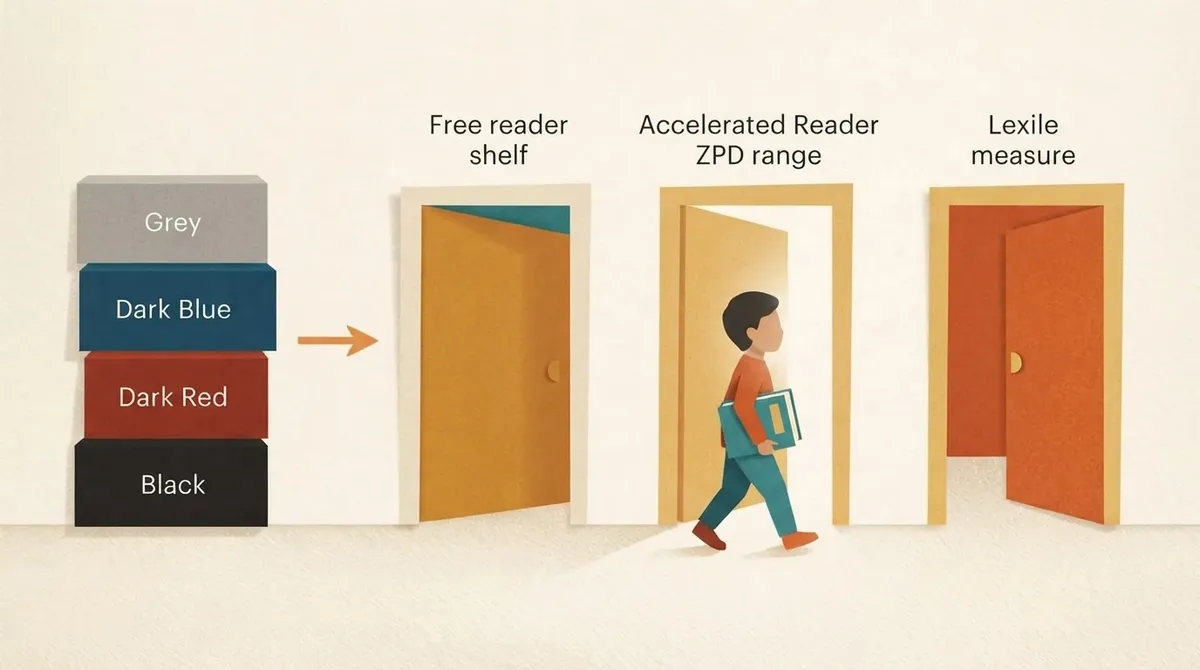
The DfE reading framework says that as phonic knowledge grows, pupils eventually no longer need books deliberately structured for beginner decoding and can read age-appropriate literature. This passage concerns decodable books; it does not set a national deadline for leaving colour bands.
Schools may use different approaches to book choice beyond colour bands. These are examples, not a fixed progression.
- A broader choice of books. Some schools use terms such as “free reader” when pupils have more choice. Ask the school what the term means there and how it helps pupils find suitable books.
- An Accelerated Reader ZPD. Renaissance defines the ZPD as a range of book levels from which a pupil may select books. It is approximate, because interest and prior knowledge also matter.
- A Lexile measure. MetaMetrics’ Lexile Framework places reader and text measures on one scale. The publisher describes a suggested independent-reading range from 100L below to 50L above a reader’s reported measure. It is a separate framework, not a conversion from book-band colours.
These approaches use different information and are not interchangeable. Ask how the school uses any measure it provides.
Step 6: Match your expectations to what the curriculum asks
For Years 3 and 4 the statutory word reading requirements are short. Pupils should "apply their growing knowledge of root words, prefixes and suffixes (etymology and morphology)" and "read further exception words, noting the unusual correspondences between spelling and sound". The curriculum also says pupils should "apply phonic knowledge and skills as the route to decode words until automatic decoding has become embedded and reading is fluent", and that a child still struggling to decode at this stage should be taught through "a rigorous and systematic phonics programme so that they catch up rapidly" while still following the Year 3 and 4 programme for new books and vocabulary.
Notice what is not there: any colour, any reading age, any band. The programmes of study were published in September 2013, last updated in July 2014, and GOV.UK states they "are issued by law; you must follow them unless there's a good reason not to". They are the actual expectation. Everything else is a school's chosen way of getting there.
On fluency, the reading framework (page 60) is unusually plain-spoken: researchers generally measure fluency as words read correctly per minute, both accuracy and speed matter, and "Pupils do not pass through a magic barrier and suddenly become fluent." The framework's stated aim (page 4) is that by the end of Year 6, reading and writing should be "sufficiently fluent and effortless" to manage the demands of Year 7 across all subjects.
Step 7: Support reading at home
A short, relaxed reading session can help you notice what your child enjoys and what they find tricky. For example:
- Listen to your child read a passage, or read it together.
- Ask what happened and what they think a character might be feeling.
- Offer another book or format if the current one is not holding their interest.
These activities are not a test of reading level. Talk with the teacher if you are concerned about word reading, fluency or understanding.
On assessment, check what is real before you worry. GOV.UK's guidance for parents on primary assessments confirms the phonics screening check is in June of Year 1, the multiplication tables check is in June of Year 4, key stage 2 tests are in May of Year 6, and key stage 1 tests are now optional at the school's discretion. There is no statutory reading test of any kind in Year 4. The 2026 phonics screening check threshold was 31, according to GOV.UK's 2026 check materials. It was 32 in earlier years. GOV.UK states that assessment arrangements for the 2026 to 2027 academic year remain unchanged while future arrangements are under review.
Step 8: What to do if your child is stuck or has run out of colours
If your child has stayed with the same band for a while, ask the teacher what they are practising and how progress is being reviewed. The answer may involve word reading, fluency or comprehension. The curriculum says pupils who still struggle to decode should receive systematic phonics teaching alongside age-appropriate reading and vocabulary work.
If your child has moved beyond the school’s colour bands, ask how the school helps them choose suitable books. They might use a wider range of fiction, non-fiction, poetry and other formats. Our 11 plus reading list by year group is built for exactly that, and works just as well for a child with no exam in view.
One thing to know if grammar school is on your mind
For selective entry, check the target school's current familiarisation materials and keep reading widely for vocabulary and comprehension. Starting 11+ preparation in Year 4 and when to start 11+ preparation explain how to plan around the relevant test. Our progress tracking describes the practice evidence available within Smart Cub Learning; book colours are not 11+ predictions.
Topics
- book bands
- reading
- year 4
- key stage 2
- parent guide