

Reading Age Explained: What the Number Means and What It Does Not
Learn what a reading-age score means, how it differs from other reading measures and what to ask the school about the test.
 Elspeth Marlow
- 7 min read

A reading age is an age-equivalent score reported by some reading tests. It does not mean a child reads exactly like every child of that age, and it is not a diagnosis or a national curriculum grade. To interpret it, you need the test name, the score type and the publisher's guidance.
Tests do not all report the same things. Some provide a reading age; others also report separate results for comprehension, accuracy or reading rate. A reading-age figure on its own cannot show why a child found a test difficult or what support would be useful.
What does a reading age describe?
For the New Group Reading Test (NGRT), GL Assessment defines reading age as the age at which a score is most likely to be achieved in its national sample. The publisher derives reading ages from the average raw or scale scores at different age points. It cautions that age-equivalent scores have limits, especially at the high end, and recommends looking at the Standard Age Score (SAS) for comparisons and monitoring.
That is a test-specific conversion. A score of 24 cannot be turned into a reading age without the test's own scoring tables, version and reference sample. A result is not an estimate of a child's age, effort, school year or future progress.
Check the notation too. Some reports show years and months as, for example, 8:06. If a report prints 8.6, ask whether the decimal point is being used to mean eight years and six months. Do not assume the notation without checking the report guide or asking the school.
Different tests report different reading measures
The test name matters because assessments use different tasks and report different results.
- NGRT, for ages 6 to 16, includes tasks such as sentence completion and passage comprehension. Its reports can include a reading age, a Standard Age Score, a percentile and a confidence band. GL describes the SAS as adjusted for age and compared with a nationally representative sample of pupils of the same age.
- The Salford Sentence Reading and Comprehension Test, for ages 5 to 16, is an individually administered short assessment. Its publisher says it can report reading and comprehension ages, alongside standardised scores and other measures.
- YARC, the York Assessment of Reading for Comprehension, is a one-to-one assessment. Its primary and secondary passage-reading tests report reading accuracy, rate and comprehension separately. Those are not interchangeable with one reading-age figure.
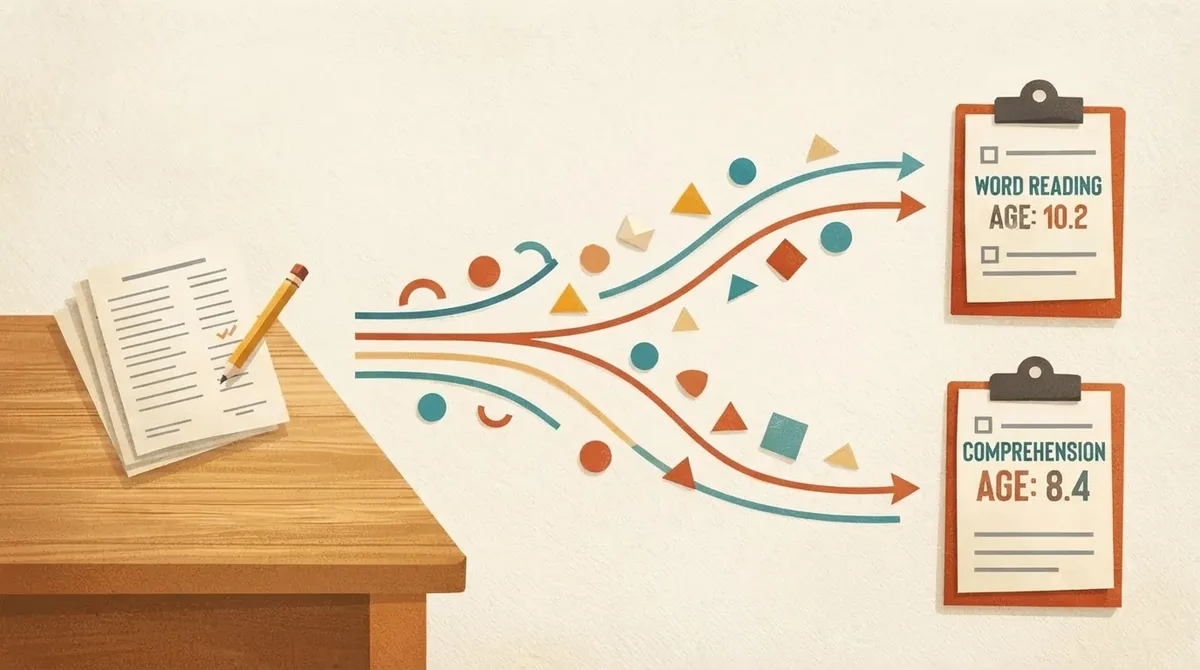
A child might receive separate reading and comprehension ages from a test that reports both. The illustration below uses made-up figures to show that two different outputs can sit beside each other. Ask which specific assessment produced the results on your child's report.
A reading age below chronological age is not a diagnosis
An age-equivalent number compares a test score with scores in that assessment's reference data. It does not, by itself, establish a learning difficulty, explain the reason for a result or identify an intervention. A small difference in months is not a universal threshold for action.
For example, if a child is eight years and four months old and a report gives a reading age of 8:06, that is a two-month difference only if the report uses years-and-months notation. It does not tell you the child's percentile, the confidence interval, or whether the result is meaningful for that test. Ask the teacher to explain the assessment and consider the result alongside classwork and the child's reading in everyday lessons.
Useful questions include:
- Which test and version was used, and what did it assess?
- What are the Standard Age Score or other standardised result and confidence band, if the test reports them?
- Does the result fit with what the teacher sees in reading, writing and class discussion?
- What would be useful to look at next?
Standardised scores are also test-specific
For NGRT, GL says the Standard Age Score is based on the number of questions answered correctly, adjusted for age, and compared with a nationally representative same-age sample. Its scale has a mean of 100 and a standard deviation of 15; GL says about 68% of people score between 85 and 115. These figures describe NGRT's SAS, not every test that reports a standard score.
If your report is from another assessment, use that publisher's definitions instead. Percentiles, standard scores and age-equivalent scores answer different questions. A percentile describes a position within the test's reference group; an age equivalent translates a score to the age point associated with average scores. Neither is a diagnosis on its own.
Key stage 2 reading results use a different measure. Pupils receive a scaled score from 80 to 120, and a score of 100 or more meets the expected standard. That is not the same scale as an NGRT Standard Age Score or a reading age. In England's provisional 2025/26 results, 75% of pupils met the expected standard in reading and 63% met it in reading, writing and maths combined. These are population figures, not norms for an individual reading-age test.
How a school reading assessment fits with statutory checks
England's phonics screening check is statutory for most pupils in Year 1. It has 40 words: 20 real words and 20 pseudo-words. For the 2026 check, the threshold mark was 31; the threshold can vary because the words and overall difficulty vary slightly between years.
Key stage 2 tests take place at the end of Year 6. A school may also choose reading assessments between statutory checks, but a reading-age result is not a national Year 4 test or a required national score. The government's announced Year 8 assessment is a separate plan.
In October 2025 the Department for Education announced a mandatory reading test at age 13, in Year 8. The announcement says it will assess reading fluency and comprehension, provide a snapshot, not require revision, and that schools will make results available to parents. As of 24 October 2026, it does not describe the question format or give a timetable. Check for later government details before relying on those points.
What to do if you are concerned
You do not need to wait for a particular number of months or years before raising a concern. Tell the teacher what you notice: for example, difficulty reading words accurately, keeping track of a passage, understanding unfamiliar vocabulary or talking about what was read. Ask how the school interprets its assessment and what it is already doing in class.
The national curriculum for English describes both word reading and comprehension. In its non-statutory notes for Years 3 and 4 word reading, it says: “At this stage, teaching comprehension should be taking precedence over teaching word reading directly.” Its introduction to lower key stage 2 adds that “pupils who are still struggling to decode need to be taught to do this urgently through a rigorous and systematic phonics programme so that they catch up rapidly with their peers.” This is classroom guidance, not a way to diagnose a child from one age-equivalent score.
The school can discuss whether the result warrants a closer look and what further assessment, if any, is appropriate. Continue ordinary reading and conversation if that suits your family, but a particular number of minutes or books cannot be prescribed from a reading-age result alone.
Does the average adult have a reading age of nine?
The Home Office recommends writing public-facing content to a maximum reading age of nine, including for specialist audiences. That is advice for writers about making information easier to read. It is not a finding about the reading ages of adults, and it does not support the claim that the average adult reads like a nine-year-old.
Adult literacy surveys use their own proficiency measures. Do not convert those results into reading ages unless the assessment publisher provides a valid conversion.
If grammar school is on your mind
A school reading-age result cannot predict an 11+ outcome. Selective tests use their own tasks, scoring and admission rules. Check the current guidance for the actual school or consortium, and use the test name and score definitions when asking the teacher about your child's reading.
For more on test comprehension, see our guides to 11+ comprehension questions and 11+ pass marks and qualifying scores. For reading at home, see the 11+ reading list.
Topics
- reading age
- reading
- year 4
- assessment
- primary