


Year 4 Fractions Explained for Parents
What the Year 4 fractions curriculum says, how fraction walls and bar models can help, and why some non-statutory guidance introduces mixed numbers. Includes a free printable practice sheet.
 Elspeth Marlow
- 14 min read
Your child comes home in Year 4 with a page of fractions. Some of it looks familiar: half of something, a quarter of something. Then there is a line reading 2 and 3/5, next to it 13/5, and a question asking whether they are the same. Mixed numbers are not an explicit item in the statutory Year 4 fractions list, but they do appear in the Department for Education's non-statutory guidance for teachers.
The statutory programme of study sets ten fraction statements for Year 4. The Department for Education's non-statutory guidance, written with the NCETM, also offers three ready-to-progress criteria about mixed numbers. One criterion covers content listed in the Year 5 programme; the guidance says it was included in Year 4 to improve coherence. Schools can use this guidance when planning, but it does not change the statutory programme.
This guide separates statutory requirements from non-statutory guidance, works through examples, and links a free printable practice sheet. Methods can vary between schools; if you are helping at home, the teacher can explain the approach your child is learning.
What does the Year 4 fractions curriculum actually ask for?
The statutory list sits inside "Number - fractions (including decimals)" in the national curriculum programmes of study for mathematics. Here is each statement, with what it looks like on an actual page of your child's book.
In a fraction such as 3/5, the numerator is the top number, 3; it counts how many equal parts are being described. The denominator is the bottom number, 5; it tells how many equal parts make one whole.
- Recognise and show, using diagrams, families of common equivalent fractions. A fraction wall or a set of bars, with the child shading 1/2 and 2/4 and 4/8 and seeing them line up.
- Count up and down in hundredths, and recognise that hundredths arise when dividing an object by 100 and dividing tenths by 10. Counting aloud: 0.07, 0.08, 0.09, 0.10. Or a 100-square with 37 squares shaded.
- Solve problems involving increasingly harder fractions to calculate quantities, and fractions to divide quantities, including non-unit fractions where the answer is a whole number. "Find 3/5 of 45." A non-unit fraction has a numerator greater than one, such as 3/5 rather than 1/5.
- Add and subtract fractions with the same denominator. For example, 3/8 + 4/8. The non-statutory guidance also gives examples beyond one whole, such as 7/5 + 4/5.
- Recognise and write decimal equivalents of any number of tenths or hundredths. Writing 7/10 as 0.7 and 23/100 as 0.23.
- Recognise and write decimal equivalents to 1/4, 1/2 and 3/4. These are 0.25, 0.5 and 0.75.
- Find the effect of dividing a one- or two-digit number by 10 and 100, identifying the value of the digits as ones, tenths and hundredths. 46 divided by 10 is 4.6. The digits move, the decimal point does not.
- Round decimals with one decimal place to the nearest whole number. 3.6 rounds to 4.
- Compare numbers with the same number of decimal places up to two decimal places. Is 0.45 bigger than 0.54?
- Solve simple measure and money problems involving fractions and decimals to two decimal places. "A kilo of apples costs GBP 1.20. What do three quarters of a kilo cost?"
The statutory list is followed by non-statutory notes. They describe using factors and multiples to recognise equivalent fractions and simplify where appropriate, with 6/9 = 2/3 as an example. A factor divides a number exactly; a multiple is the result of multiplying a number by a whole number. For the wider picture, our guide to the Year 4 maths curriculum sets fractions alongside number, measurement and geometry.
Why does Year 4 feel like the year fractions get hard?
Fractions are already taught as numbers in Year 3: the DfE's Year 3 ready-to-progress guidance asks pupils to locate fractions within one on a number line. In Year 4, the statutory programme extends work with hundredths, equivalent fractions, fractions of quantities and same-denominator addition and subtraction. Non-statutory notes also connect fractions on the number line and describe calculations beyond one whole.
The DfE and NCETM Mathematics guidance: year 4 discusses the importance of understanding fractions as numbers as well as parts of a whole. Its ready-to-progress material uses mixed numbers to support addition and subtraction across one.
So a child may meet a familiar fraction-of-a-shape task alongside new number-line or mixed-number work. The concepts build across years; a question that is difficult today does not by itself show that the child is behind.
A fraction wall is one way to explore equivalent fractions
Equivalent fractions name the same amount in different ways. Diagrams can help children see this before using number facts to calculate them. A fraction wall is one possible representation.
Draw a rectangle for 1 whole. Under it, an identical rectangle cut into 2, then one cut into 4, then 6, then 8, then 10. Put a finger at the left edge and slide right along the halves row, stopping at the end of the first half. Look straight down: you land on the end of 2/4, 4/8 and 5/10. Those are equivalent fractions, and your child has seen it rather than been told it.
Once the picture is clear, a number rule can describe the same relationship: multiply or divide the numerator and denominator by the same number, as long as it is not zero. For example, 1/2 = 2/4 and 6/9 = 2/3.
The statutory Year 4 statement asks pupils to recognise and show families of common equivalent fractions using diagrams. The non-statutory notes also mention using factors and multiples to recognise equivalents and simplify where appropriate. The ready-to-progress criteria for other years give additional milestones, but they do not make the Year 4 statutory statement exclusive. If you are unsure whether a particular answer needs simplifying, follow the instructions in the task or ask the teacher.
Try equivalent fractions with a bar you can slice and shade.
This part of the guide is a short interactive exercise. It works in your browser.
Where do tenths, hundredths and decimals fit in?
Year 3 established tenths. Year 4 adds hundredths, and the curriculum links them to division: a hundredth is what you get when you divide a whole into 100, or a tenth into 10. When the denominator is 10, the fraction is in tenths and its decimal form has one place after the point. A denominator of 100 means hundredths and two decimal places. The non-statutory guidance also connects hundredths to place value and decimal measures.
Money can provide a familiar example. One pound is 100 pence, so 1p is 1/100 of a pound, written £0.01, and 37p is 37/100 of a pound, written £0.37. This is one context for hundredths, alongside measurements and diagrams.
A worked example of dividing by 10: in 46, the 4 represents 4 tens and the 6 represents 6 ones. After division, those values are 4 ones and 6 tenths, so the answer is 4.6. Dividing by 10 again gives 0.46: the 4 is now 4 tenths and the 6 is 6 hundredths. This explanation focuses on the value of each digit; a teacher may use other words or diagrams as well.
The statutory programme says pupils should recognise and write the decimal equivalents of 1/2, 1/4 and 3/4: 0.5, 0.25 and 0.75. It does not set a separate recall-speed target.
Why is my child doing mixed numbers when they are not in the Year 4 curriculum?
Keep the statutory Year 4 requirement separate from optional planning guidance.
Alongside the statutory list, the DfE published non-statutory ready-to-progress criteria to support teaching and planning. It lists three criteria for Year 4 fractions:
- 4F-1 Reason about the location of mixed numbers in the linear number system.
- 4F-2 Convert mixed numbers to improper fractions and vice versa.
- 4F-3 Add and subtract improper and mixed fractions with the same denominator, including bridging whole numbers.
All three concern mixed numbers. For 4F-2, the guidance explains that this criterion covers content listed in Year 5 and was included in the Year 4 guidance to improve coherence.
This is one reason a school may teach mixed numbers in Year 4. The guidance supports that planning choice; it is non-statutory and does not mean every school must use the same sequence.
A mixed number names a whole number and a fraction together, such as 2 and 3/5. An improper fraction has a numerator equal to or greater than its denominator, such as 13/5, which is more than one whole.
For an original example, imagine 2 and 3/5 metres of ribbon. Two whole metres, each divided into fifths, gives 10 fifths. Add the 3 fifths already there and you have 13 fifths, or 13/5. To convert a mixed number to an improper fraction, multiply the whole number by the denominator, then add the numerator.
To convert back, divide the numerator by the denominator and use the remainder as the numerator of the leftover fraction. For example, 21 ÷ 8 is 2 remainder 5, so 21/8 = 2 and 5/8. Concrete materials or drawings may help some children understand the relationship; use them when helpful.
How do schools add and subtract fractions with the same denominator?
When denominators match, the parts are the same size. For example, 7 fifths plus 4 fifths is 11 fifths, so 7/5 + 4/5 = 11/5. Add or subtract the numerators while keeping the denominator the same. This example goes beyond one whole and is explained in the non-statutory guidance.
For adding mixed numbers with the same denominator, one example is 2 and 3/8 plus 1 and 2/8: add the whole numbers and the fractions to get 3 and 5/8. Subtraction can need a different approach when the fractional part of the first number is smaller than the amount being subtracted. The DfE guidance shows ways to handle this without introducing negative fractions.
For 8 and 1/5 minus 4/5, here are two ways to reason through the example, adapted from the guidance:
- Subtract through the whole number. Take off 1/5 first to land exactly on 8, then take off the remaining 3/5. 8 minus 3/5 is 7 and 2/5.
- Subtract from the whole number. Take 4/5 from one of the 8 wholes, leaving 7 and 1/5, then add back the 1/5 you had. That gives 7 and 2/5.
Different schools may present methods differently. If your child is unsure, ask the teacher which approach they are practising before introducing another written method.
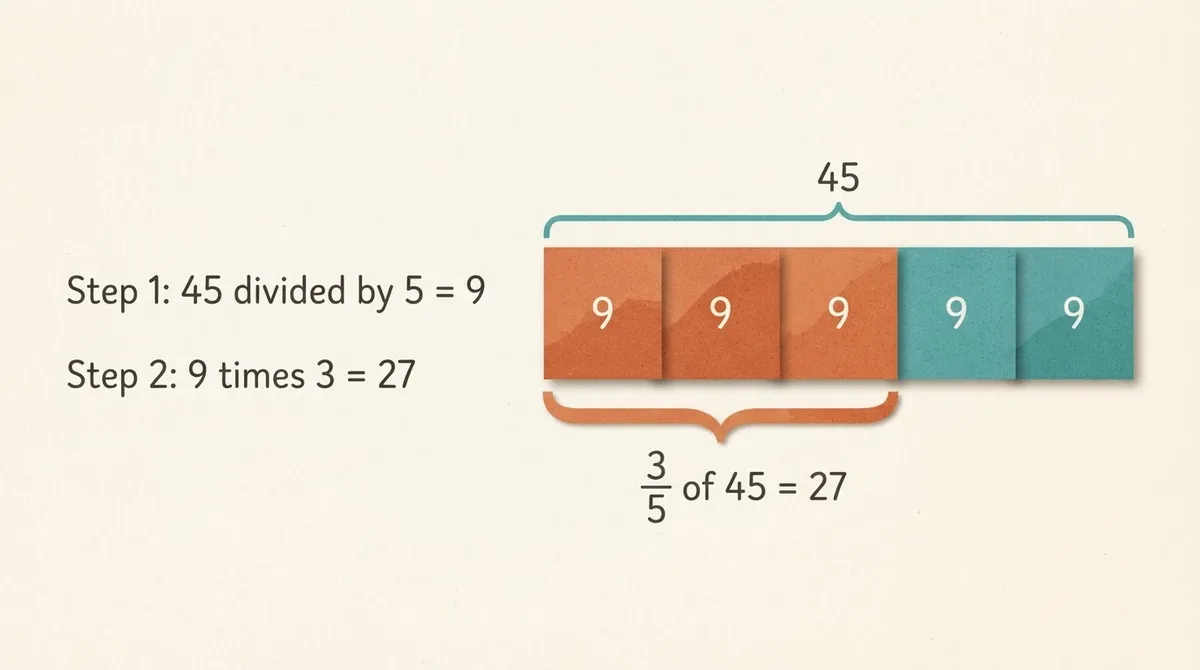
How do you find a fraction of an amount?
This example uses division and multiplication facts.
Find 3/5 of 45. Draw one bar and label the whole thing 45. Cut it into 5 equal parts, because the denominator is 5. Each part is 45 divided by 5, which is 9. Shade 3 parts, because the numerator is 3, and three lots of 9 is 27. Divide by the bottom, multiply by the top.
For another example, imagine 13 pieces of ribbon, each 1/4 metre long. Thirteen quarters is 13/4; 13 divided by 4 is 3 remainder 1, so the total length is 3 and 1/4 metres.
The explorer below uses whole-number amounts. When the amount divides evenly by the denominator, it shows equal parts as a bar and the calculation. If it does not divide evenly, it explains the quotient and remainder instead.
This part of the guide lets you explore fractions with a fraction wall or a bar model. It works in your browser.
Examples of errors and ways to check them
Here are possible errors to discuss. The DfE guidance mentions some related misconceptions; this is not a ranking of how often they occur.
- Adding the denominators. 1/4 + 1/4 answered as 2/8. Fix it by saying it aloud: one quarter plus one quarter is two quarters. The units do not change when you count them.
- Counting marks instead of intervals on a number line. Look at how many equal spaces span from 0 to 1, then count those spaces. For example, four equal intervals make quarters.
- Judging a mixed number by the size of its digits. A child needs to reason that 1 and 7/8 is close to 2, while 1 and 7/30 is much closer to 1. It is the relationship between numerator and denominator that counts, not how big they look.
- Stopping a conversion early. If a remainder is as large as or larger than the denominator, another whole can be made. For example, 17/4 is 4 and 1/4, because 17 ÷ 4 = 4 remainder 1.
- Thinking a bigger denominator always means a bigger fraction. For unit fractions, more equal parts make each part smaller: 1/8 is less than 1/4. A diagram can help compare them.
- Comparing decimals by length. 0.45 read as larger than 0.5 because it has more digits. Line up the place-value columns: 4 tenths against 5 tenths.
Is there a Year 4 fractions test, and what should we do at home?
There is no separate statutory fractions test in Year 4. Schools can assess fractions in their own classroom activities. National Key Stage 2 maths tests take place in Year 6 and include maths content such as fractions.
For pupils registered at maintained schools, academies and special schools, the statutory Year 4 assessment is the multiplication tables check. The 2027 assessment and reporting arrangements say schools must register pupils; a headteacher may decide that a pupil should not take the check and record the reason. Independent schools cannot participate. The DfE parent leaflet describes 25 timed questions on times tables up to 12, preceded by 3 practice questions, with 6 seconds per question and no pass mark. The 2027 check window runs for two weeks from Monday 7 June. Our multiplication tables check guide covers the day itself.
Some fraction calculations use multiplication and division facts. For example, finding 3/5 of 45 involves dividing 45 by 5, then multiplying by 3. Fluency can make this calculation easier, but difficulty with one calculation does not identify its cause. If your child is finding the work difficult, you could ask the teacher which part to practise next.
If short practice fits your household, you could choose one example at a time: compare equivalent fractions with a wall, convert a mixed number, or find a fraction of an amount. There is no fixed routine required by the curriculum.
Download the printable Year 4 fraction wall and practice sheet (PDF). It is one A4 page with a fraction wall, equivalence questions, mixed-number conversions, same-denominator calculations and fractions of amounts, with answers. You can choose a section that matches what your child is practising.
Quick answers to the questions parents ask
Is there a Year 4 fractions test? No separate statutory fractions test exists in Year 4. The statutory multiplication tables check applies to pupils at maintained schools, academies and special schools; independent schools cannot participate.
What are the Year 4 fraction objectives? The statutory programme lists ten statements above. Separate non-statutory ready-to-progress guidance includes criteria 4F-1, 4F-2 and 4F-3 about mixed numbers.
Why is my child doing mixed numbers? DfE and NCETM guidance includes mixed-number criteria in its Year 4 ready-to-progress material, though the guidance is non-statutory and the statutory programme lists mixed-number conversion in Year 5.
I was taught a different method. Does it matter? Methods may differ. Ask the teacher what the class is practising, especially if your child is unsure about subtraction across a whole number.
What if they are unsure of some times tables? Some fraction calculations use related multiplication and division facts. Ask the teacher which facts or fraction steps would be useful to practise.
If you are considering selective schools, check the current dates with the relevant council. Buckinghamshire's timeline for September 2028 entry says families can register in May to June 2027 and testing takes place in early September 2027. Dates and processes vary by area. For general planning, see starting 11+ preparation in Year 4.
Topics
- year 4
- fractions
- maths
- ks2
- primary curriculum