


The Year 3 and 4 Statutory Spelling List: Full List and Free PDF
All 100 entries from the statutory Year 3 and 4 word list, reproduced as readable text, with examples of useful spelling patterns. Includes a free printable PDF with a blank test sheet, no sign-up.
 Elspeth Marlow
- 11 min read

The statutory Years 3 and 4 spelling list can be hard to use in its original format: it appears on page 16 of the 26-page English Appendix 1, alongside guidance for teachers. This page reproduces the England curriculum list as readable text and offers a printable checklist and blank practice sheet.
English Appendix 1 says the Years 3 and 4 and Years 5 and 6 word lists are statutory. It describes them as a mixture of words pupils frequently use in writing and words they often misspell, and says the 100 words in each list can be taught within Key Stage 2 alongside other appropriate words (English Appendix 1: Spelling). This list is for Years 3 and 4 in England. It is not a one-term quota or an individual age-based pass mark.
This guide gives you the list, a free printable version with a blank test sheet, the spelling rule behind each group of words, ways to use sounds, word parts and spelling patterns, and explains where and when this list is actually assessed.
Start here: the free printable list (no sign-up)
The printable is two A4 pages: one alphabetical checklist of the 109 word forms, followed by a blank six-word practice sheet. The nine paired entries are expanded into their separate spellings. No email address, no membership, no sign-up.
Download the printable Year 3 and 4 spelling list and blank test sheet (PDF)
Use the printable alongside the current list or sequence supplied by your child's school. A school may add other practice words, so check which set a class exercise uses.
The full statutory list: all 100 entries
Reproduced exactly as printed on page 16 of English Appendix 1, including the bracketed and paired entries:
- accident(ally), actual(ly), address, answer, appear, arrive, believe, bicycle, breath, breathe, build, busy/business
- calendar, caught, centre, century, certain, circle, complete, consider, continue
- decide, describe, different, difficult, disappear
- early, earth, eight/eighth, enough, exercise, experience, experiment, extreme
- famous, favourite, February, forward(s), fruit
- grammar, group, guard, guide
- heard, heart, height, history
- imagine, increase, important, interest, island
- knowledge, learn, length, library
- material, medicine, mention, minute
- natural, naughty, notice
- occasion(ally), often, opposite, ordinary
- particular, peculiar, perhaps, popular, position, possess(ion), possible, potatoes, pressure, probably, promise, purpose
- quarter, question
- recent, regular, reign, remember
- sentence, separate, special, straight, strange, strength, suppose, surprise
- therefore, though/although, thought, through
- various
- weight, woman/women
The spelling practice below selects ten word forms at random from the list, uses each in a sentence and marks your typed spellings at the end. A new run may cover more of the list; one run does not cover every word.
This part of the guide is a short spelling test that reads the words aloud. It works in your browser.
Why "100 words" is really 109 spellings
Count the statutory entries above and you get 100. Expand the nine paired entries and the list contains 109 word forms: accident(ally), actual(ly), busy/business, eight/eighth, forward(s), occasion(ally), possess(ion), though/although, woman/women.
Those brackets and slashes show paired spellings within one entry. "Actual" and "actually" are both included. "Busy" and "business" are related: as Appendix 1 explains, business can be formed as busy + ness, with the y in busy changed to i. The expanded list contains 109 word forms.
A school may split paired entries into separate words for practice. That is fine: compare the full set with Appendix 1 rather than assuming a differently arranged worksheet is wrong. Our printable expands the paired entries into 109 word forms.
The list grouped by the rule each word teaches
Appendix 1 sets out statutory spelling requirements separately from its word list and also provides non-statutory rules, guidance and examples. The following comparisons connect some words to those patterns; they are not a complete mapping or a promise that learning one rule will spell every related word correctly.
- More prefixes. The Years 3 and 4 appendix includes prefixes such as dis-, mis-, in-, il-, im-, ir-, re-, sub-, inter-, super-, anti- and auto-. For disappear, the appendix says the prefix dis- is added to the root appear. The resulting word has one s and two p letters.
- The suffix -ly, and when it becomes -ally. -ly goes straight on to most roots. After a consonant, y changes to i, so happy becomes happily. A root ending in -le loses it, which is exactly how probable becomes probably, a word worth checking carefully. Roots ending in -ic take -ally instead, "except in the word publicly". The list entries actually, accidentally and occasionally are built from actual, accidental and occasional, so the double l comes from the root plus -ly and not from guesswork.
- The suffix -ous. Famous and various are on the list and use the suffix -ous.
- Endings written -tion, -sion, -ssion and -cian. The appendix groups these spellings under endings commonly sounding like /shun/ and gives clues about the root. Compare mention and position (-tion), occasion (-sion, with a /zh/ sound), and possession (-ssion). Question is also on the statutory list, but its ending sounds different, like /chun/. The fourth pattern, -cian, appears in words for people, such as musician; that example is outside the 100 entries.
- /ay/ spelt ei, eigh or ey. Eight, eighth, weight and reign. Then the trap: height uses the same eigh letters for a completely different sound, so it has to be learnt separately rather than filed with weight.
- /s/ spelt c before e, i or y. Centre, century, certain, circle, exercise, notice, decide and medicine all obey it. Appendix 1 notes that "medicine is related to medical so the /s/ sound is spelt as c", which turns a hard word into a sensible one.
- Dropping final e before a vowel suffix. Examples include arrive to arriving, believe to believing and separate to separating. The appendix describes this as a spelling rule; it is not a claim about where pupils generally lose marks.
- Letter strings doing several jobs. The ou string has different pronunciations in enough, though, through, thought and group. The word fruit contains ui, not ou. Group these by sight and family, not by sound.
These examples show ways to connect list words to the taught patterns.
Word parts and spellings to notice
A single rule does not explain every word. Use the curriculum's notes on word parts alongside phonics and letter patterns.
For less familiar words, look at the sounds, letter patterns, roots and endings rather than assuming every spelling is arbitrary. Appendix 1's non-statutory notes give examples of word relationships that may help pupils notice spelling:
- business can be formed as busy + ness, with the y changed to i. In busy, the /ɪ/ sound is spelt with u; the curriculum uses the word pair to show how a root can change when a suffix is added.
- bicycle is "cycle (from the Greek for wheel) with bi- (meaning two) before it". Two wheels.
- medicine is related to medical.
- opposite is related to oppose, "so the schwa sound in opposite is spelt as o".
- disappear is dis + appear, so the only thing to learn is appear.
The appendix says knowledge of roots can help pupils spell longer words when they also know how prefixes and suffixes are added. For words such as February, Wednesday, separate and potatoes, a pupil may choose to say the word in parts while writing it; it is one optional practice cue.
How this list differs from the Year 1 and 2 common exception words
The appendix distinguishes the Year 1 and 2 common exception word examples from the statutory Years 3 and 4 list. For example, "because" and "beautiful" appear in the Year 2 examples, not in the Years 3 and 4 list.
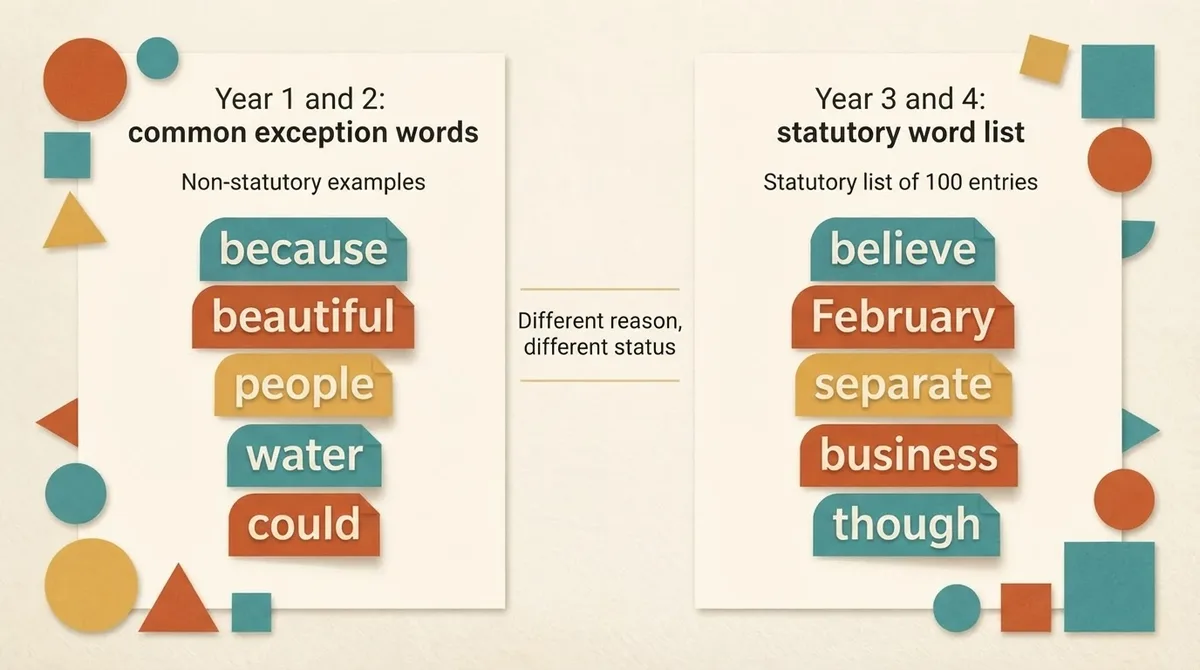
- Different descriptions. The Year 1 and 2 appendix notes explain that exception words contain grapheme-phoneme correspondences not yet taught as widely applicable. The Years 3 and 4 and Years 5 and 6 statutory lists are described as a mixture of words pupils use frequently and words they often misspell.
- Different legal status. In Appendix 1 the left-hand column is statutory; the middle and right-hand columns are non-statutory guidance. The Year 1 and 2 example words sit in those guidance columns, although the programme of study requires pupils to learn common exception words. The Years 3 and 4 and Years 5 and 6 word lists are statutory in themselves.
"Busy" appears in the Year 2 examples and again as part of the Year 3 and 4 entry "busy/business".
Is there a spelling test in Year 4?
No. There is no statutory spelling test in Year 4 anywhere in England, and there is no statutory English assessment in Year 4 at all. The only national check in Year 4 is the multiplication tables check, which is "an onscreen check consisting of 25 times table questions", sat in June, and where "there is no pass mark for the check" (gov.uk guidance for parents). If you want the maths side of the same year, see our guide to the Year 4 maths curriculum.
Any weekly spelling tests in Year 4 are local school assessments, not a national spelling test.
At the end of Key Stage 2, statutory teacher assessment of writing considers pupils' independent work. The current teacher assessment framework for English writing includes the statement "spell correctly most words from the year 3 / year 4 spelling list, and some words from the year 5 / year 6 spelling list" under working towards the expected standard. The working at standard includes spelling most words from the Year 5 and 6 list and using a dictionary to check the spelling of words.
The end-of-key-stage 2 teacher assessment framework, which GOV.UK says is unchanged for 2026 to 2027, says "most" indicates that a statement is generally met with only occasional errors. These are Year 6 assessment standards; they do not establish a Year 4 pass mark or an individual judgement based on a short practice test.
A short routine to review a small word set
Choose a small set from the class sequence and practise in a way that suits the child. The example ideas below are optional; the curriculum does not prescribe a home timetable or a fixed number of words per week.
- Look, say, cover, write, check. Read a word, cover it, write it from memory, then check the spelling.
- Use a word in a sentence. This gives a chance to practise it in context as well as on its own.
- Return to words that need another look. Follow the teacher's sequence where available and keep the practice set manageable.
The Years 3 and 4 programme of study includes writing from memory simple sentences dictated by the teacher and using the first two or three letters of a word to check spelling in a dictionary (English programmes of study). At home, these can be practised when useful; the curriculum does not set a home routine.
The printable lists words alphabetically for lookup. Choose a small set to practise, following the school’s sequence where available. Compare shared patterns and revisit difficult words in a later session.
What about the spelling paper in the KS2 tests?
That paper is sat at the end of Key Stage 2, in Year 6 for most pupils. Paper 2 of the Key Stage 2 English grammar, punctuation and spelling test asks pupils to write 20 spellings in an answer booklet, with "approximately 15 minutes" to complete it; it is not strictly timed. The 2026 paper was scheduled for Monday 11 May. The national spelling test is not a Year 4 assessment.
My child's school list looks different. Who is right?
The statutory Years 3 and 4 list is set out here. A school may also choose additional practice words or arrange the list in a different order; check which words are part of the current class sequence.
Looking a little further ahead than Year 4
Families considering selective schools should check each school's current admissions policy and published familiarisation materials; test content and format vary. Curriculum spelling practice does not guarantee performance on an entrance test. For general planning, see starting 11 plus preparation in Year 4 and when to start 11 plus preparation. The separate guide to 11 plus spelling rules and word lists is about selective-entry contexts, not a statutory curriculum list.
Topics
- spelling
- year 4
- year 3
- english
- printables
- primary