

11 Plus Spelling Rules and Word Lists
The 11 plus does not test spelling as memory, it tests it as rule recognition, and the rules are a published government list. Here are the rule families, a graded word list grouped by rule, and ten worked spot-the-error questions.
 Elspeth Marlow
- 17 min read
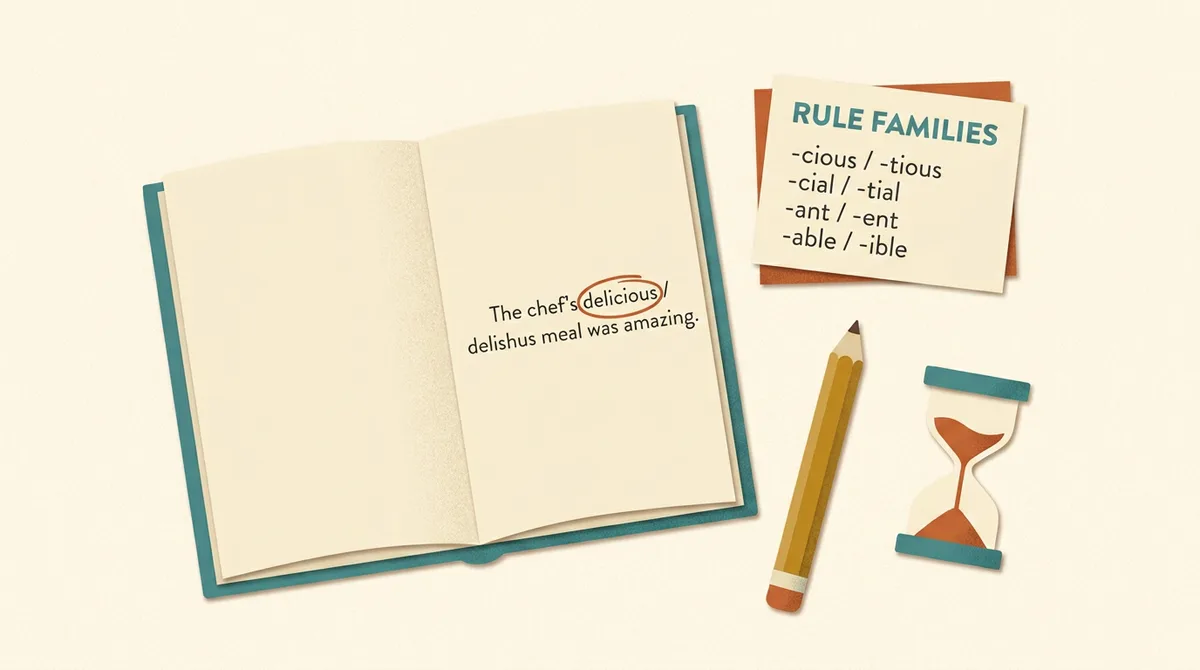
Search for 11 plus spelling and almost every page hands you the same thing: a very long list of words, usually alphabetised, usually without definitions, sometimes 1,800 of them. The implied advice is that spelling is a memory problem and the solution is volume. A child works through the As in October and has forgotten them by the time they reach the Ss in February.
That is the wrong model of the task. The words a Year 6 child can be asked to spell in a selective test are not drawn from a publisher's imagination. They come from English Appendix 1 of the national curriculum, a government document that sets out a finite list of spelling rule families for Years 5 and 6 plus a statutory list of 100 words chosen precisely because they are words children "often misspell". That document is public, free and about as close to a syllabus as 11 plus English gets.
So this guide does three things no word list can. It shows you how to check whether your region's test contains spelling at all (several do not). It shows you what a spelling question actually looks like on the day, because in the GL Assessment format children are proofreading a sentence, not writing to dictation. And it teaches the rule families, with their exceptions, so that a child who has learned eight patterns can spell thousands of words they never revised.
Does your child's 11 plus actually test spelling?
Start here, because it is the question that decides whether the rest of this page is worth your time. The 11 plus is not a national exam. Formats are set locally, and GL Assessment says so itself: "11+ tests vary from area to area", and the timings, topic combination and question count in your local test "may differ" from its own practice materials (GL Assessment).
The difference is not subtle. North Yorkshire Council describes its Paper 1 (Verbal Skills) as one that "combines Key Stage 2 reading comprehension and spelling test with verbal reasoning questions. All questions are multiple choice". The English section runs for 25 minutes: a passage to read and answer questions on, "followed by some exercises in spelling and grammar. 26 questions in total", with content capped at the Year 5 national curriculum (North Yorkshire Council). Spelling is explicitly in.
Bexley is the counter-example. Its Paper 1 is Verbal Ability and English Comprehension, assessing vocabulary, comprehension and verbal reasoning across roughly 50 minutes of multiple-choice questions. There is no spelling element. A Bexley family drilling -cious and -tious endings is spending time that would be better spent on vocabulary and comprehension. Warwickshire complicates it further, because its 11 plus paper is shared across several neighbouring authorities, so the format that matters may not be the one your nearest county advertises.
Three checks, in order:
- Read your local authority's own admissions or selection-test page, not a tutoring site's summary of it. Councils publish the paper structure and timings.
- If the schools you are applying to are academies or independent, read each school's admissions page separately. They set their own papers and may differ from the county consortium.
- Download the official familiarisation booklet for your test provider and look at the actual question types in it.
If spelling does not appear anywhere in those three sources, treat it as a general literacy asset rather than an exam target, and put the hours into vocabulary and comprehension instead. If it does appear, read on.
What does an 11 plus spelling question really look like?
This is the part parents almost never see before test day, and it changes how you practise. GL Assessment describes its English paper as covering comprehension, "Use of capital letters and punctuation", "Spelling, where children are asked to spot mistakes", and "Word choice and grammar" (GL Assessment English paper practice).
Spot mistakes. Not write the word. The typical item gives a sentence broken into four or five labelled parts, and the child marks the part containing a spelling error, or marks "N" if there is no mistake. That last option matters more than it looks: a child who assumes every question hides an error will invent one.
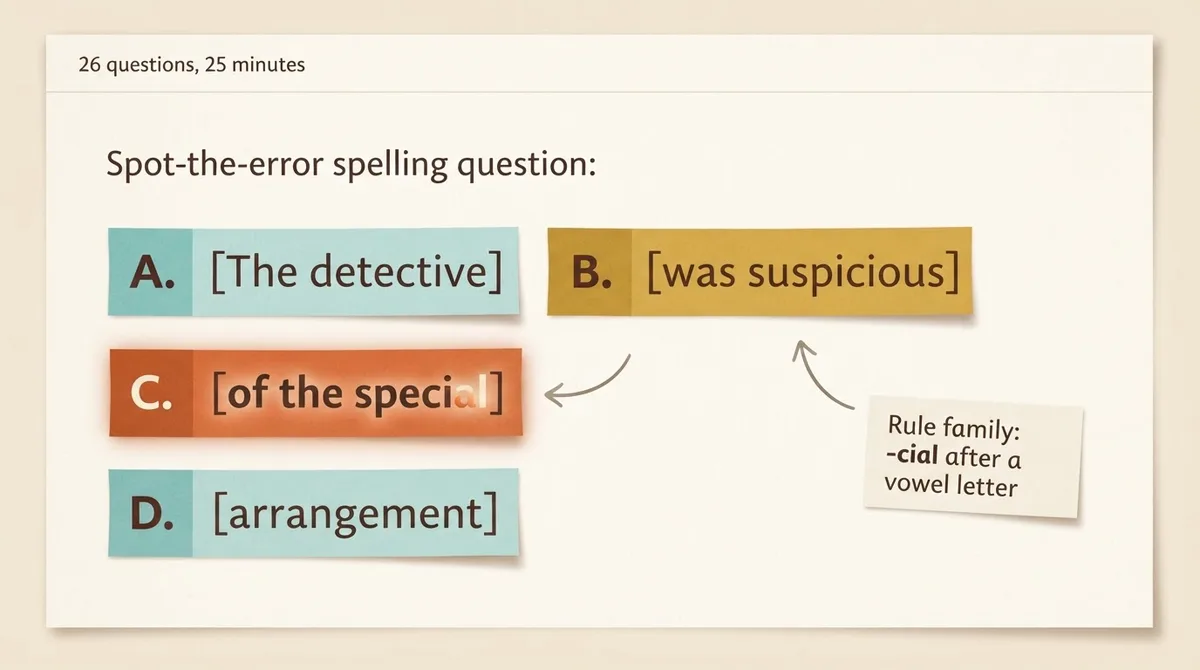
Three practical consequences follow.
First, the skill is recognition, not recall. Your child has to look at recieve and feel that something is wrong. That is a different muscle from producing the word on a blank line, and it is trained by reading sentences with deliberate errors planted in them.
Second, the pace is brisk. North Yorkshire's 26 questions in 25 minutes includes a comprehension passage, so the spelling and grammar items get well under a minute each. A child who stares at a word for thirty seconds will run out of paper.
Third, errors are chosen to sit on rule boundaries. Test writers do not misspell cat. They write responsable, occured, concious, stationary where stationery is meant. Every one of those sits on a named rule family, which is why the families are worth learning.
Where do the 11 plus spelling words actually come from?
The national curriculum's spelling appendix contains two statutory word lists, one for Years 3 and 4 and one for Years 5 and 6, and it is unusually candid about how they were picked: "The lists are a mixture of words pupils frequently use in their writing and those which they often misspell", and "the 100 words in each list can easily be taught within the four years of key stage 2". It also draws a clear line about what is binding: "In this spelling appendix, the left-hand column is statutory; the middle and right-hand columns are non-statutory guidance" (English Appendix 1: Spelling).
The Year 5 and 6 list includes exactly the words that turn up in 11 plus papers year after year: accommodate, aggressive, amateur, awkward, bruise, cemetery, committee, conscience, conscious, definite, desperate, disastrous, embarrass, environment, exaggerate, familiar, forty, government, guarantee, harass, leisure, marvellous, mischievous, necessary, neighbour, nuisance, occur, parliament, privilege, pronunciation, queue, recommend, rhythm, secretary, sufficient, twelfth, vehicle, yacht.
The statutory Year 5 and 6 requirements also name the rule families themselves: /ʃəs/ endings spelt -cious or -tious; /ʃəl/ endings; -ant, -ance/-ancy, -ent, -ence/-ency; -able, -ible, -ably, -ibly; adding vowel suffixes to words ending in -fer; use of the hyphen; the /iː/ sound spelt ei after c; the letter string ough; silent letters; and homophones and other words often confused.
That is the scope. It is finite, it is published, and it is the same document the people writing your child's paper are working from. Four families cover most of it.
Rule family 1: why is it delicious but ambitious?
Both endings sound identical, so children guess. The curriculum's rule of thumb is about the root word: "If the root word ends in -ce, the /ʃ/ sound is usually spelt as c". So vice gives vicious, grace gives gracious, space gives spacious, malice gives malicious. Anxious is the exception the curriculum itself flags. Where there is no -ce root, -tious is the safer bet: ambitious, cautious, infectious, nutritious.
The /ʃəl/ ending has an even cleaner test: "-cial is common after a vowel letter and -tial after a consonant letter, but there are some exceptions". Official, special, artificial (vowel before the ending) against partial, confidential, essential (consonant before it). The exceptions to teach are initial, financial, commercial and provincial, and it is worth telling a child why the last three break the pattern: they are built on finance, commerce and province, so the c travels with the root.
That "but here is why" habit matters. A child who learns exceptions as arbitrary noise starts distrusting the rule; a child who learns them as related words keeps applying it.
Rule family 2: is it -ant or -ent, -able or -ible?
This family produces more 11 plus errors than any other, because the endings are unstressed and sound like nothing much at all.
For -ant/-ance versus -ent/-ence the curriculum gives two handles. "Use -ant and -ance/-ancy if there is a related word with a /æ/ or /eɪ/ sound in the right position; -ation endings are often a clue": observant sits with observation, expectant with expectation, hesitant with hesitation. And "use -ent and -ence/-ency after soft c (/s/ sound), soft g (/dʒ/ sound) and qu": innocent, decent, frequent, confident.
Then comes the most useful sentence in the whole document: "There are many words, however, where the above guidance does not help. These words just have to be learnt", with assistant, obedient and independent named. Say that out loud to your child. It converts a frustrating word into a small, honest category rather than evidence that they are bad at spelling.
-able versus -ible works the same way. The curriculum notes that "the -able/-ably endings are far more common than the -ible/-ibly endings", so -able is the better guess under time pressure. The sharper test: "the -able ending is used if there is a related word ending in -ation", giving applicable/application, considerable/consideration, tolerable/toleration. When -able joins a word ending in -ce or -ge, "the e after the c or g must be kept", which is why we write changeable and noticeable. And -ible "is common if a complete root word can't be heard before it": possible, horrible, terrible, visible, incredible. Sensible is the exception where a whole word can be heard.
Rule family 3: referred or refered, and does i before e still work?
The -fer words are a genuine trap because the same root splits two ways, and the deciding factor is stress. "The r is doubled if the -fer is still stressed when the ending is added": referring, referred, referral, preferring, preferred, transferring, transferred. "The r is not doubled if the -fer is no longer stressed": reference, referee, preference, transference. Have your child say the pair aloud, re-FER-ring against REF-erence, and the doubling stops being random.
The i before e except after c jingle is taught far more broadly than the curriculum supports. The actual rule "applies to words where the sound spelt by ei is /iː/": deceive, conceive, receive, perceive, ceiling. Outside that long-ee sound it simply does not apply, which is why children who chant the whole rhyme write recieve correctly but then mangle words it was never about. The named exceptions are protein, caffeine and seize, plus either and neither when said with an initial /iː/.
And then there is ough, which the curriculum describes without much enthusiasm as "one of the trickiest spellings in English, it can be used to spell a number of different sounds". There is no rule to learn here, only groups to sort into: ought, bought, thought, nought, brought, fought; rough, tough, enough; cough; though, although, dough; through; thorough, borough; plough, bough. Sorting is the exercise: give a child the fifteen words shuffled and ask them to group by sound.
Rule family 4: silent letters and the homophones that catch children out
Silent letters are defined in the curriculum as "letters whose presence cannot be predicted from the pronunciation of the word": doubt, island, lamb, solemn, thistle, knight. The document also notes that in knight "there was a /k/ sound before the /n/", which is a useful thing for a child to hear, because it reframes a silent letter as a fossil rather than a cruelty.
Etymology is a real strategy here, and the curriculum models it. Conscience "is simply science with the prefix con- added", from Latin scio, 'I know'. Desperate is often said as desp'rate, but its -sper- comes from Latin spero, 'I hope', where the e was clearly sounded. Familiar is related to family, which is why that first unstressed vowel is an a. Three of the hardest words on the statutory list, defused by one sentence each.
Homophones get the only fully mechanical rule in the appendix: "In the pairs of words opposite, nouns end -ce and verbs end -se". Advice/advise, device/devise, licence/license, practice/practise, prophecy/prophesy. Advise even has a /z/ sound "which could not be spelt c". The statutory often-confused list for Years 5 and 6 also runs through aisle/isle, aloud/allowed, affect/effect, altar/alter, ascent/assent, bridal/bridle, cereal/serial, compliment/complement, descent/dissent, desert/dessert, draft/draught, farther/father, guessed/guest, heard/herd, led/lead, morning/mourning, past/passed, precede/proceed, principal/principle, profit/prophet, stationary/stationery, steal/steel, wary/weary and who's/whose.
Homophones are the one family where the spot-the-error format bites hardest, because both spellings are real words. Only the sentence tells you which is wrong.
Try the homophones now: each sentence needs the right one.
This part of the guide is a short interactive exercise. It works in your browser.
What should an 11 plus spelling word list look like?
Regrouped by rule and graded, not alphabetised. A week of practice should be one coherent family, so that Monday's rule is still doing work on Friday. Here is the statutory material reorganised the way we would actually teach it.
Easier, high-frequency (start here): forty, twelfth, occur, neighbour, leisure, bruise, queue, vehicle, yacht, awkward, amateur, definite, secretary, familiar, marvellous.
Medium, rule-driven: conscious, sufficient, ambitious, official, special, essential, confidential, observant, hesitant, innocent, frequent, possible, terrible, considerable, noticeable, referred, preference, ceiling, receive, thorough.
Harder, learn-and-check: accommodate, aggressive, cemetery, committee, conscience, desperate, disastrous, embarrass, environment, exaggerate, government, guarantee, harass, mischievous, necessary, nuisance, parliament, privilege, pronunciation, recommend, rhythm.
Set twelve to fifteen words a week from one band and one family. Print the list yourself if a paper copy helps, then re-test the previous two weeks alongside the new set so nothing quietly decays. This is the same spacing principle behind a sensible revision timetable, and it is why the alphabetical mega-list fails: it never revisits anything.
Can we see some worked spot-the-error questions?
Ten original items in the GL-style format. In each sentence, the four candidate words are in bold. Pick the misspelled one, or decide there is no mistake.
- The committee agreed it would be necesary to postpone the annual concert. Answer: necessary. Family: learn-and-check statutory word.
- Our neighbour was anxious that the fence looked too artificial and not very speciel. Answer: special. Family: -cial after a vowel letter.
- She was confident that her independant project would win a privilege at the ceremony. Answer: independent. Family: -ant/-ent, one of the "just have to be learnt" words.
- He refered the letter to the head, who kept a reference copy in the secretary's cabinet. Answer: referred. Family: -fer doubling under stress.
- It is possible the timetable is changable, so please check the noticeable board in the corridor. Answer: changeable. Family: keeping the e after c or g.
- The stationary shop had run out of envelopes, which was a nuisance before the exam. Answer: stationery. Family: homophones.
- They took her advise about the bridle path and made a slow descent to the cemetery. Answer: advice. Family: nouns end -ce, verbs end -se.
- The ancient thorough fare was too rough for the vehicle. No mistake. Family: ough sound groups (all four are correct).
- He tried to decieve the judges but his conscience made him confess to the committee. Answer: deceive. Family: ei after c for the /iː/ sound.
- It was a disasterous attempt to accommodate twelve guests in one awkward environment. Answer: disastrous. Family: statutory list, drops the e.
Notice how few of these require exotic vocabulary. The words are ordinary; the discrimination is the difficulty. If your child finds the sentences easy but the timing hard, the fix is exposure to more sentences, which is what full English papers give you in a way that isolated word lists never will.
Try a spot-the-error question now: one word is spelt wrong.
This part of the guide is a short interactive exercise. It works in your browser.
How do you improve spelling for the 11 plus week by week?
Twenty minutes, four days a week, on one rule family, beats an hour of random words on a Sunday.
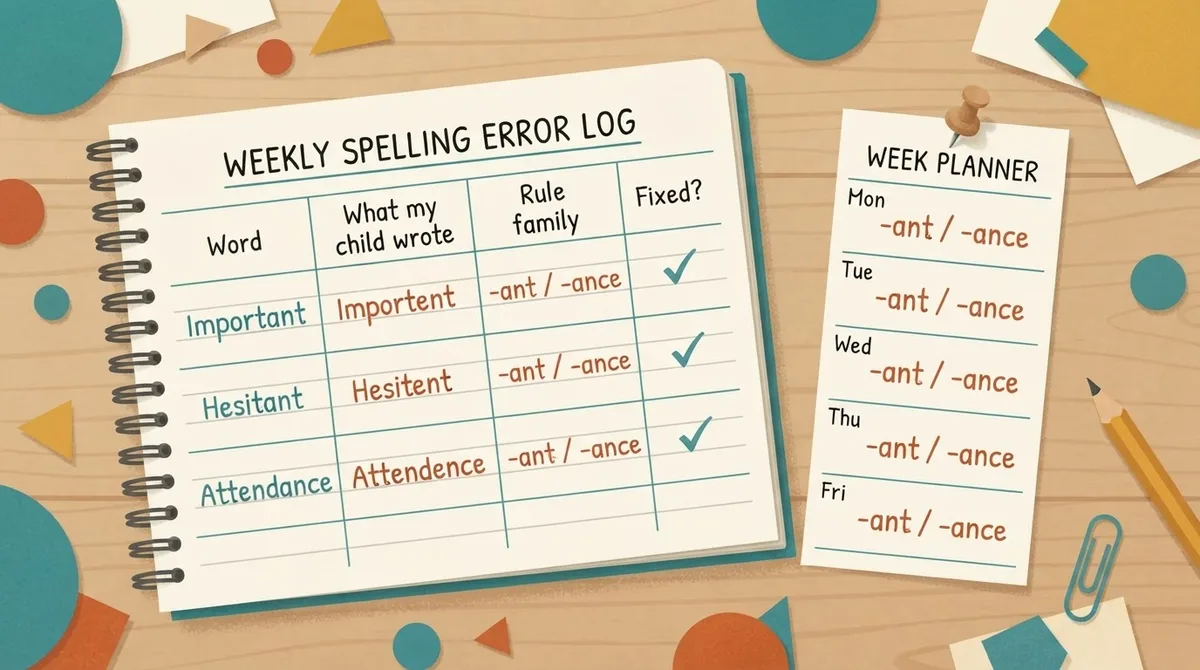
A workable week looks like this. Monday: introduce the family and its rule of thumb, and say the rule aloud in your child's own words. Tuesday: sort words into rule-follows and exceptions, which forces the decision the exam will force. Wednesday: proofreading, so give ten sentences with three or four errors planted among them and time it. Thursday: mixed retrieval, including the previous two weeks' families. Friday off, or a five-minute verbal check in the car.
The error log is the compounding part. Record four things for every mistake: the word, what your child wrote, the rule family it belongs to, and whether it was fixed on the next attempt. Logging the rule rather than the word is the whole trick. Three separate errors on responsable, reversable and sensable are not three words to memorise, they are one -able/-ible rule that has not landed yet. Fix the rule and all three go. Tracking that pattern over weeks is exactly the kind of thing our progress tracking is designed to surface, but a paper notebook does the job perfectly well.
One caution on balance. Spelling is a modest share of the marks in a GL English paper, so it should be a modest share of the hours. If your child is losing more marks on inference questions than on proofreading, the spelling list is the wrong place to be. The same logic applies across subjects, which is why it is worth mapping the whole picture against the 11 plus maths topics and question types before deciding where the week's time goes.
11 plus spelling questions parents ask
Is it "11+" or "11 plus"? Both are used and both are correct. Councils and schools tend to write 11+; parents and search engines tend to use 11 plus. There is no difference in meaning.
What are the trickiest words for the 11 plus? In our experience the reliable offenders are accommodate, necessary, occurred, embarrass, definite, separate, conscience, rhythm, privilege, mischievous and the stationary/stationery pair. Notice that most are on the statutory Year 5 and 6 list, which is exactly why that list exists.
How long should we spend on 11 plus spelling? Twenty minutes on four days a week, for six to ten weeks, will move most children through the main rule families with room for revisiting. Beyond that you are getting diminishing returns compared with comprehension practice.
Does spelling matter if our test has no spelling section? It still shows up in creative writing tasks where those are set, and in the general accuracy of written answers. But it stops being an exam target, and your revision plan should reflect that.
Do we need to buy a spelling pack? Not to start. The curriculum appendix is free, the rule families are in this article, and the statutory word list above is the same one publishers repackage. Paid packs mainly buy you volume of practice questions, which is useful once the rules are secure and not before.
If you want the whole English picture rather than spelling alone, our 11 plus vocabulary guide covers the other half of the word work, and you can start a free account to set a plan against your own region's paper format.
Topics
- 11 plus spelling
- english
- spelling rules
- word lists
- gl assessment