


Practice Papers and Mock Tests
Working Out on Paper in the 11 Plus: Check the Test Rules
Where candidates may write working and how answers are recorded varies by test. Check the current instructions for your child’s test before practising a routine.
 Elspeth Marlow
- 7 min read

Where a child may write working, and how their answer is recorded, depends on the test. Before practising a routine, check the current instructions for the right entry year and test area.
For 2027 entry, Bexley uses the Quest Selection Test and publishes candidate arrangements. CSSE's 2027-entry guide describes its own papers and requirements. Buckinghamshire provides instructions for its Secondary Transfer Test. These local examples are not universal 11+ rules, and formats can change between entry years.
The myth: "marks are given for method"
The Bexley and Buckinghamshire examples below use multiple-choice papers, where candidates record a selected answer. The CSSE 2027 guide describes two separate tests, one in English and one in Mathematics, but does not say how answers are recorded. Do not assume that written method marks are awarded, or that every test is multiple choice: check the target test's mark scheme and candidate instructions. Working on the question paper can help a child organise their own steps, but the sources do not establish that writing always improves accuracy.
What the providers actually say: Bexley, CSSE and Buckinghamshire
Bexley (2027 entry, September 2026 sitting). Bexley's current information identifies Quest Assessments as test provider and explains the current format and candidate arrangements (Bexley Selection Test information). Bexley's information says all working out must be done in the test booklet, as rough paper will not be provided. Quest's candidate guidance says working may be done in the question booklet, which is not marked, and explains how to record or change answers. Use the current guidance for your child's cycle rather than an old copy (Quest guidance for children).
CSSE (2027 entry). The current guide describes the 2027-entry cycle, including separate English and maths papers and the English reading period. It is not a guide to later entry years. CSSE's practice-material page currently lists past papers for 2021-2023 entry. The familiarisation maths PDF linked here is an older example; treat its page layout as historical practice material, not proof of current answer-recording rules (CSSE examination page and current documents; CSSE practice material; 2027-entry guide; older familiarisation maths paper).
Buckinghamshire. The council's current guidance explains the Secondary Transfer Test format, familiarisation and test conditions. Read its guidance for the relevant entry cycle and follow instructions given to candidates at the centre (Buckinghamshire Council: Secondary Transfer Testing process).
The Kent Test is not covered here. If your child is sitting it, read Kent County Council's own Kent Test guidance before building any of these habits.
Instructions for changing answers are local. Bexley's Quest guidance describes its answer sheet, while the older CSSE familiarisation paper has its own amendment instructions. Do not transfer one paper's marking or correction rule to another test. CSSE's 2027-entry guide does not establish that the older familiarisation paper's answer-sheet instructions apply unchanged to future cycles.
Why children stop writing things down
If a child avoids writing, ask what is getting in the way. Possible explanations include:
- Time pressure. Writing can feel slow, especially when a child is unsure what to record.
- A multiple-choice format. A child may prefer to look at the options first. If permitted, they can try noting an intermediate result before comparing options.
- Confidence or habit. Some children prefer mental calculation. Working on paper is one available strategy, not a measure of ability.
Worked example 1: multi-step maths
A box holds 24 pencils. A school buys 15 boxes and shares the pencils equally between 8 classes. Each class then puts its pencils into pots of 5. How many full pots does each class make?
One way to keep track of the steps is to write:
- 24 x 15 = 360
- 360 / 8 = 45
- 45 / 5 = 9
If the options include an intermediate result, a child might be tempted to stop at 45. This example illustrates one possible error; it does not claim that a real test uses this distractor.
Writing intermediate results may help some children keep track of a multi-step calculation. There is no universal minimum number of lines: record enough to make the method clear to the child.
Worked example 2: non-verbal reasoning
A series of four boxes. In each, a small arrow sits inside a square frame with dots along the top edge. Across the series the arrow turns 90 degrees clockwise each time, the dots go 1, 2, 3, 4, and the arrow's tail alternates solid, hollow, solid, hollow. Which of five options comes next?
For this invented example, a child could note the changing features before choosing an option:
R90 / dots +1 / tail alt
That gives three features to compare: the next quarter-turn, five dots and a solid tail. This description is illustrative; a real question needs its figures and answer choices to be solvable.
Our guide to non-verbal reasoning question types works through several common formats.
Worked example 3: verbal reasoning letter codes
If FROG is written in code as GTRK, what is the code for BIRD?
One way to compare the letters is to write them in matching columns and note the shifts:
- F R O G
- G T R K
- +1 +2 +3 +4
Applying those shifts to BIRD gives CKUH.
Looking only at the first pair could suggest a one-letter shift throughout. Checking every pair helps test whether that explanation fits the full example.
In some tests, a child may be able to make notes in the question booklet; check the current instructions before practising this. More code patterns are covered in our guide to verbal reasoning codes and letter sequences.
The booklet routine
If working on paper helps, a small routine can make it easier to use. Adjust it to the test instructions and the child's needs.
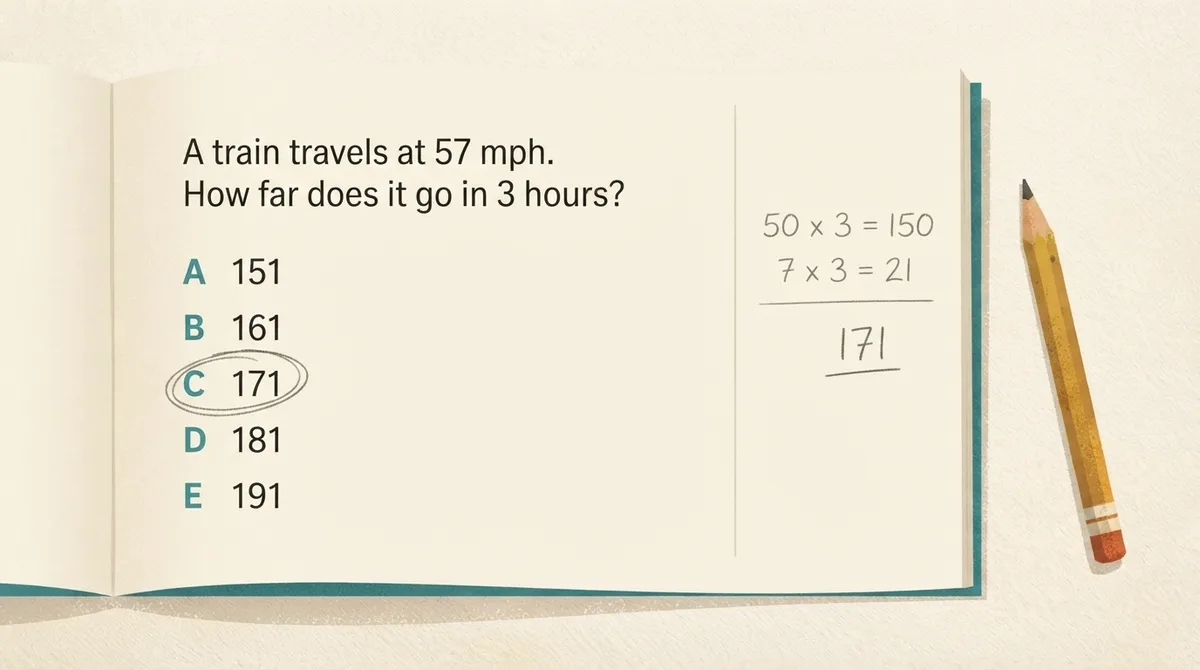
- Use an allowed space. Check whether notes belong in the booklet or another permitted place.
- Record useful steps. For a multi-step calculation, jot intermediate results if that helps keep track.
- Handle options as instructed. Follow local guidance for marking or changing an answer.
- Write down patterns when useful. Comparing a sequence or letter code in columns can make a possible rule easier to check.
- Keep it brief. A note should help the child decide, not become a separate task.
Paper practice can let a child try the layout and materials shown in their target test's familiarisation guidance. Online practice can support other question skills, but may not reproduce a particular paper's answer-transfer process. Use printed practice papers or our free 11+ practice papers where they fit the target test. A mock exam is another practice option; it cannot guarantee how a child will perform on test day.
Transferring answers to the sheet
Some tests use a separate answer sheet; others may use a different response method. For a separate sheet, follow the provider's instructions for aligning question numbers and changing an answer. Do not assume that transferring in batches, crossing out or erasing is allowed in every test. See our guide to 11+ answer sheets for general practice ideas, then check the target provider's rules.
Read your own area's instructions
Do not take a blog's word for the rules in your area, including this one. GL Assessment notes that local test timings and question counts may differ from its materials (GL free materials). When you open the guidance for the correct entry year, check:
- Is rough paper provided, and may children write in the question booklet?
- Is the paper answered in the booklet, or on a separate answer sheet?
- Is the sheet machine-read, and how should a changed answer be handled?
- What equipment is permitted, and is a ruler allowed?
- How long is each paper, and does that include the instructions being read out?
If an instruction is unclear, ask the admissions team or test provider. Practise only routines that match the candidate guidance, and explain that notes are for the child's own use unless the test instructions say otherwise.
Topics
- exam technique
- maths
- non-verbal reasoning
- answer sheets
- gl assessment