


Free Verbal Reasoning Practice Test with Explanations
A free, timed, auto-marked 11+ verbal reasoning practice test, with results split by question family and a short explanation for each answer.
 Elspeth Marlow
- 11 min read

Some employment verbal reasoning assessments use a passage followed by statements to mark True, False or Cannot Say. That format differs from the word and letter puzzles shown in the 11+ materials discussed here. Always check the format used by the test you are preparing for.
That passage-based format is different from the examples in the GL Assessment familiarisation materials for 11+ verbal reasoning. Those materials include word relationships, hidden words and letter questions. Test content and instructions vary locally, so an employment practice test may not match an 11+ paper.
This page offers a free, timed verbal reasoning practice test and a guide to the methods behind its question families. The format notes use official admissions material, including Buckinghamshire's familiarisation booklet. Formats vary by area, so check whether your local 11+ includes verbal reasoning before choosing practice material.
Start here: take the free verbal reasoning practice test
The test is for children aged roughly 10 to 11 preparing for an 11+ or grammar school entrance exam. It is free, needs no download, and marks itself the moment your child finishes.
- It is timed. The widget presents twelve questions in ten minutes. This is a short practice set, not a simulation of a local test's full duration. For comparison, Buckinghamshire's familiarisation booklet says its Verbal Skills test takes around an hour including practice instructions: English is 25 minutes plus 5 minutes practice, and verbal reasoning is 20 minutes plus 5 minutes practice (Buckinghamshire Secondary Transfer Test familiarisation booklet).
- Questions are multiple choice. Buckinghamshire's current familiarisation booklet describes its own papers as multiple choice; follow the instructions for your local test.
- It shows an overall score and a question-type breakdown. The result includes both the total score and separate counts for each type in this set.
- Answer feedback is shown in place. Each question has a short explanation; these are brief practice explanations, not full step-by-step solutions.
You can try it without preparation to see how the questions are presented. Treat one short result as a description of this attempt, not a measure of a child's general ability.
This part of the guide is a free timed practice test. It works in your browser.
Sitting a verbal reasoning test for a job instead?
If you found this page while preparing for a Civil Service aptitude test, GOV.UK describes its verbal test as a passage followed by a statement to judge True, False or Cannot Say (GOV.UK Civil Service verbal and numerical tests). Other employers may use different formats. The examples below concern 11+ verbal reasoning.
What verbal reasoning means in the 11+
Buckinghamshire's familiarisation booklet describes verbal reasoning as using rules and relationships involving words and letters.
This definition distinguishes the examples in that booklet from passage-based formats such as the Civil Service test. It does not describe every local 11+ paper. Word and letter puzzles use relationships and rules; comprehension and English may also feature elsewhere in a local selection test.
Before choosing materials, check that they match your local test. For wider context, our 11+ verbal reasoning guide covers how the subject sits alongside other test areas.
Three formats shown in Buckinghamshire's familiarisation material
Buckinghamshire's familiarisation booklet uses the headings production of words, relationships between words, and manipulation of letters, with examples under each. It warns that the actual test may contain other types. These headings are useful for describing the examples below, but should not be treated as a fixed description of every GL paper. The examples that follow are original practice questions, not copied test items.
Step 1. Production of words: finding the hidden four-letter word
In this question type, the end of one word and the start of the next form a hidden four-letter word. Buckinghamshire's booklet illustrates the rule with a sentence example; the question below is original.
Here is an original one. Find the four-letter word hidden across two neighbouring words in:
The lab and the office opened late.
Worked solution. Check each pair of neighbouring words. The last letter of lab and the first three letters of and form band, a valid four-letter word across the join.
The four-letter word can be split in three ways across the join:
- One plus three. lab and gives band.
- Two plus two. Each internal door was closed gives chin.
- Three plus one. There were extra places set out gives trap.
So the method is mechanical, and mechanical is good under time pressure:
- Write the sentence out and mark every join between two words.
- At each join, test the three splits in order: 1+3, 2+2, 3+1.
- Read the four letters as a word and check that it is a valid word for the question.
- For this example, only one join contains the target word, band.
Checking each neighbouring pair in order is one systematic way to search this example. In a timed test, use the instructions and working space provided for that paper.
The practice test above does not include hidden-word questions yet, so try the skill here. This exercise hides a three-letter word rather than four, but the method is the same: read across the join.
This part of the guide is a short interactive exercise. It works in your browser.
Step 2. Relationships between words: analogies, and why you mark two answers
The booklet shows an analogy format where the reader chooses two words, one from each group, to complete the relationship. Its example pairs opposites and instructs candidates to mark two selections. The original example below uses an adult-animal and young-animal relationship.
For this example, the prompt asks for two selections. Follow the number of answers requested in any local test question.
Puppy is to (dog bone small) as kitten is to (cat milk fur).
Worked solution. First name the relationship in plain words before you look at the options at all: a puppy is the young version of an adult animal. A kitten is the young version of a cat, and a puppy is the young version of a dog. Both must be marked.
Look at what the wrong options are doing. Bone and milk are things associated with the animals, and small and fur are descriptions of them. Both are genuine connections, which is precisely why they are there. They are association traps, and the defence against them is naming the relationship before reading the choices.
- Cover the bracketed options with a finger.
- Say the relationship in one short sentence: "X is the young version of Y", "X is the tool a Y uses", "X is the opposite of Y".
- Uncover the options and find the pair that fits that sentence, not the pair that merely feels related.
- Mark both answers. Then check that you have marked both.
For more example formats, see our verbal reasoning question guide.
Step 3. Manipulation of letters: letter series and the printed alphabet
Buckinghamshire's booklet includes an alphabet aid and a letter-series example. It uses two linked sequences: one set of letters moves forward while the other changes by a different pattern. The example below is original.
Here is an original series to solve:
BR BS CT CU ?
Worked solution. Split the pair into two separate series and solve each one independently. The first letters run B, B, C, C, so each letter appears twice and the sequence moves forward by one: the next letter is D. The second letters run R, S, T, U, moving forward one place each time: the next letter is V. The answer is DV.
One way to organise this example is:
- Draw a line down the middle of the pair. Treat the left column and the right column as two unrelated puzzles.
- If the test provides an alphabet, use it to count the steps. Otherwise, follow the local test's permitted working materials.
- Write the step size above each column: plus one, plus two, minus one, repeat.
- Only then build the answer pair, left letter first.
The Buckinghamshire booklet says rough working belongs in the question booklet, not on the answer sheet, and warns candidates to erase a changed answer rather than cross it out. Follow the answer-sheet instructions for your own test.
Step 4. Check whether your local test includes verbal reasoning
Before choosing practice material, check whether the test for your target school includes verbal reasoning.
There is no single common 11+ paper format. GL Assessment says local timings, topic combinations and question counts may differ from its familiarisation materials, and advises families to check with the relevant admissions authority. Here are three examples from published local guidance:
- Buckinghamshire. The council's current transfer test guide describes two booklets: one covers English and verbal reasoning, the other non-verbal and mathematical skills. In the familiarisation booklet, the Verbal Skills test takes around an hour including practice instructions: English 25 minutes plus 5 minutes practice, verbal reasoning 20 minutes plus 5 minutes practice (familiarisation booklet). Verbal reasoning has a separately timed section.
- Medway (2027 entry). The council describes three papers: English, Mathematics and Reasoning. Verbal reasoning is not a separate paper; it sits inside a Reasoning paper that also includes spatial and non-verbal reasoning. The marked Reasoning paper is 45 minutes, with 25 minutes for verbal reasoning; English is 30 minutes and Mathematics 50 minutes (Medway Council).
- CSSE (published 2027-entry information). CSSE lists English and Mathematics papers, both 60 minutes, with an additional 10 minutes reading time for English. It says the 2027-entry guide is available for general information and 2028-entry information will be published later; check again for the next cohort (CSSE).
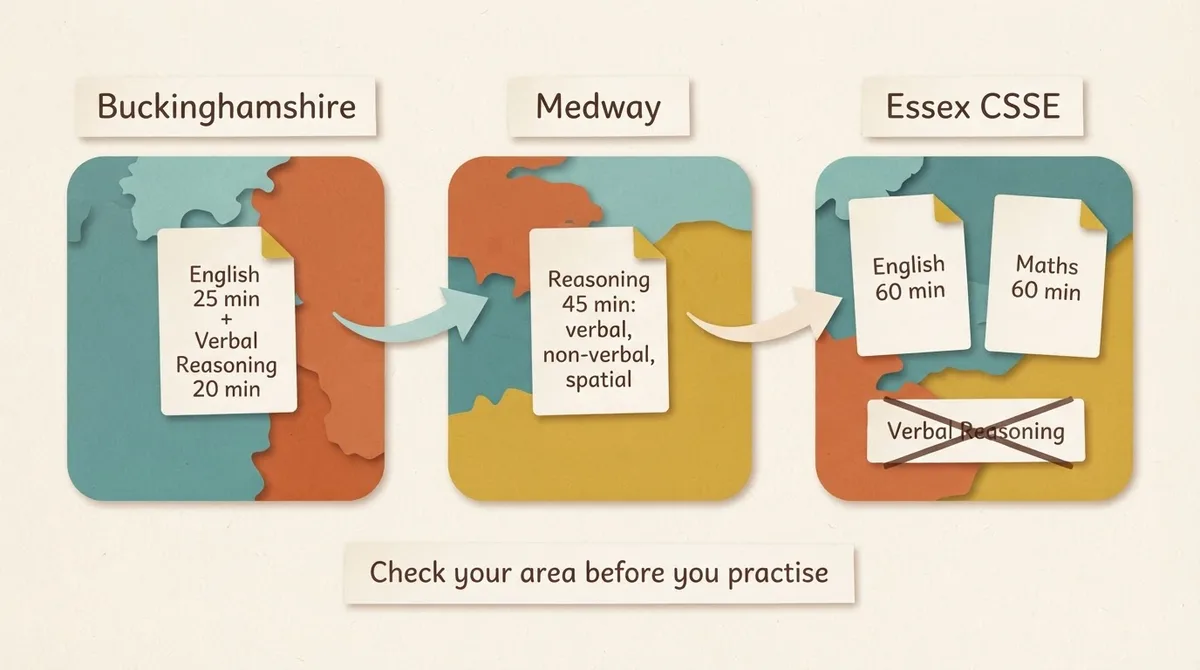
Before choosing practice material, check the target schools' current admissions page and note which papers are sat, how long they last and whether verbal reasoning is a separate or combined section. If it is not listed, follow the published requirements for that test. Our parent guide to the 11+ explains the wider application timeline.
Step 5. Read your results by question family, then practise the weak one
The test on this page reports an overall score and separate counts for the two types it covers: eight analogy and classification questions, and four letter, number and code questions. It does not include hidden-word questions, so practise those with the exercise in Step 1. The split can suggest which examples to review, but one short sitting is too small to establish a lasting weakness.
- Review the question types shown in the result. The counts describe this attempt and are too small to diagnose a lasting strength or weakness.
- Open any missed answers and read the short explanation. Notice which join, relationship or letter pattern the example uses.
- If useful, choose a few similar questions to practise. There is no fixed practice schedule established by this short set; use your child's needs and the local test guidance to decide what to do next.
- If you retake the widget, compare attempts cautiously. This public test does not save results or sync them to progress tracking. The same twelve questions recur, so a higher retake score may reflect familiarity with them.
- Then check pace. This practice test allows ten minutes for twelve questions; the timing of your local paper may differ.
Possible follow-up activities include reviewing unfamiliar words in context or practising letter patterns. Check whether your local paper provides an alphabet and what working materials are permitted. If your area assesses non-verbal reasoning, see our free non-verbal reasoning practice test and non-verbal reasoning question guide.
Verbal reasoning practice test: parents' questions answered
Is verbal reasoning in the 11+? Some local tests include it and others do not. Buckinghamshire includes a separately timed section; Medway includes it in a combined Reasoning paper. CSSE's published 2027-entry information lists English and Maths only, and says new 2028-entry information will be published later. Always check the current guidance for your cohort.
Is this the same as the verbal reasoning test used by employers? Formats vary. GOV.UK describes the Civil Service verbal test as a passage followed by True, False or Cannot Say statements. The 11+ examples in this guide use word and letter relationships. Check the format for the specific test you are preparing for.
Is it really free? Yes. The test, marking, question-family breakdown and short answer explanations are free to use.
What score should my child be getting? This twelve-question score cannot be converted into a local qualifying mark. For September 2027 entry, Buckinghamshire set a qualifying standardised score of 121 (current results guidance); other areas may use different criteria. Check the policy for the schools on your shortlist, then use this practice result only to review the question methods.
My child gets the answer but runs out of time. This short widget cannot explain why. The test's question count, timing, familiarity with the format and individual circumstances can all matter. Check your local test guidance and, if helpful, review which questions took the longest before choosing what to practise.
Topics
- verbal reasoning
- 11 plus
- practice test
- gl assessment
- answer explanations