


Free Non-Verbal Reasoning Practice Test with Instant Answers
Try a short online non-verbal reasoning practice set with instant marking and explanations. Review the question types covered, but do not treat its score as an 11+ result.
 Elspeth Marlow
- 8 min read

This is the 11+ version of the test, written for children in Year 5 and Year 6 preparing for grammar school or independent school entrance. If you have landed here looking for a graduate or job-application aptitude test, skip to the last section before the FAQs and we will point you somewhere more useful.
Many free non-verbal reasoning resources for UK parents are printable papers. They are useful for rehearsing a paper exam, but marking them and spotting patterns across question types takes time. This page gives you a short online practice option with immediate feedback.
The test below is different in three ways: you can start it in one click with no email address, it marks itself the moment you finish, and the result groups answers by the three question categories in this set. Use that small sample to decide which explanations to revisit, not as a diagnosis.
This part of the guide is a free timed practice test. It works in your browser.
Take the free non-verbal reasoning practice test
The set above is a free practice set, not a preview of a paid test. Press start and the ten-minute timer runs; your child works through the twelve questions on screen and picks an answer option for each one. When the time is up, or when they finish early, the result appears with a worked answer for every question.
No account, no card and nothing is saved by this public test. If you want to compare attempts, write down the score and the question-type breakdown before leaving the page.
Myth: a score out of twelve tells you where your child stands
Reality: the total describes only this short set. Two children can both score 8 out of 12 and need different practice. One child may miss some net questions; another may miss some transformation questions. A small set is too short for a firm diagnosis, but the question-type breakdown tells you what to review first.
The current set has six net-folding questions, four rotation or reflection questions, and two visual-analogy questions. It does not include matrices, series or odd-one-out questions. The set is short, and repeated attempts use the same questions. Start with the worked answers, especially for a type your child missed. Between two and six questions in a family cannot establish whether a child has mastered it. GL Assessment describes practice papers as a way to build a picture of strengths and weaknesses (GL Assessment 11+ FAQs); this one short sitting can only suggest what to explore next.
If an item type was unfamiliar, our guide to non-verbal reasoning question types shows how to solve it, so the next step is one click rather than a search.
How the test is timed and marked
The test runs against a visible countdown, because working at speed is a separate skill from working accurately. GL Assessment puts it plainly: "Tackling a practice paper under timed conditions gives children valuable experience of managing their time effectively."
Marking is automatic and immediate. Every question your child got wrong or skipped shows the correct option and why it is correct, so a wrong answer becomes a lesson rather than a red cross.
One caveat worth repeating: real 11+ papers vary by area. GL warns that "the exact timings for, and number of questions in, your local 11+ test may differ from those in our familiarisation and practice materials" (GL Assessment free materials). Treat this as a short practice set, not a replica of your county's paper or a standardised assessment.
Which question types the test covers
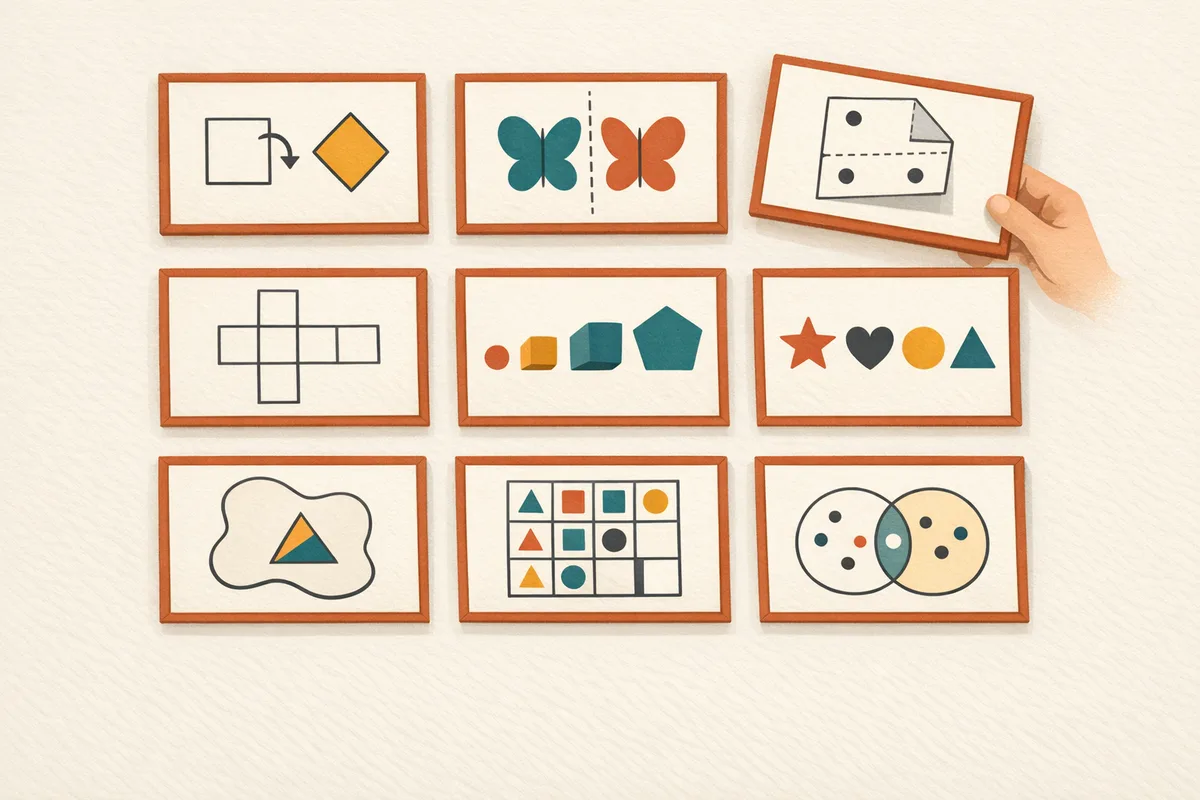
GL Assessment describes broad skills assessed in its non-verbal practice papers, including: "processing graphic information and following patterns and rules", "applying mathematical skills: rotation, reflection and symmetry", "use of spatial awareness", and "applying logical thinking and problem-solving skills" (GL non-verbal practice papers).
The exact item formats vary by test. Examples in familiarisation materials include sequences, classes, codes, hidden shapes and paper folding. Other providers and local tests may use different formats. This original set currently draws on nets and folded faces, rotation and reflection, and visual analogies. Our method guide for solving them walks through an original worked example for each family, including the ones this test does not cover.
Rehearse the paper version too
Myth: an online practice set reproduces every paper test. Reality: this set is online only. Some admissions tests use paper booklets and a separate answer sheet. Check the arrangements for your child’s test before practising its format.
This set cannot rehearse a paper answer sheet. Use it to discuss its sample questions, then use the target provider’s materials to learn the local format: our free 11+ practice papers collection covers non-verbal reasoning and the other subjects too.
What counts as a good non-verbal reasoning score
This set’s raw mark out of twelve is not an official result and cannot be converted into one. Boards may convert test marks into standardised scores; a Standard Age Score has an average of 100 and "takes into account the pupil's age in years and months" (GL Assessment guide to standardised tests). The process depends on the actual admissions test, not this practice set.
Buckinghamshire is a published example. Its Secondary Transfer Test Score combines 50% verbal skills, 25% mathematical skills and 25% non-verbal skills. A combined score of 121 or more qualifies a child for a Buckinghamshire grammar school, but the council says that score does not predict whether a place will be offered (Buckinghamshire Council). The non-verbal section contributes a quarter of that qualifying score; it is not a quarter of an offer decision. Thresholds and weightings differ elsewhere, so check your own authority's arrangements.
Where non-verbal reasoning appears in UK 11+ exams
Not every area tests it. Where it does appear, it is usually one component of a larger paper. The West Midlands Grammar Schools Entrance Test "contains four sections: English, Verbal Reasoning, Non-Verbal Reasoning and Mathematics", is multiple choice, and runs as two tests of around 60 minutes each (Warwickshire County Council). Buckinghamshire likewise sits two papers, each about 45 minutes (60 minutes including the introduction and examples), with a break between, measuring verbal, non-verbal and mathematical skills.
Our parent guide to the 11+ sets out how the regional formats differ before you commit to a revision plan.
How often should your child practise?
A short session is one option for practising a specific method. Choose a pace that suits your child and the target test. Use the three question-type scores and worked answers to choose the next topic, then return to a longer paper when they need to rehearse exam pace. This public test draws from the same small question bank on repeat attempts, so a rising score may reflect familiarity with its questions.
Taking a non-verbal reasoning test for a job instead?
If you are an adult preparing for a graduate scheme or a recruiter's abstract reasoning assessment, this is not the right test. Those use different item styles and different norms. Look for publisher-specific abstract or inductive reasoning practice from the assessment provider named in your invitation email.
Non-verbal reasoning test FAQs
Where can I find a free non-verbal reasoning test?
On this page, above: it is free, ungated and auto-marked. GL Assessment also publishes free familiarisation PDFs, but those need printing and hand marking.
Is non-verbal reasoning an IQ test?
No. This page offers a short set of practice questions, not an IQ measure or a validated diagnostic. GL describes 11+ non-verbal reasoning as problem solving using pictures and shapes (GL Assessment 11+ FAQs). Getting used to these question formats may help a child practise the method, but this score cannot measure intelligence or predict an admission result.
What is a good non-verbal reasoning score?
On the Standard Age Score scale described above, 100 is average. Buckinghamshire uses 121 as the threshold for its combined transfer score, not for the non-verbal section on its own. Neither number can be read from this twelve-question practice result. Check the scoring rules for your own target schools.
How can my child improve quickly?
Read the worked answers first, then practise one missed method at a time before returning to mixed papers. Follow the answer-sheet instructions in your local test; if there is no penalty for a wrong answer, use remaining time to answer any blanks.
Is this suitable for Year 4?
The test on this page starts a countdown, so it has no untimed mode. For a Year 4 child, use our question-type guide to talk through examples without a timer. Return to the test when timed practice is useful.
Topics
- non-verbal reasoning
- 11 plus
- practice test
- nvr
- free resources