

Lincolnshire Grammar Schools and the 11 Plus Entrance Test
Lincolnshire is not one selective system: most schools share one GL Assessment test route, while Caistor Grammar School runs its own. Here is who to register with, what is on each paper, and why qualifying is not the same as getting a place.
 Elspeth Marlow
- 15 min read
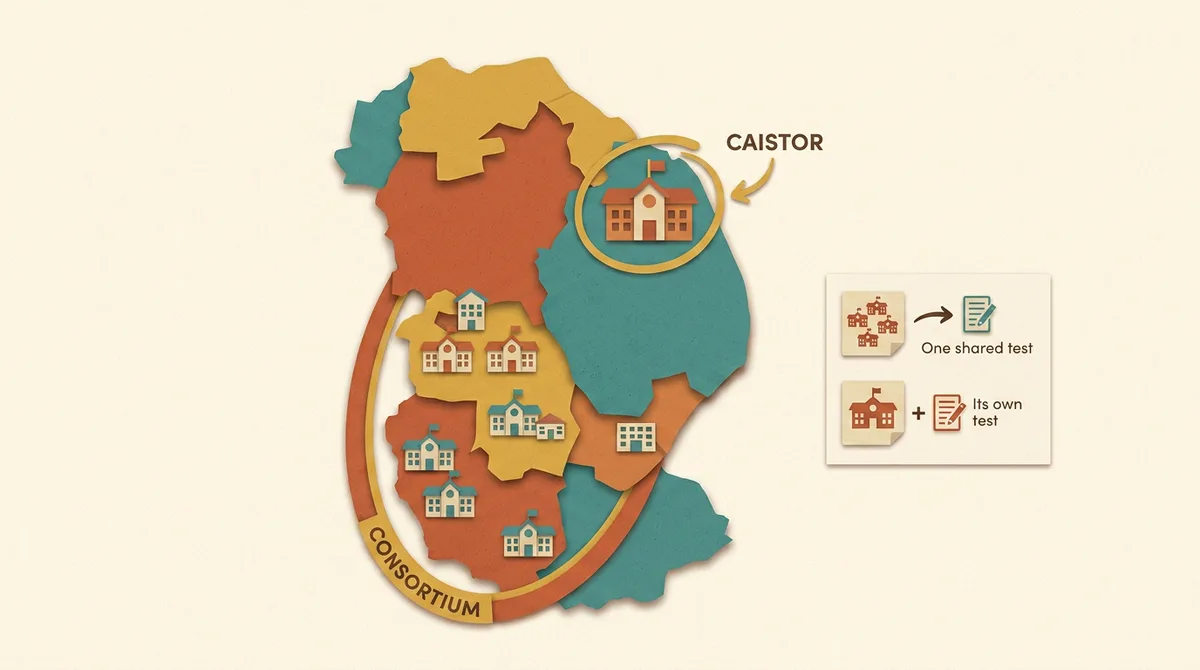
Lincolnshire has two 11+ routes to keep separate: most grammar schools share a consortium test, while Caistor Grammar School runs its own test and registration. Test registration and the later application for a school place are separate steps.
Most of Lincolnshire's selective schools belong to the Lincolnshire Consortium of Grammar Schools and use the same GL Assessment tests. A child sits the consortium test once; registered member schools receive results under their own standardisation and qualification rules. Caistor Grammar School sits outside that arrangement. It runs a separate assessment with two Verbal Reasoning papers, its own test dates and a separate registration timetable. A family applying to Caistor and a consortium school needs to follow both registration routes and sit both tests.
The second error is procedural. For a consortium test sitting, register through a member school; Caistor takes its own registrations. The county council handles the later application for a school place, not the test booking. The King's School makes the two procedures explicit. Completing only the council's autumn school application will not enter a child for an earlier 11+ sitting. This article separates test registration, sitting the right test and applying for a place.
Applying for September 2027 entry now? Kesteven and Grantham Girls' School scheduled its consortium result email for 9 October 2026, and Caistor scheduled its separate result for 13 October. Read the message from the school that administered your child's test and check whether the result meets each school on your shortlist's rules. Then name the schools you genuinely prefer on your home council's secondary application. Lincolnshire County Council gives 31 October 2026 as its on-time deadline. Its 12 noon, 14 December final date is for late applications and changes, and it warns that a school outside Lincolnshire may not accept a late preference. A qualifying result is not a school offer.
Preparing for September 2028 entry? Bourne Grammar School says its registration for current Year 5 pupils opens in January 2027. It has not yet given test dates on that page. Check the member school where your child would sit the shared test and Caistor's separate admissions page as each publishes its 2028-entry calendar. The 2026 dates below describe the previous cycle.
How many grammar schools are there in Lincolnshire?
The consortium's current school map lists 15 selective schools, as does our Lincolnshire school directory. Our directory groups 14 under the shared test route, including Boston Grammar on the contextual evidence explained below, and Caistor Grammar School separately. Caistor publishes its own tests and registration. Older official material can give a different count: King Edward VI Grammar School's FAQ still includes the former selective school at Spilsby, which the current consortium map no longer lists. The map is a list of selective schools, rather than an explicitly labelled membership roster, so confirm the shared-test arrangement with each school on your shortlist.
The practical point is the split: consortium schools share a test route, while Caistor has a separate one. Check the admissions information for every school on your shortlist, including how results are used and how places are allocated. Our guide to finding grammar schools near you covers catchment, travel time and shortlisting.
Which schools use which test, and who do you register with?
Here is the practical breakdown. Use the registration instructions for the school administering each test.
Consortium schools (one shared GL Assessment test route). These include Bourne Grammar School, The King's School, Grantham and Spalding Grammar School, alongside the other schools in the consortium directory. For confirmed member schools:
- The test is the shared Lincolnshire Consortium GL Assessment paper set.
- Sit the shared test once. Ask the administering school how results reach each school you are considering; each school applies its own standardisation and qualification rules.
- Register for the sitting through a member school, following that school's instructions. Kesteven and Grantham Girls' School opened its main 2027-entry window on 7 January 2026 and closed it on 31 March, then reopened for late registration on 1 May. The King's School gave 17 July as its late-registration close and advised families to contact the school after that date. Do not assume every member school has the same late window.
- Ask the administering school where your child will sit, as primary-school and member-school arrangements differ.
Boston Grammar School: confirm the shared-test arrangement directly. We include Boston in the shared route as an inference from its current 11+ instructions: school registration, two September reasoning papers, primary-school or Saturday school sittings, and references to LCGS familiarisation. These match the consortium’s published arrangements. The school does not explicitly name its own test as LCGS on that page, and its linked 2027 policy could not be retrieved during this review. Ask the school to confirm before relying on result sharing or registration arrangements.
Caistor Grammar School’s separate test (its own registration). Caistor requires registration directly with the school rather than with the local authority at that stage. For September 2027 entry the school's published registration deadline is 14 August 2026, with the two papers sat on 19 September 2026 and 26 September 2026 and results notified on 13 October 2026 (caistorgrammar.com). A consortium score does not transfer to Caistor, and a Caistor score does not transfer to the consortium.
If you want both, follow a consortium member school's registration process and Caistor's separate process. Your child must sit both test routes. Check the exact dates for the entry year before planning around the September weekends.
Admissions arrangements and timetables can change between entry years. Always confirm on the school's own admissions page or the consortium's 11 plus pages before you rely on a date.
The lookup below shows the shared-test route and school links. Confirm the registration and late-testing instructions with the school administering your child's sitting. Caistor is separate, so check its own page as well.
This part of the guide looks up which 11+ test your area uses. It works in your browser.
What is actually on the papers?
Lincolnshire’s two routes have different paper formats.
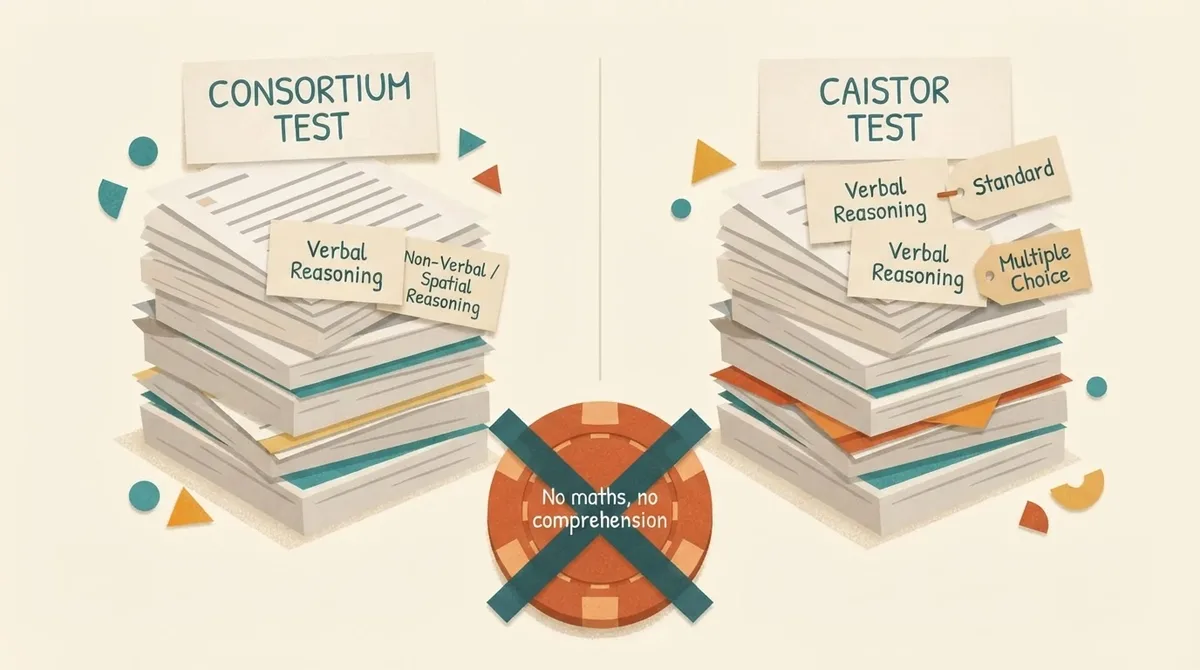
The consortium test is reasoning only. The current 2027-entry route describes two GL Assessment papers: Verbal Reasoning, then Non-Verbal Reasoning and Spatial Awareness. Boston Grammar School's current 11+ information also describes Verbal Reasoning and Non-Verbal Reasoning papers. There is no separate maths or English-comprehension paper in the shared route. Use the school's familiarisation material for the format. Our breakdown of non-verbal reasoning format, timing and marks covers the question types that come up.
The Caistor test is two Verbal Reasoning papers: a Standard paper, then a Multiple Choice paper, sat a week apart. For a Caistor-only family, that means preparation is almost entirely verbal: vocabulary, word codes, letter sequences, logic puzzles and the timing discipline to keep pace across a long paper.
The test content differs by route. Check the familiarisation material for the test your child will sit and use it to choose relevant practice. Do not assume that a generic four-subject list describes either Lincolnshire test.
Does a score of 220 get my child a place?
No, and this is the correction most likely to change what a Lincolnshire family does next.
Caistor states that a total standardised score of 220 or more makes a candidate eligible for entry, with the school aiming at the upper 25 per cent of the ability range. Several consortium schools use 220 as a qualifying score, but the rule is not universal: Boston Grammar School uses a rank-based selection rule. Qualification is not an offer of a place. Check each school's current policy.
What happens above the threshold varies by school:
- Some schools treat 220 as a gate and then admit qualified applicants in the order set by their oversubscription criteria.
- Boston Grammar School publishes no fixed qualifying score at all. It aims to take the top 25 per cent of each cohort and selects on rank order of relative performance, with a Published Admission Number of 120 pupils per Year 7 intake.
- Carre's Grammar School uses the shared consortium test and its agreed minimum standard; its Year 7 policy does not set a fixed 220 score or a top-25-per-cent threshold. The policy's top-25-per-cent CAT4 assessment is for in-year admissions, not Year 7 entry.
So there are really two hurdles. First, qualify. Second, compete: if more qualified children name the school than it has places, the school's own oversubscription criteria decide. Boston Grammar's order, after qualifying children whose EHCP names the school, is looked-after and previously looked-after children, Pupil Premium children, siblings of current pupils, then straight-line distance. An independent lottery resolves a remaining tie for the final place.
That lottery draw is worth sitting with. A family 200 metres outside the effective distance cut-off in one year may be inside it the next, because the cut-off is a consequence of who applied, not a published boundary. Caistor defines in-catchment status as living within 6.5 miles "as the crow flies" of the school as at 1 September 2026. Being in catchment does not guarantee a place. If you want the wider picture on how thresholds are built, how standardised scores and age weighting work explains why a raw mark and a reported score are not the same thing.
Registering for the test is not applying for a place
Lincolnshire County Council is explicit about this. Even if a child achieves the required standard in the 11+, the council states they will not automatically be offered a place: applicants must still list the grammar school on their application, after which selection follows the school's own oversubscription criteria. The council also confirms that individual grammar schools set their own admissions policies, and directs parents to the school or the consortium website for testing details (lincolnshire.gov.uk).
That gives you three separate acts with three different owners:
- Register for the test. Owner: the member school where your child will sit the shared test, or Caistor for its separate papers. The main window at King's and Kesteven and Grantham Girls' closed on 31 March 2026 for September 2027 entry, but those schools published later registration arrangements; Caistor's deadline was 14 August. Check the chosen school's rules rather than treating 31 March as the only possible close. Failure mode: your child does not get a main test sitting or receives a delayed result.
- Sit the test. Owner: the school or your child's primary. Timing: September of Year 6. Failure mode: a clash between the Caistor dates and a consortium date you did not diary.
- Apply for a school place. Owner: your home local authority, on the Common Application Form. For a Lincolnshire resident applying for September 2027 entry, use the 31 October 2026 national deadline. The council's 14 December final date is for late applications and changes, and an out-of-county school may not accept them. Failure mode: qualifying brilliantly and then never naming the school, so you cannot be offered it.
Caistor's own page sets these side by side: the school's registration deadline of 14 August 2026, then the local authority preference form deadline of 31 October 2026, then national offer day on 1 March 2027. Lincolnshire County Council also gives 31 October as the national closing date; its 14 December date is the final cutoff for late applications and changes, not an alternative deadline to plan around. Our general walkthrough of how to register for the 11 plus covers what a registration form typically asks for.
What does the Lincolnshire timeline look like in practice?
Use the 2027-entry cycle below to see the order of events. For a child currently in Year 5, replace every date with the school's published 2028-entry calendar:
- Spring of Year 5: shortlist schools. Decide whether Caistor is in or out, because it has separate registration and test dates.
- Late spring to summer: open evenings. Check each school's admissions page for its current registration method and open-evening arrangements.
- Spring of Year 5: King's and Kesteven and Grantham Girls' main 2027-entry registration windows closed on 31 March 2026, and each school published a later registration route. Caistor's separate deadline was 14 August. For a later entry year, check the school administering each test before the spring term ends.
- September of Year 6: tests. Boston Grammar's 2027-entry papers were scheduled in September; check the school's own timetable and sitting arrangements for each cycle. Caistor's fell on two September Saturdays in the published cycle above.
- October: results. Lincolnshire County Council confirms grammar school entrance tests take place in September with results posted before 31 October, so you know your child's outcome before you finalise preferences.
- Autumn: submit the Common Application Form to your home local authority by its national deadline. For Lincolnshire residents applying for September 2027 entry, that is 31 October 2026.
- 1 March: national offer day.
- Spring: appeals, if needed.
The published timetable places test results before the on-time school application deadline. Use it to decide which schools to include and to make sure you name realistic alternatives. Lincolnshire's preference guidance says schools do not see where you rank them; the council uses your order only if more than one can offer a place. Keep the schools in your genuine preference order.
What if we live outside Lincolnshire?
Families living outside Lincolnshire can apply, subject to each school's admissions arrangements.
- Ask where to sit. Living outside the county does not by itself exclude an applicant, but test arrangements differ. Contact the school administering the test about arrangements for children whose primary school is outside Lincolnshire.
- You register for the test with the school administering it. Ask that school about arrangements for a child attending a primary school outside Lincolnshire. Your home authority does not register your child for a Lincolnshire 11+ sitting.
- You apply through your home local authority. This is the part that trips people up. If you live in Nottinghamshire, you name the Lincolnshire school on the Nottinghamshire Common Application Form, on Nottinghamshire's deadline. Your home authority passes the preference to Lincolnshire. Caistor confirms that out-of-county applicants apply through standard local authority procedures.
- Check each school's oversubscription rules. Some use defined catchments or distance; others use different criteria. Caistor's 2027-entry policy defines a 6.5-mile catchment. Do not assume that one school's rules apply across the county.
What if my child does not qualify?
A child who does not meet a grammar school's required standard cannot normally receive an offer through the main allocation. That makes your other preferences on the application form especially important. Name a non-selective school you would genuinely be happy with, while checking the target school's published review or appeal process if you have evidence that the assessment does not reflect your child's ability.
If you are refused a place at a school you named, you have a statutory right of appeal to an independent panel. The national timescales set out on gov.uk are worth knowing before school offers arrive:
- You must be given at least 20 school days from the decision letter to submit your appeal.
- You must be given at least 10 school days' notice of the hearing.
- Appeals must be heard within 40 school days of the appeal deadline.
- A decision usually follows within 5 school days.
- The panel has three or more independent people (gov.uk).
Be clear-eyed about what an appeal can achieve. Where a child has not met the qualifying standard, an appeal generally has to argue that the child is nonetheless of the required academic ability, which is a high bar and needs evidence: school assessment data, a headteacher's supporting statement, or documented circumstances on the test day such as illness. For a qualified child refused a place, the panel considers whether the admission arrangements were lawful and correctly applied. It also weighs the family’s reasons for admission against the school’s case that admitting another child would cause prejudice. A distance refusal is not limited to an argument that the distance was measured wrongly. Our guide to reading the results letter and weighing your options goes into how to decide whether to appeal at all.
How should we prepare for the Lincolnshire papers?
Because the paper mix is narrow, preparation here is more targeted than in counties that test four subjects.
- Decide the school list first. Consortium-only means verbal plus non-verbal and spatial reasoning. Caistor-only means verbal reasoning, twice. Both means both, and a heavier September.
- Match the practice to the papers. The consortium has a verbal paper and a non-verbal and spatial paper. Caistor uses two verbal papers. Use the free familiarisation material linked by Kesteven and Grantham Girls' School to see the shared test's multiple-choice format.
- Use timed practice to become familiar with the format. The consortium and Caistor schedules put papers on separate dates. Follow each school's instructions and avoid treating practice results as predictions of an admissions outcome.
- Review errors by question type where your materials provide that information. A total score alone does not explain which practice topics need attention.
Smart Cub Learning's timed paper tests provide practice with timed questions and question-type feedback. They are practice materials, not official Lincolnshire tests or a prediction of qualification.
For a future entry year, start with the calendar. Record the registration instructions for the school administering each test and check them again when that school publishes its new cycle. If you already have a 2027-entry result, submit your home council's school application by its deadline.
Topics
- lincolnshire
- 11 plus
- grammar schools
- admissions
- gl assessment