


Is My Child Suited to the 11 Plus? Readiness Signs by Year Group
Use observations, teacher discussion and the local test format to consider preparation. These prompts do not predict a qualifying score or a school place.
 Elspeth Marlow
- 14 min read
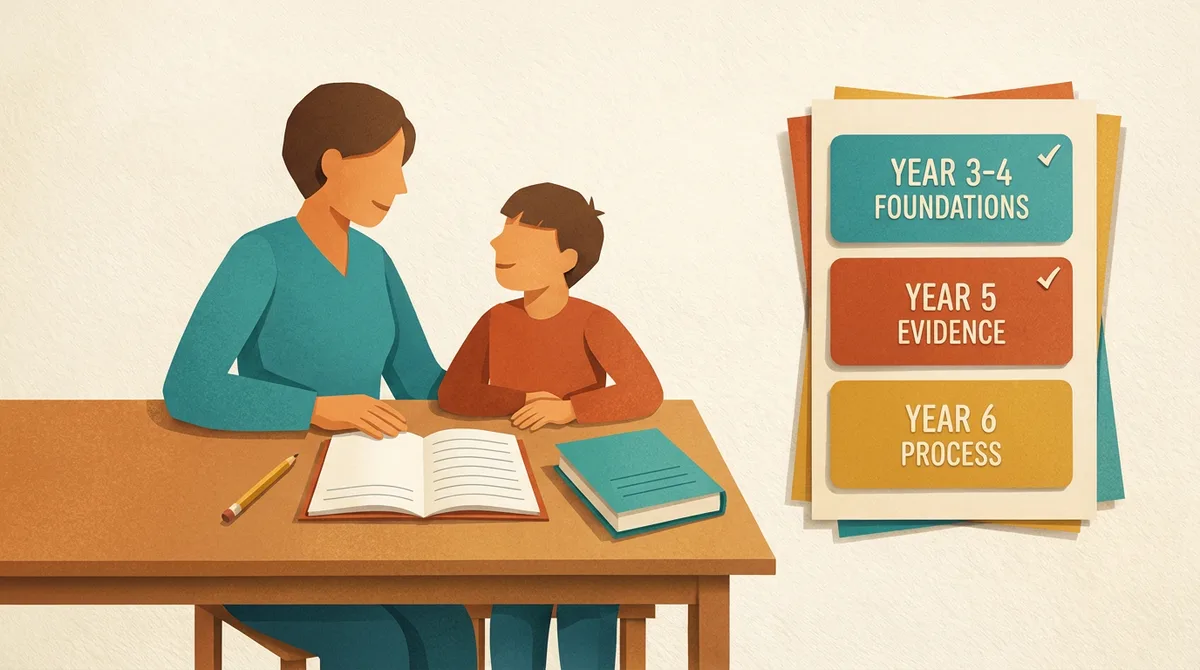
Most parents arrive at this question in the form "is my child clever enough for the 11 plus?" It feels like the honest version of the worry, but it is unanswerable. There is no measurement of cleverness you can take at home, no school report line that converts into a selection outcome, and no reputable source that will tell you a nine-year-old is or is not the right kind of child.
A more useful question is: what can I observe about my child now, and what does the local test specification tell me to consider? Suitability is not a fixed property of a child. It depends on the child, the particular test and the family's school choices. Published test formats and admissions rules can help you understand that context, but they cannot predict an individual result.
This guide explains how test formats and age-standardised scoring work, offers reflection prompts for different year groups, and suggests ways to gather context without treating practice as a prediction. Check your own area's current specification and admissions arrangements. No checklist or practice result can tell you whether a child will qualify or receive an offer.
Why is "is my child clever enough?" the wrong question?
Because it asks about a trait, while selection tests assess responses to particular questions under test conditions. The tests and ways of interpreting results differ by area.
Treating the 11 plus as an aptitude scan can lead families to assume that confident readers need no familiarisation, or to rule out a quieter child before checking whether the local test includes the question types that concern them.
The reframe is simple. Replace "is my child clever enough" with three checkable questions:
- What does my area's test contain, and what content limit does the test provider publish?
- What can my child currently do, unprompted, that maps onto that content?
- What proportion of children who sit that test reach the published standard, and would we be happy with the outcome if we were outside it?
What does the 11 plus actually test?
The honest answer is: it depends where you live, and the differences are large enough to change the decision. Three examples make the point.
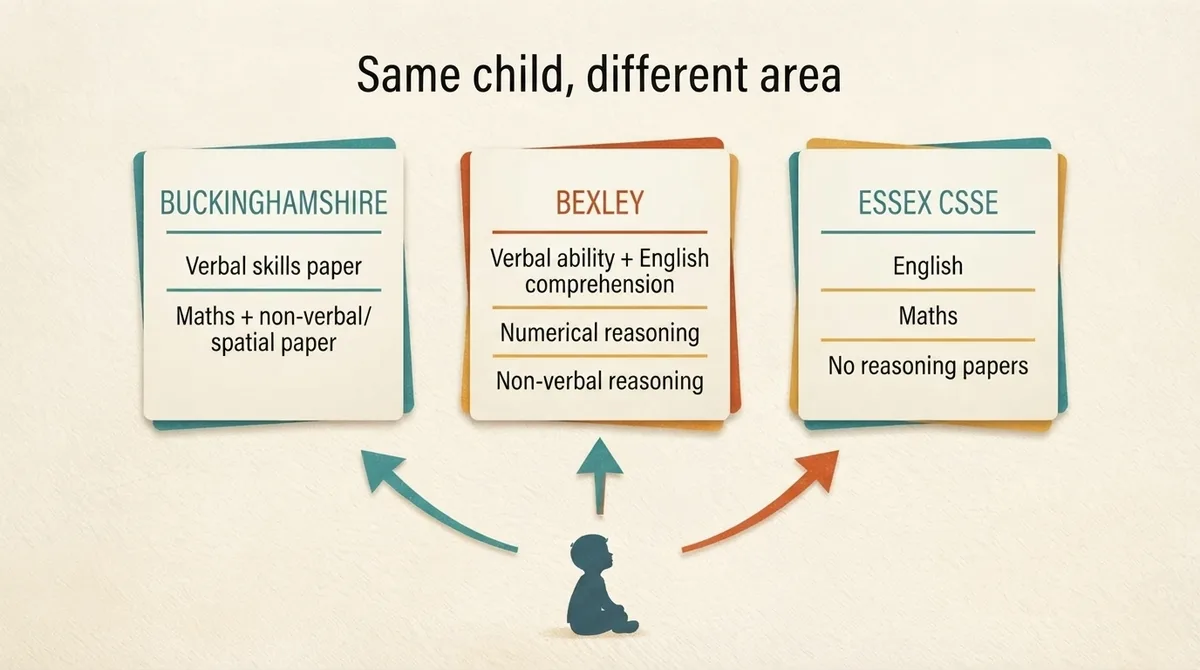
In Buckinghamshire, the Secondary Transfer Test is two papers. One "tests verbal skills including comprehension, technical English and verbal reasoning", the other "tests mathematics and non-verbal skills including spatial reasoning", and "each paper is about 45 minutes long (60 minutes including the introduction and examples)", per Buckinghamshire Council's testing process page.
In Bexley, the Selection Test "assesses verbal ability and English comprehension, numerical reasoning, and non-verbal reasoning", and the council publishes a content ceiling: the numerical reasoning content covers material "not exceeding what children are expected to learn by the end of Year 5" (Bexley Council, about the test).
In Essex, candidates "sit two tests. One in English and one in Mathematics", and there are no standalone verbal or non-verbal reasoning papers at all (CSSE).
So a child with strong comprehension and weak non-verbal reasoning is a different test-preparation situation in Colchester than in Aylesbury. Before you assess your child, read your own area's specification. Our guides to what grammar schools select for and to the GL, CEM and ISEB formats set out how tests, scores and admission rules interact.
One more thing worth saying plainly: reasoning papers are learnable formats, not innate gifts. GL Assessment publishes free familiarisation materials covering verbal reasoning, non-verbal reasoning, English and maths, and states they are "particularly useful for verbal reasoning and non-verbal reasoning tests as children may not have encountered these types of questions before". Difficulty with a question type a child has not encountered may reflect unfamiliarity; one example cannot establish a fixed ability or future outcome.
Does a summer birthday count against my child?
No, and this is the single most common specific worry that the official documents already answer. GL Assessment defines a Standard Age Score as one that "converts a pupil's raw score to a standardised score which takes into account the pupil's age in years and months", with an average of 100, and calls it "the fairest way to compare performance of different pupils within a year group" (GL Assessment, a guide to standardised tests). Buckinghamshire says the same in admissions language: standardisation "takes into account each child's age in years and months on the date they take the test".
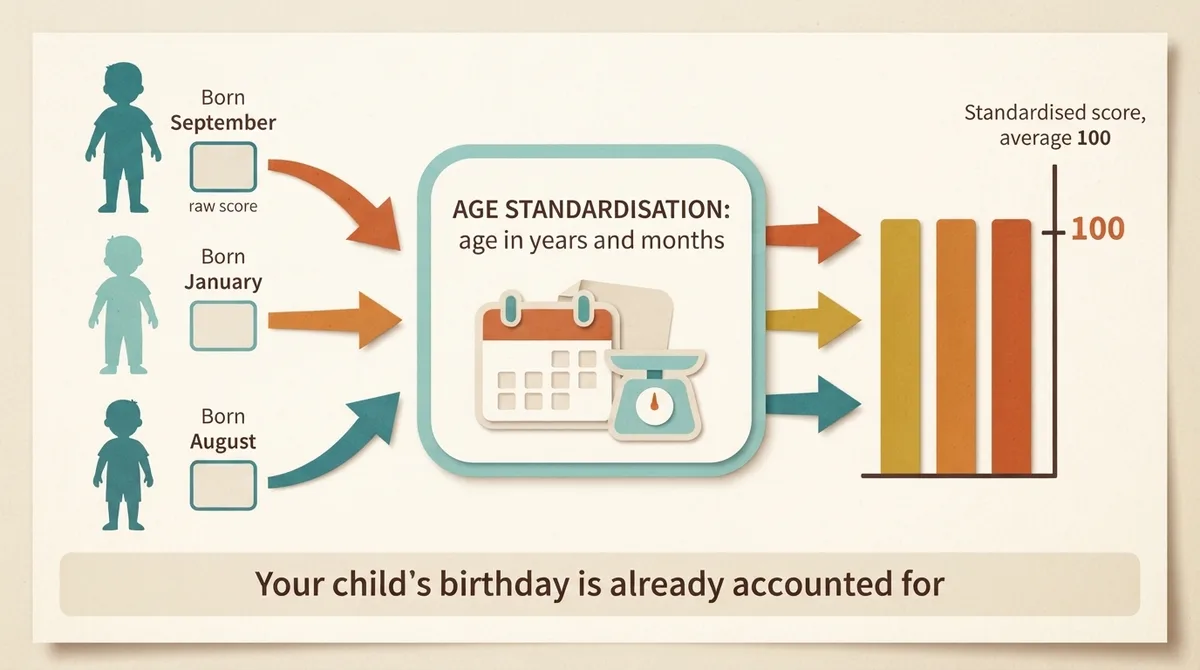
Age standardisation adjusts the score for age in years and months. It does not remove every difference in experience, development or test-day performance, and it cannot guarantee the same outcome for children born in different months. The mechanics are in how standardised scores and age weighting work.
What are the readiness signs in Years 3 and 4?
In Years 3 and 4, broad foundations may be more useful to discuss than a practice-paper score. Bexley says its numerical reasoning content does not exceed what pupils are expected to learn by the end of Year 5; a Year 3 score may therefore reflect topics not yet taught as well as unfamiliar formats. Check the content limits for your own test.
What to look for, as behaviour you can observe this week:
- Reading stamina and enjoyment. Can they enjoy a book or story for a period that suits them? Do they choose to reread? If they tire quickly, that may be a reading habit to support; it does not determine whether they are suited to a later test.
- Secure number facts. Notice which number facts they recall easily and which they work out. These are useful topics to practise alongside their school learning.
- Curiosity about patterns. Interest in puzzles, sequences, codes, spot-the-difference, Sudoku, anything with a rule to find. These activities can be enjoyable, but they are not a measure of non-verbal reasoning readiness.
- How they feel when an answer is marked wrong, and whether the task remains comfortable.
These observations are prompts for a conversation, not a prediction or readiness threshold. The statutory primary national curriculum sets out what is taught in key stages 1 and 2; compare your child's learning with their current school work rather than assuming a particular performance signals 11+ readiness. Our Year 4 preparation guide covers what actually matters at this age, and when to start 11 plus preparation sets out the sensible runway.
What are the readiness signs in Year 5?
In Year 5, you may have more of the relevant school content to compare with the published test specification. The timing and content differ by area, so these are discussion prompts rather than benchmarks:
- Which maths or English topics currently feel secure, and which would benefit from more teaching or practice?
- How does your child respond to a short, manageable task they did not choose?
- Recovers from being wrong. A child who scores 6/20 on their first non-verbal reasoning set and says "show me how that one worked" offers a useful observation about how they respond to feedback. A single score does not compare their readiness with another child.
- Reads a text once and can say what it was about, rather than rereading four times to answer a single question.
- Handles multi-step instructions in one go.
If you choose to practise, familiarisation material can help your child understand the format. A practice response still cannot distinguish a knowledge gap from unfamiliarity, tiredness or other factors on its own. See 11 plus preparation in Year 5 for the term-by-term shape.
What are the readiness signs in Year 6?
By Year 6, check the actual test date, content and instructions. Depending on the area and the child, preparation may involve revisiting curriculum topics, learning question formats or understanding answer-sheet procedures.
- Timed working. If the test allows pupils to return to earlier questions, can they use that option? Follow the actual test instructions.
- Answer-sheet transfer. If the local test uses a separate answer sheet, find out how answers are transferred and practise that process if appropriate.
- Recovery after a bad mock. You might notice how your child feels after a difficult practice session and whether the amount of preparation remains manageable.
- Whether the test allows time to review answers; follow its instructions.
Buckinghamshire's process helps here: children first sit a Practice Test that "looks the same as the Secondary Transfer Test and has the same instructions" (testing process page). If your area offers an equivalent, treat it as the process rehearsal it is.
How do I gather real evidence, and what do parents over-weight?
Collect three things: a per-skill snapshot across the subjects your area actually tests, a trend over time, and your child's own view.
A free diagnostic may give you one practice snapshot across English, maths, verbal reasoning and non-verbal reasoning. It cannot tell you why a response was difficult or predict an admissions result. Use it, if helpful, as one prompt for deciding what to revisit, alongside school feedback and your child's own view. Repeated results provide more context than one sitting, but they are still practice data, not a qualification forecast.
Signs parents systematically over-weight:
- A single practice paper percentage. Papers vary wildly in difficulty and none is standardised against the actual cohort.
- Reading age. Useful, but it does not predict performance on timed numerical reasoning.
- Classroom "top table" status. It is relative to one class in one school, not to everyone sitting your area's test.
- Neatness and compliance. These read as academic promise and are not.
- A tutor's confident forecast. Nobody sees the cohort in advance.
Other useful context includes how your child responds to a difficult task, whether preparation feels manageable and whether they want to take part. A common parental fear is not failure but a child who scrapes in and then sits unhappily at the bottom of a fast-moving class. That is a legitimate thing to weigh, and the honest test is whether the current preparation intensity is sustainable, or whether it is already at maximum with a year to go.
Why can the same child be "suited" in one area and not another?
Because the published proportions and the paper formats both differ, and neither is a national constant.
Buckinghamshire publishes a threshold and an expectation: "If your child's STTS is 121 or above, they qualify for grammar school", and "we expect that about 37% of children will get an STTS of 121 or more". Each paper is standardised to a score "between 60 and 170" and the two are added to give the Secondary Transfer Test Score (marking the Secondary Transfer Test).
Bexley describes its test as "highly competitive, with approximately 30% of applicants being deemed selective", and gives the raw numbers for one year: "in 2025, a total of 5,866 children sat the test, and 2,070 achieved the selective standard", which is about 35% of that cohort. There is no fixed published pass mark; candidates are ranked by total age-standardised score and "the Council, in conjunction with the four Grammar Schools, determines the selective score" each year (Bexley Council).
Those figures are not directly comparable (different cohorts, different self-selection into sitting), but they make the point: the denominator is local, the content is local, and so is suitability. For how competition and difficulty actually feel in practice, see is the 11 plus hard.
What does "not yet" look like, and what are the honest alternatives?
Separate two very different situations.
Gaps that close with time. A Year 4 child who has never met a non-verbal reasoning question; a Year 5 child with a specific unclosed topic such as fractions; a child whose working speed is slow but whose accuracy is high. These are teachable with a normal amount of work over a normal timeline.
A genuine mismatch. Preparation that is already at its ceiling and still not moving; distress that persists across months rather than around a single bad session; a child who, asked directly and given permission to say no, does not want it. Pushing here is unlikely to be kind to the child, and a place won at that cost is worth questioning.
If the answer is not the 11 plus, the alternatives are real, not consolation prizes. gov.uk's guide to types of school lists grammar schools as one type among community schools, academies, free schools and foundation or voluntary schools, and notes that grammars "select their pupils based on academic ability and there is a test to get in". Compare the available schools' curriculum, support, journey and admissions arrangements with your child's needs and your family's preferences. The right choice is specific to each child.
Other routes worth knowing:
- 12+ and 13+ entry. Some grammar and independent schools admit at later ages into spare places. See 12 plus and 13 plus entry explained.
- ISEB Common Pre-Tests. These assess "mathematics, English (reading comprehension and grammar), verbal reasoning and non-verbal reasoning" as four adaptive online assessments, are age-standardised against a sample of independent-school applicants, and are used for Year 7 entry "or for deferred entry into Year 9" (ISEB). Our ISEB guide explains the format. A child who is not ready at ten may be a strong candidate at twelve.
What if my child narrowly misses?
Some areas run a formal review for children below the standard. Buckinghamshire's Selection Review is "your opportunity to explain, in writing, why you think your child would be best suited to a grammar school" for a child who did not reach 121, and a successful review gives the child the same status "as if they had scored 121 or higher" (Buckinghamshire Selection Review). Other areas may offer different review or appeal routes; check your own authority's current admissions guidance and deadlines. The review routes, the statutory appeal timeline and what evidence actually helps are covered in results day and appeals and, for Buckinghamshire specifically, in our Buckinghamshire 11 plus guide.
A ten-point readiness checklist
Score each statement 0 (no), 1 (partly) or 2 (yes), based on what you have observed in the last month, not on hopes.
- I have read my area's official test specification and know which papers my child will sit.
- My child has reading habits that suit them and their current age.
- Number facts are recalled, not reconstructed.
- My child can manage an age-appropriate practice task with support if needed.
- My child asks how a wrong answer worked rather than shutting down.
- We know which test subjects and formats our area uses.
- There is a realistic runway of time before the test date.
- My child, asked without pressure, says they want to try.
- We have a school we would be genuinely happy with if this does not work out.
- The preparation we are doing now is sustainable for the whole runway.
This checklist is a conversation-starter, not a predictor, assessment or pass score. A low response may point to a topic or practical question worth discussing, but there is no score threshold and no item determines whether a child should sit a test. You can skip any prompt that is not relevant to your child's age or local test. When you are ready to turn the answers into a schedule, our year-by-year 11 plus preparation plan is the next step.
Common questions
How do I know if my child should sit the 11 plus?
Check three things: your area's published test content, what your child can currently do against that content, and whether the family has a school you would be content with if the outcome is no. Those questions can help structure a family discussion. Sitting a test can involve time, pressure and a consequential school choice, so consider your child's wishes and the available alternatives before deciding.
Does practising reasoning papers actually help, or is it innate?
GL Assessment's own position is that familiarisation matters most for verbal and non-verbal reasoning precisely because children may never have seen those question types. Familiarisation can show a child what a question format looks like. That is different from predicting a score or a place, which depends on the test, the cohort and the admissions rules.
Topics
- 11 plus readiness
- year 4
- year 5
- year 6
- grammar schools
- choosing schools