


11 Plus Preparation in Year 5
Plan 11 plus preparation in Year 5 around your chosen schools, registration windows and test dates. Use a manageable study plan and review it as your child learns.
 Elspeth Marlow
- 11 min read
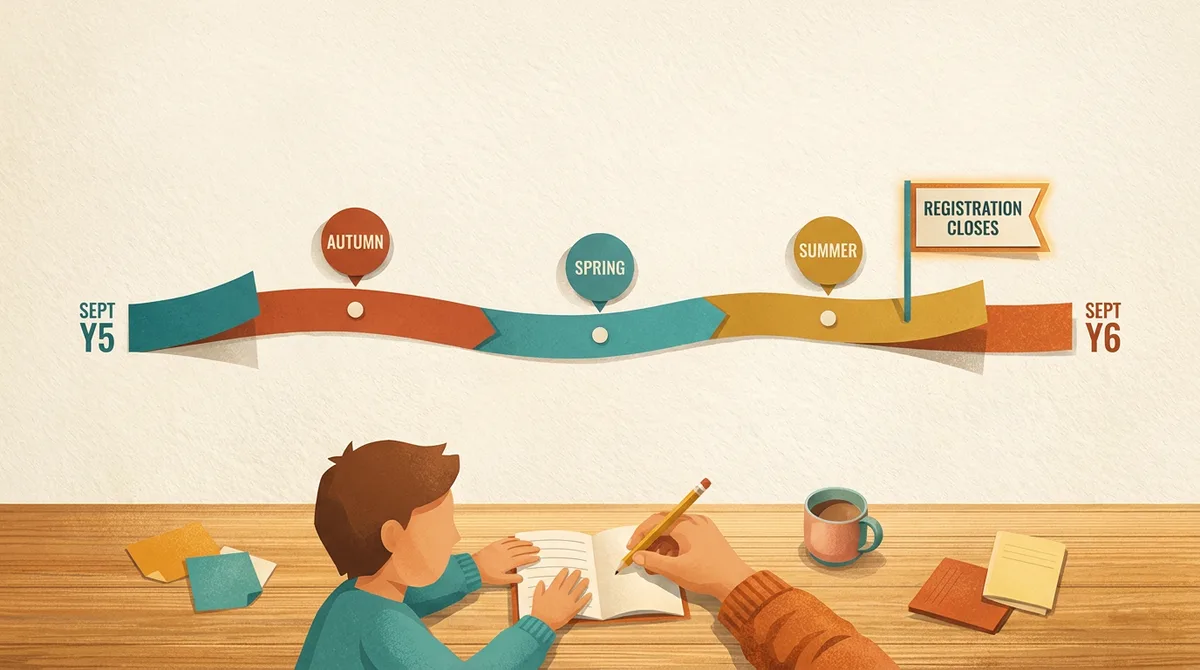
If your child is in Year 5 in autumn 2026, you are usually planning for Year 7 entry in September 2028. Start with the schools you may apply to, their test registration dates and your home council's secondary application timetable. Some test registration windows close during Year 5; others stay open longer. Put each official deadline in your calendar, including any separate access-arrangements deadline.
Many selective tests take place around the start of Year 6, but the timetable varies. Gloucestershire's grammar schools are planning a 3 July 2027 test for September 2028 entry, at the end of Year 5. The home-council secondary school form is a separate step. Work backwards from the dates for your chosen schools and council.
The 2027-entry dates below are examples from the previous Year 5 cohort. They are not the deadlines for a child currently in Year 5. Check the 2028-entry information as each school publishes it, especially where a July 2027 test brings preparation forward.
Why Year 5 matters
Some children take a selection test before Year 6 starts; many others sit it during Year 6. Year 5 can give families time to learn the format and practise gradually, but the dates for a particular school may mean registration or testing comes earlier.
For a child currently in Year 5, the Department for Education's published dates put key stage 2 tests on 8 to 11 May 2028, in Year 6. They fall after the Gloucestershire July 2027 test and after many autumn 2027 tests. Schoolwork still matters throughout the year; there is no need to treat either assessment as a reason for excessive practice.
Keep two simple lists: the admissions tasks with dates, and the skills your child is learning. Review both once a term.
Decision one: find your exam before you buy a single workbook
Before choosing materials, establish four things about your target schools: who runs the test, what the papers contain, when registration opens and closes, and whether your child is registered automatically or by you.
That last point catches families out. In Buckinghamshire, the council states plainly that you do not need to register your child if they attend a state-funded primary school in Buckinghamshire, because those pupils are registered for you. Parents of children at partner schools, or at any school outside the county including Milton Keynes, must register manually, and late registration will not normally be accepted without exceptional reasons. Two families in the same street can therefore have completely different obligations.
Three worked examples show why you must check your own route:
- Buckinghamshire. For 2027 entry, Secondary Transfer Test registration opened at 10am on 1 May 2026 and closed at 3pm on 2 June 2026. The Practice Test was 8 September 2026, the real test 10 September 2026, and results were released on 9 October 2026. The registration window for this previous cohort fell within Year 5.
- Gloucestershire. For 2028 entry, the grammar schools' planned test registration window runs from noon on 8 February 2027 to noon on 19 March 2027. The schools are planning a 3 July 2027 test, during Year 5 for the current cohort, with Future Stories Community Enterprise as the provider. Confirm the final arrangements with a school before using any provider-specific practice material.
- CSSE in Essex. Its 2027-entry guide describes a 19 September 2026 test. Use this as an example of a September route, then check CSSE's 2028-entry guide when available.
After the test, check when and how results are sent, then submit the separate secondary school application to your home council by its deadline. For 2027 entry, Kent residents have until 2 November 2026, while other councils publish different local instructions. National Offer Day is normally 1 March, or the next working day when that date is not a working day. Confirm the dates for your child's entry year.
Put the actual opening and closing dates in your calendar as soon as the school or test consortium publishes them. Add a reminder well before the close, and check if a separate form or access-arrangements request has its own deadline.
To find your exam, pick your area below. It shows the test, its subjects and the dates we have checked.
This part of the guide looks up which 11+ test your area uses. It works in your browser.
Decision two: what to teach, given what school will and will not cover
Start with the published content for your chosen test and what your child is doing at school. This helps you find gaps without assuming every 11+ paper covers the same topics.
The national curriculum maths programme of study includes place value, formal written methods, factors and multiples, decimals and percentages in Year 5. Ask what your child's class has covered and practise any topics they find difficult before increasing speed.
The Year 6 programme includes topics such as long division by two-digit numbers, ratio and proportion, simple algebra and estimating volume. Some selective tests may ask about content before a child has covered it at school; others may not. Check the test provider's specification and sample material before teaching topics early. Ask your child's teacher what has already been introduced.
For English, regular reading and discussion support comprehension and vocabulary. The exact grammar and writing tasks depend on the assessment, so use the school's published sample questions to decide what to practise.
For a test with verbal or non-verbal reasoning, unfamiliar question formats may need some introduction. GL Assessment's free familiarisation material helps children see its multiple-choice layout and question types. Check that your chosen test actually uses those formats; our reasoning practice guide explains the question families.
Decision three: how many hours, and where they come from
If your child benefits from a routine, you could try a sample plan like this, then adjust it to the test, school workload and your child's wellbeing. The timings are suggestions, not a required number of hours:
- Autumn term: a few short sessions on reading, maths gaps or the relevant reasoning format.
- Spring term: review progress and introduce timed sections if the test uses them and your child is ready.
- Summer term: try the published sample material and a full practice paper if useful. For a summer test, bring this step forward.
There is no evidence-backed number of hours that guarantees qualification. Keep enough time for normal schoolwork, rest and play. If sessions keep collapsing, our guide to building a manageable revision timetable may help more than adding hours.
Buckinghamshire's preparation advice suggests working quietly, reading and using its familiarisation booklet. Families use different kinds of support. Our comparison of tutors, apps and self study can help you choose what fits your child and budget.
Autumn term of Year 5: foundations, untimed
Start by learning the question types your chosen test uses. Untimed practice can help your child understand a new skill before trying it under time pressure.
Try a small sample of relevant maths, English and reasoning questions. Note which ones your child can explain and where they need help. Progress tracking can help you record the areas to revisit, but you do not need to test a subject that your chosen exam does not include.
Spend the term on the skills your child needs: perhaps number facts, reading comprehension, vocabulary, or first exposure to reasoning questions in their actual test. Leave out topics that are not relevant.
End-of-term check. Revisit a few question types from September. Can your child explain a method more clearly now? Use mistakes to choose the next topic; there is no universal percentage target for December.
Spring term of Year 5: accuracy under time
For many children, spring is a sensible time to introduce the test's timing and answer format. For a planned July Year 5 test such as Gloucestershire's 2028-entry assessment, registration closes in March. Check the schools' current provider guidance before choosing familiarisation material.
Try a short timed section, then review the questions together. Work out whether mistakes came from an unfamiliar topic, a rushed reading of the question or the answer format.
The time allowed depends on the test. Buckinghamshire's Secondary Transfer Test uses two multiple-choice papers of about 45 minutes each, plus instructions and examples. Use your provider's timing and marking guidance to discuss what your child should do when a question stalls them.
Spring check. Compare a timed section with earlier untimed work on the same question type. If mistakes increase, slow down and review the method before trying more timed practice.
Summer term of Year 5: registration, then full papers
Registration may already have closed by summer. Gloucestershire currently plans a 19 March 2027 closing date for 2028-entry test registration. Use your route's actual date and submit any required form in good time.
If your child is ready, use a complete paper to practise the format and review the answers afterwards. Use the authority’s published paper samples for paper rehearsal. Our paper-test overview and mock-test overview explain the product’s practice options; check their subjects and format before choosing them.
Before-test check. Can your child follow the instructions, pace themselves and recover when stuck? Practice-paper marks are useful for finding gaps, but they cannot be converted reliably into a school's standardised result or an offer forecast.
The summer holiday between Year 5 and Year 6
For a child with an autumn Year 6 test, the summer holiday can provide time for a little familiarisation and rest. For a July Year 5 test, the test will already be over. Follow the timetable for your chosen schools.
If the test is still ahead, consider a practice paper in the correct format and revisit a few difficult topics. If the test provider offers an official familiarisation session, check who is eligible and what it covers. Leave room for a proper break.
Starting late: January or March of Year 5
March of Year 5 leaves about six months before a September Year 6 test, but only months or weeks before some Year 5 tests. Check registration first: Gloucestershire currently plans to close 2028-entry test registration at noon on 19 March 2027. Whether preparation time is sufficient depends on the test and your child's starting point.
Compressed order of operations:
- Week one. Confirm your test, its format and its registration dates. This still comes first.
- First few sessions. Try the test provider's sample material and identify unfamiliar question types.
- Following weeks. Practise the relevant gaps and review mistakes together.
- Before the test. Try a timed section or full paper if your child is ready and there is time.
- For an autumn test. Use some of the summer holiday for gentle review and rest. A summer Year 5 test needs an earlier plan.
Focus on the content your chosen test actually includes. Review workload and progress rather than increasing hours automatically. If you are weighing when to start, the year by year preparation plan shows how the timeline changes, and you can see how a structured plan is built if that would help.
Common Year 5 mistakes, and the questions parents ask most
Common mistakes include preparing for a different test format, marking answers without reviewing mistakes, and missing a registration deadline. Check the school's current process and adapt practice to what your child needs.
How do I prepare my child for the 11 plus? Confirm the test and its dates, look at the published sample material, practise relevant gaps, then introduce timing when useful.
How early should I prepare? Year 5 gives many families time to learn the test format. A Year 5 test may require earlier planning than a September Year 6 test. Our guide on when to start 11 plus preparation covers earlier years.
How long does preparation take? There is no fixed number of hours. Keep sessions manageable and review whether they help your child understand the material.
Do SATs get in the way? For the current Year 5 cohort, key stage 2 tests are scheduled for May 2028, after the 2027 selective tests discussed here. Speak to your child's teacher if the combined workload becomes difficult.
The 2027-entry examples above are past dates for a child in Year 5 in autumn 2026. The Gloucestershire 2028-entry dates are current published dates. Test formats, timings and deadlines differ by area. Always confirm your school's and home council's instructions for your child's entry year.
If you want help organising practice, you can start a plan and track the skills your child works on. Set the schedule around the actual test date and your child's needs.
Topics
- year 5
- 11 plus
- preparation
- timeline
- admissions