


Verbal Reasoning Worksheets for 11 Plus Practice
A free verbal reasoning worksheet pack with original 11+ style questions, answer keys and score boxes. Includes optional ideas for reviewing answers and choosing what to practise next.
 Elspeth Marlow
- 9 min read
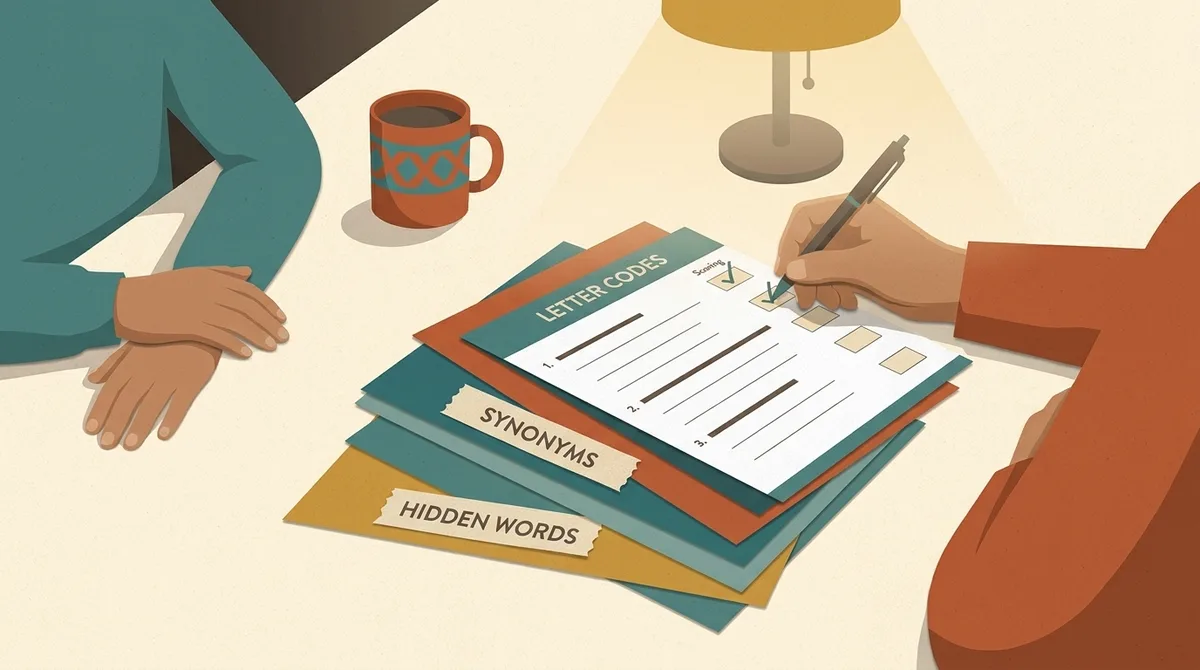
This free printable pack contains original verbal reasoning practice questions, a separate answer grid and answer keys. The examples use familiar 11+ question formats, but test content and timing vary by area, school and year. Check current local guidance before using a worksheet as exam-specific preparation.
This pack practises codes, sequences, synonyms, hidden words and sentence logic. Some adult aptitude tests use reading passages with true, false or cannot-say questions. Check your child’s local test guide to see which formats are relevant.
These questions were written for this worksheet pack and are not copied from GL Assessment familiarisation papers. GL Assessment’s permissions policy explains that its protected materials generally require permission for reproduction. Use official familiarisation material only through the provider’s current terms and links.
What is in the pack, and what it deliberately leaves out
The PDF has fourteen A4 pages: a cover, ten question sheets, a separate answer grid and a two-page answer key. Some sheets combine related question types.
- Sheets 1 and 2: synonyms and word meaning, antonyms
- Sheets 3 and 4: letter codes, word and number codes
- Sheets 5 and 6: letter sequences, number sequences
- Sheet 7: letter connections and word analogies
- Sheets 8 and 9: hidden words and compound words, anagrams and sentence logic
- Sheet 10: a 20-question mixed timed paper with its own separate answer grid
Each question sheet has a score box for the date, score and whether you want to revisit it. Use the results as one guide to selecting another practice activity; a worksheet score alone does not diagnose a learning need.
Download the printable verbal reasoning worksheet pack (PDF)
What the pack leaves out on purpose is teaching. It does not explain how a letter code works or how an antonym distractor is built, because that belongs in a lesson, not on a worksheet. If your child cannot start a sheet at all, read our walkthrough of every verbal reasoning question type first, then come back and use the sheet as practice rather than as a puzzle.
Grouped practice and mixed practice
A grouped sheet lets you focus on one format at a time. A mixed paper brings formats together. Either can be useful, depending on what your child is practising and the test format they are preparing for.
For example, the same total score can come from different patterns of correct and incorrect answers. Reviewing the questions can show which formats to revisit, while a single score cannot explain why an answer was missed.
A grouped sheet can make it easier to compare answers within one format. The pack groups questions for that reason; it does not establish mastery or predict performance on a different test.
Sheets 1 and 2: synonyms, antonyms and the option list that does the work
GL describes verbal reasoning as using written information to think logically and solve problems. On word-meaning questions the logic sits in the option list, not the headword.
Worked example from sheet 2: PRAISE with options (a) applaud (b) notice (c) reward (d) forget (e) criticise. The trap is (a): applaud is similar in meaning to praise, not opposite to it. The fix is procedural, not vocabulary-based: say the instruction out loud before reading the options ("I need the OPPOSITE"), then eliminate.
If answers are missed on either sheet, review the word meanings and the instruction. The same wrong answer can have different causes, so ask your child to explain their choice before deciding what to practise next. Our guide to synonyms and antonyms covers the distractor patterns in detail.
Sheets 3 to 6: codes and sequences, where marks are won back fastest
Codes and sequences use rules that can be written down and checked against examples. If a question is missed, compare the rule your child used with the one shown in the key, then decide whether to try another example.
Worked example from sheet 3: if CAKE is written as DZLD, how is MILD written? Write the alphabet out. C to D is plus one, A to Z is minus one, K to L is plus one, E to D is minus one. So the rule alternates: plus one, minus one. Apply it to MILD: N, H, M, C. Sheets 5 and 6 include alphabet-position references that can help with these questions.
Sheet 4 uses letter-to-number codes, with each letter assigned a number within the example. Sheet 6 uses number series with different rules, such as adding a constant or doubling and adding one. Sheet 7 shifts to word connections, which look verbal but behave like sequences: identify the relationship in the first pair, then apply it. Our deeper walkthrough of codes and letter sequences is the teaching companion to these four sheets. Some practice habits, such as checking a rule against examples, can be used in other subjects too. See our guide to non-verbal reasoning question types for those formats.
Sheets 8 and 9: word building and sentence logic
These sheets practise word-building and sentence logic. Sheet 8 covers hidden words (a four-letter word straddling the join between two adjacent words) and compound words. Sheet 9 covers anagrams, move-one-letter questions and sentence logic. Move-one-letter questions can have more than one valid answer, so accept any pair where both words are real. The key gives PINE and STAR for SPINE and TAR, but SPIN and TEAR also works. For CLAMP and RATE the key gives LAMP and CRATE, but CLAM and PRATE is also valid.
Worked example, hidden word: "Please wash this pan carefully." Read across the word joins only. "this pan" gives t-h-i-s-p-a-n: SPAN. The method is mechanical, so teach the method rather than hoping: put a finger over everything except the last three letters of one word and the first three of the next, then slide along.
Worked example, sentence logic: Amir is taller than Beth. Beth is taller than Chloe. Dev is shorter than Chloe. Who is the shortest? Writing the comparisons as a list or diagram can help keep the details clear. Dev is shorter than Chloe, who is already shorter than Beth and Amir, so Dev is shortest.
The mixed practice sheet and its separate answer grid
Sheet 10 is the only timed item in the pack: 20 questions across all types, 20 minutes, and answers written on the separate grid rather than on the question page.
That separation is not decorative. For the 2026 Kent Test, Kent County Council described multiple-choice questions answered on a separate sheet and marked by computer (Kent County Council). Buckinghamshire's Secondary Transfer Test is likewise entirely multiple-choice. When a test uses a separate answer sheet, practise following its instructions. Check that each answer is entered beside the matching question number; the effect of a marking error depends on the test’s answer-sheet design and marking process.
If a separate answer sheet is used in your child’s test, you can practise transferring answers and checking the question numbers. GL Assessment offers free familiarisation materials and says local test timings and question counts can differ from its examples. Check your council or school’s current guidance for the format your child will sit.
Using the worksheets at a comfortable pace
The pack is for flexible practice. You might work through a few questions without timing, pause to discuss a method, or use a timer if that suits the learner and matches the practice goal. Do not treat the worksheet length as an official test duration. For a full practice paper, use the current instructions and timing from your target school or local authority.
Test structure and scoring differ by area. For example, Buckinghamshire’s current guide describes two multiple-choice papers and explains how its standardised score is calculated (Buckinghamshire Council: marking the Secondary Transfer Test). That arrangement should not be assumed for another test.
Reviewing answers and choosing another activity
Use the key to check answers and discuss any that were difficult. A score records performance on that sheet on that occasion; it cannot by itself show whether a skill is secure or identify why an answer was missed. If you revisit a format, try a fresh example when available, and compare the method as well as the final answer.
An optional four-week example, using the sheets in the pack:
| Week | Example practice |
|---|---|
| 1 | Sheet 2 (antonyms) and sheet 3 (letter codes). Talk through any misses. |
| 2 | Sheet 4 (word and number codes) and sheet 8 (hidden words and compound words). |
| 3 | Go back to the sheet that caused the most misses and compare methods. |
| 4 | Sheet 10 as a 20-minute mixed paper on its separate grid, then revisit the weakest format. |
This is only an example, not a recommended dose or a promise about how quickly a learner will improve. Adjust the pace around the child, school guidance and other commitments. You can also choose another activity from our practice resources.
Some 11+ tests use standardised scores. Each authority or school explains how its results are used in its own admissions process. A worksheet score is not an official test score and cannot predict an admissions outcome.
Verbal reasoning worksheet questions parents ask
Are the worksheets really free, with answers, no sign-up? Yes. One PDF, all ten sheets, full answer key at the back. No email, no account, no watermark asking you to upgrade.
Which sheets suit Year 5 and which suit Year 6? The pack is not divided by school year. Choose a sheet based on what the learner is ready to try and the formats in their local test. Our guide to reasoning practice in Year 5 discusses practice in that year group.
Are these suitable as KS2 verbal reasoning worksheets generally? They are optional practice activities. Learners may find some sheets more accessible than others; choose questions with the language and challenge level that suit your child.
How many worksheets a week is enough? There is no single amount that suits every learner. Choose a manageable amount and allow time to discuss answers.
My child got everything right. What now? Check that they can explain the methods. You could try another format or use current familiarisation material if it matches their target test.
Do we still need paid practice papers? Use materials that fit the target test and your child’s needs. Check the publisher and local admissions guidance; a worksheet score does not determine whether additional practice is needed.
Topics
- verbal reasoning
- worksheets
- 11 plus practice
- printables
- year 5