

Southend Grammar Schools and the Consortium Test
All four Southend grammar schools use the CSSE English and maths tests. Compare their priority areas, test registration and the separate school application.
 Elspeth Marlow
- 8 min read
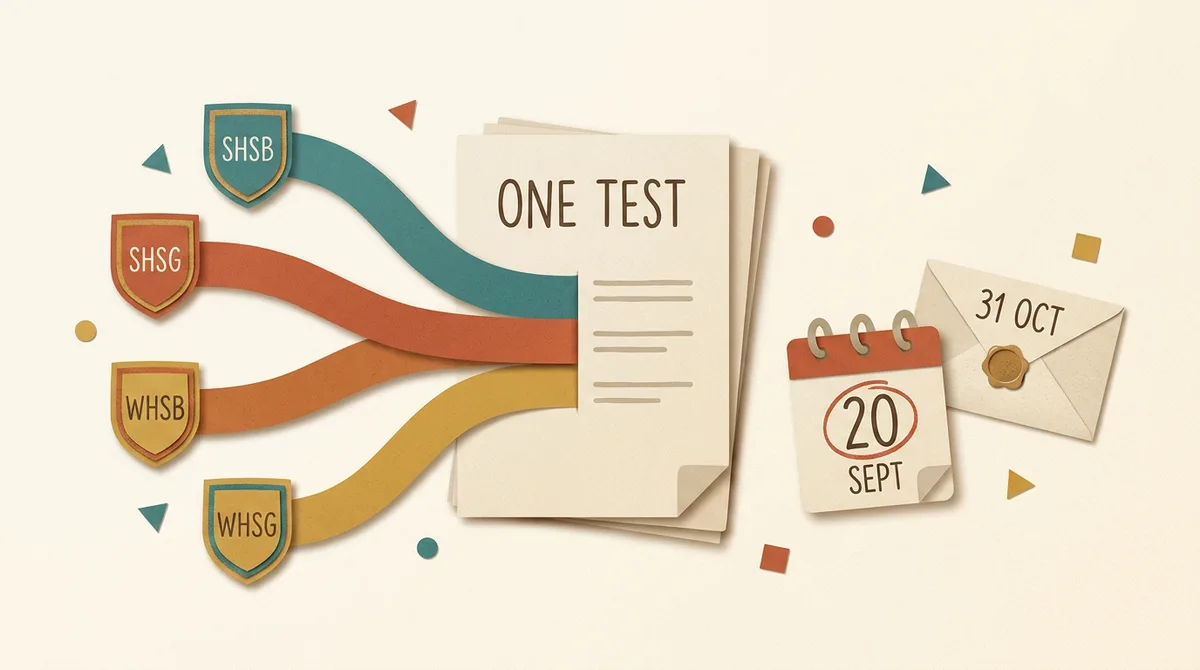
If your child took the CSSE test in September 2026 for a September 2027 place, the immediate task is to use the result to choose schools and submit the separate home-council application. Southend Council accepts on-time applications from its residents until 31 October 2026. Families living elsewhere apply through their own council and should check its deadline. CSSE's current notice confirms results were emailed on 12 October and reminds families to complete the council form.
All four Southend grammar schools, Southend High School for Boys, Southend High School for Girls, Westcliff High School for Boys and Westcliff High School for Girls, are members of the Consortium of Selective Schools in Essex (CSSE). The same CSSE English and Maths assessment is used across its ten member schools. Check the CSSE membership list and each school's admissions policy before completing your preference list.
The four grammars share a test but set their own admissions and priority rules. This guide separates those rules from CSSE test registration and shows how the nearby partially selective schools and Chelmsford County High School for Girls fit into a wider shortlist.
Myth one: there is a separate Southend paper
There is no second Southend-only paper for the four grammar schools. CSSE administers one shared assessment for its member schools.
For example, a child considering Westcliff High School for Boys and Colchester Royal Grammar School does not need separate CSSE test registrations for those two schools. Test entry and the later council school preferences are still different steps.
The test format is set out in the CSSE 2027-entry guide. Candidates sit two tests: English, lasting sixty minutes with ten minutes of additional reading time on top, and Mathematics, lasting sixty minutes. There is no standalone verbal or non-verbal reasoning paper, which surprises families arriving from Kent or Buckinghamshire, where reasoning dominates. Formats vary a great deal by region, so preparation bought for one county is rarely a clean fit for another.
CSSE standardises the English and Maths results and weights the two papers equally. A raw mark alone cannot be compared with a school's published standardised-score guidance. Our standardised-score explainer shows how the current test cohort is treated.
Myth two: "CSSE school" means "grammar school"
Do not assume every CSSE member is a grammar school. Check each school's admissions arrangements before making a shortlist.
CSSE's current historical guidance sheet groups its members under Essex grammar schools, Southend grammar schools and partially selective schools. Those are different admissions routes even though they share a test.
- Essex grammar schools in CSSE: Colchester Royal Grammar School, Colchester County High School for Girls and King Edward VI Grammar School in Chelmsford. Each has its own admissions policy and may use a priority area.
- Southend grammar schools: Southend High School for Boys and Girls, and Westcliff High School for Boys and Girls. They are fully selective but apply their own published priority arrangements.
- Partially selective schools: Shoeburyness High School, St Bernard's High School for Girls and St Thomas More High School for Boys. They are not grammar schools and offer only some places through the selective route.
For the partially selective schools, check catchment eligibility and any school-specific supplementary form. Southend Council's 2027 booklet contains the current school arrangements. Do not infer eligibility or an offer from an old score table.
If your shortlist mixes grammar and partially selective schools, you are not choosing between four similar options. You are choosing between two different admissions machines that happen to share a paper.
The genuine second test, and it is not in Southend
A family considering schools outside CSSE may need a second assessment.
Chelmsford County High School for Girls is an Essex grammar school and is not a CSSE member. It uses a Future Stories Community Enterprise test, on its own date and its own registration window. For 2027 entry the school lists the test as Thursday 3 September 2026, with registration open from 9am on Monday 13 April 2026 until 4pm on Wednesday 3 June 2026, as its admissions page sets out.
For the same 2027-entry cycle, the CSSE guide set registration from 12 May to 19 June 2026, with a 19 September main test. Chelmsford County High used an earlier registration window and a separate test. A child considering both routes needed both registrations; neither school application was completed by registering for a test.
For a child currently in Year 5, check the 2028-entry pages before assuming these 2027-entry windows repeat.
Make a list of each school's test provider, registration deadline, admissions policy and any separate school form. The CSSE and Chelmsford County High routes need different test registrations.
Myth three: registering for the test is applying to the school
It is not, and this is the most expensive misunderstanding on the page.
The CSSE 2027-entry guide says its test registration form does not apply for a school place. The school must also appear on your home council's application.
There are therefore two forms, owned by two different organisations, and they do different jobs:
- The CSSE supplementary information form registers your child to sit the test. It generates a score. It generates nothing else.
- Your home local authority's Common Application Form is the actual application. For 2027 entry, Southend residents can apply from 1 September to 31 October 2026 and may name up to five preferences, including schools outside the city.
The word doing the work is home. A family living in Rochford or Basildon and applying to Westcliff High uses its home local authority, not Southend. A Southend resident uses Southend even if the child attends primary school elsewhere. Check the council's deadline and keep the submission confirmation.
You need not wait for a result before applying. Southend Council says its residents may change their preferences until 31 October. Put schools in your genuine order of preference, then read each school's eligibility and oversubscription rules. Our registration guide explains the two-form pattern in other regions.
Myth four: the pass mark decides who gets in
The CSSE minimum and an individual school's allocation are different things.
The latest CSSE historical guidance sheet says ordinary CSSE offers are not made below a total standardised score of 303, with appeal and special-consideration exceptions. That is a minimum for consideration, not an offer score for every school or category.
The same official sheet gives the last selective offer scores on 1 March 2026 for 2026 entry, separating inside and outside priority areas where applicable. It shows why families should read each school's current geographic rules. Those figures describe an earlier cohort, not the threshold for 2027 entry.
Each Southend grammar's 2027 admissions arrangements explain how priority areas, reserved places and scores interact. A family outside a priority area can still be eligible for some schools, but the historical out-of-area last-offer score may differ sharply. Check the particular school and do not treat any old last-offer score as a forecast.
How competitive is each school, honestly
Older preference totals count every form naming a school, including lower preferences and children who may not meet its criteria. They are not the number of eligible first-choice applicants per place. For planning, the school's current priority rules and your child's actual result are more useful than a headline preference ratio. Our guide to 11+ competition explains those limits.
Which Southend grammar is realistic for your family
Use your child's result and each school's current policy to build the list:
- Check the school's priority area and score rules. Do this separately for each of the four grammars. The CSSE 303 floor is not a promise of a place.
- Check extra forms. A partially selective or faith school may have a supplementary information form with its own deadline. Use the current school and council instructions.
- Identify any non-CSSE test. Chelmsford County High School for Girls has a separate assessment and registration, so planning for both routes requires both sets of dates.
- Apply through your home council. List schools in genuine preference order. Southend Council recommends that its residents use all five preferences and include a realistic local option.
- Keep the offer stage separate. A qualifying score without an offer may lead to a waiting-list or appeal route, but the rules and dates belong to the school's 2027 admissions process. Check them after 1 March 2027 rather than using last year's appeal deadline.
For a child preparing for the next CSSE test, use the consortium's current free familiarisation papers to learn the English and Maths format. Timed mock tests can help with pacing, but a practice mark cannot predict a standardised result or a school offer.
And if you are still mapping the wider landscape, or comparing Southend against selective areas elsewhere, start from our pillar guide to grammar schools near me, then verify every date against CSSE and Southend's secondary admissions pages before you commit to anything. Arrangements are republished annually, and the numbers in this guide describe recent rounds rather than the one your child will sit.
Topics
- southend
- csse
- essex
- grammar schools
- admissions