


The Science of Motivating a Child Through 11 Plus Preparation
A source-led guide to 11 plus motivation: what 128 reward studies actually found, where the growth mindset evidence is weaker than you have been told, and what to say tonight.
 Elspeth Marlow
- 12 min read
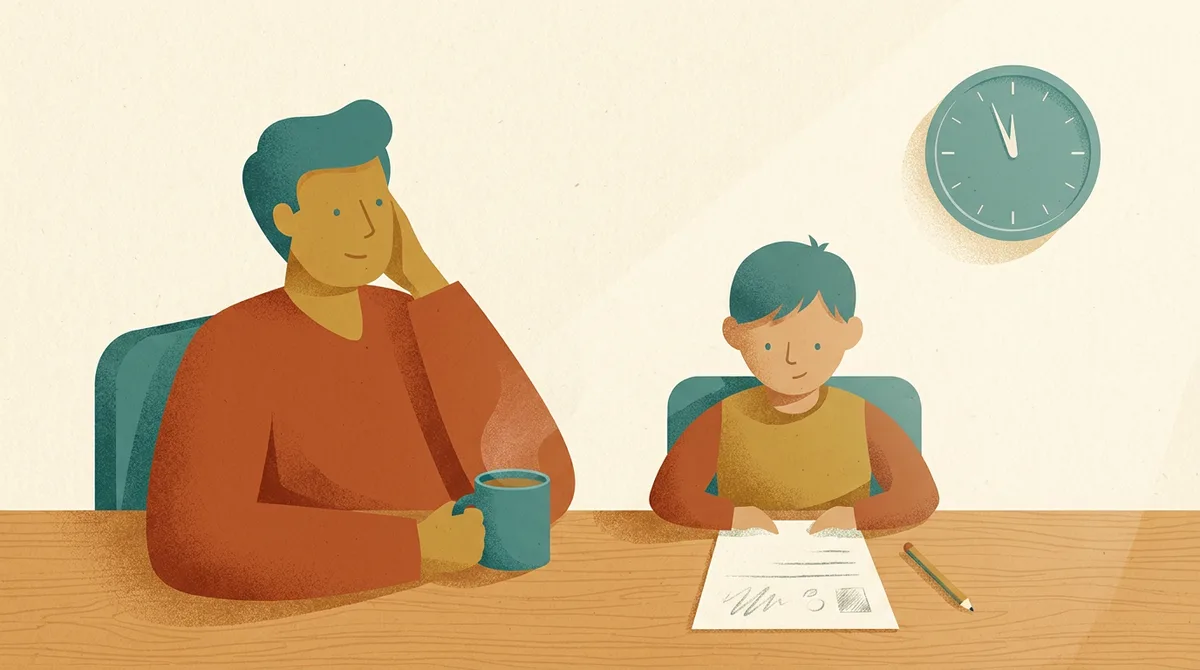
Advice about motivating children often includes praise, routines, rewards and breaks. Recommendations can conflict, and research findings do not always apply directly to 11 plus preparation.
This page separates study findings, general health guidance and practical suggestions. The linked research does not test every family situation or script below. Where evidence does not directly cover 11 plus preparation, that scope is stated.
One reframe before we start. The NHS page on helping your child beat exam stress reports that Childline says many children who contact them feel most of the pressure at exam time comes from their family. That is a reminder to ask how your child experiences preparation and to notice which parts of the routine you can adjust. The page is general exam-stress advice, not research specifically about 11 plus preparation.
Why is my child digging their heels in?
Refusal can have many causes, and it is not enough to label a child lazy. Self-determination theory (Ryan and Deci, American Psychologist, 2000, 55(1), 68 to 78) describes autonomy (having some say), competence (feeling able to make progress) and relatedness (feeling connected to the people involved) as needs relevant to motivation. This is a way to think of questions to ask, not a diagnostic tool: a child's response may have more than one cause.
Ask before you change the routine. "Why do I have to" may be about having little say over what, when or how long. You could offer two genuine choices, such as "Verbal or maths first?" Avoid presenting a choice if the child has no real option to decline.
"I'm rubbish at this" or slowing down could mean the work feels difficult, but it does not tell you why. Try a shorter or more familiar task, then ask what felt hard. If practice is affecting your relationship, protect time together that is not about the test. Our fuller reset routine is in when your child hates 11 plus practice.
Should I reward practice, or does that backfire?
This is where advice can sound contradictory. The research offers useful distinctions, but it does not settle every family situation. Deci, Koestner and Ryan reviewed 128 experiments (Psychological Bulletin, 1999, 125, 627 to 668) and found the undermining effect is real but specific. Rewards contingent on engagement, on completion and on performance all significantly reduced free-choice intrinsic motivation, with effect sizes of d = -0.40, -0.36 and -0.28. The overall tangible-reward and expected-reward groups also showed negative effects on free-choice behaviour. In the combined sample, tangible rewards had a larger negative effect for children than college students. Positive feedback increased free-choice behaviour (d = 0.33) and self-reported interest (d = 0.31) overall, though the authors report that verbal rewards tended to be less enhancing for children than for college students.
The findings do not establish that every reward harms motivation or that an unexpected treat is always safe. In the reviewed experiments, expected tangible rewards tied to taking part, finishing or performing tended to reduce free-choice interest in an already interesting activity. That is not the same as testing every family routine or a child completing necessary work. If you use rewards, avoid making a large promised prize the only reason to practise, and keep feedback specific and sincere.
The NHS exam-stress page suggests that families can think with their child about modest rewards for revision and getting through exams. That general advice and the meta-analysis address different settings. Deci and colleagues found tangible rewards tended to be more detrimental for children than college students in the experiments they reviewed, but those studies do not give a specific rule for 11 plus practice.
A practical option is to agree a family treat for finishing a busy period, while also noticing specific strategies and progress during practice. The research does not compare this exact arrangement with other family routines, so treat it as an option rather than a proven formula.
Does praising effort actually work?
One influential study Mueller and Dweck (Journal of Personality and Social Psychology, 1998, 75(1), 33 to 52) found that praising children for intelligence, rather than for effort, undermined their later motivation and performance. That paper is the source of nearly every "praise the effort, not the ability" line you have read.
The replication picture is much more mixed. Sisk and colleagues ran two meta-analyses (Psychological Science, 2018, 29, 549 to 571): one on the mindset to achievement relationship across 273 effects and 365,915 participants, one on intervention effectiveness across 43 effects and 57,155 participants. Their own summary sentence is "Overall effects were weak for both meta-analyses", with support concentrated in students who are academically at risk or of low socioeconomic status. Li and Bates (Journal of Experimental Psychology: General, 2019, 148(9), 1640 to 1655) tested a growth mindset manipulation with 9 to 13 year olds in China, an age band that overlaps 11 plus candidates. A close replication of Mueller and Dweck found no link with any of the eight motivation and attribution measures, and two further studies with an active control found no effect of the classic manipulation. Yeager and colleagues (Nature, 2019, 573, 364 to 369) ran a national US experiment with ninth graders (about 14 to 15 years old) and did find a benefit from a short online intervention, but a modest one, concentrated among lower-achieving students, and holding where peer norms aligned with the message.
Effort-focused language can describe what a child did, but the studies do not show that changing praise alone reliably improves achievement. Keep feedback specific and truthful, and consider workload, sleep, difficulty and the child's own view as separate parts of the situation.
Why does my child forget what we covered last week?
Because forgetting is normal, and because the revision most families do feels effective while doing less than it appears to. Roediger and Karpicke (Psychological Science, 2006, 17, 249 to 255) found that testing beat restudying on delayed tests "even though repeated studying increased students' confidence", and Cepeda and colleagues (Psychological Bulletin, 2006, 132, 354 to 380) found the best gap between study sessions grows as the delay before the test grows. One caveat: Roediger and Karpicke tested undergraduates reading prose, and Cepeda's synthesis is mostly adult verbal-recall tasks; Dunlosky and colleagues (Psychological Science in the Public Interest, 2013, 14(1), 4 to 58) is the review that rates techniques across ages, and it gave only practice testing and distributed practice a HIGH utility rating. Forgetting is not a judgement about your child's ability. You can explain that revisiting a topic gives them another chance to practise recalling it. The studies cited here do not test this particular parent script. The mechanics are in why short 11 plus sessions beat cramming.
Is pressure ever useful, or is it always harmful?
For this article, challenge means a task that takes effort while remaining possible with support. Pressure means adding stakes or consequences, comparisons, or implying that your approval depends on the outcome. This is a practical distinction, not a clinical definition.
The NHS lists possible signs of exam stress, including worry, tension, headaches and stomach pains, poor sleep and irritability. Its advice is to listen, avoid criticism and, after a paper, discuss what went well instead of focusing only on the hardest questions. These are general exam-stress suggestions; how any child responds varies.
It also helps to be honest about the scale of the thing. Selective schools are permitted to prioritise children who pass an entrance exam, and one place is one place. Buckinghamshire's official preparation advice to parents suggests practising quiet independent work, completing homework, developing reading comprehension and using the free familiarisation booklet. This describes that authority's guidance; it does not establish what all areas recommend. Their Secondary Transfer Test, produced by GL Assessment, is two papers of about 45 minutes each, or 60 including the introduction and examples, with a break between, covering verbal, non-verbal and mathematical skills. Formats and preparation advice vary by area. This Buckinghamshire page lists no required duration for preparation; that is not evidence about every provider or family.
What should I actually say?
Here are four situations and possible wording to try. Adapt the words to what your child says and feels.
- They say "I'm rubbish at non-verbal". Avoid dismissing the feeling or making a claim about ability. Mueller and Dweck studied particular praise conditions; that does not mean every reassuring phrase has the same effect. Try: "This type felt difficult today. Which one felt closest to solvable?"
- They stall at the start of a session. Instead of repeating the agreement, you could try: "Ten minutes, you pick the subject, and if it's horrible we stop."
- They ran out of time in a paper. Not: "you have to work faster." Try: "How many did you not reach? Let's practise skipping one question, not speeding up all of them."
- A friend got a higher score. Not: "don't compare yourself." Try: "That's their paper. Yours went from 12 right to 17 right on this section. That's the number I care about."
Scripts for a low mock score, and for repairing the evening after you have lost your own temper, are in when your child hates 11 plus practice. Notice what these have in common: they describe an observable thing (a question, a count, a strategy) rather than a trait. The reward meta-analysis found positive feedback increased intrinsic motivation on average in the reviewed experiments. That result does not prove that every form of praise helps every child.
How much sleep does a ten-year-old actually need?
The children's sleep service at Newcastle upon Tyne Hospitals NHS Foundation Trust gives a number: children aged 6 to 13 need 9 to 12 hours, and 13 to 18 year olds need 8 to 10. It also advises keeping wake times on school days and weekends within two hours of each other, and no electronic devices just before bedtime.
Be careful how you frame this. Dewald and colleagues (Sleep Medicine Reviews, 2010, 14, 179 to 189) meta-analysed sleep and school performance and found all three variables significantly but modestly related: sleepiness strongest at r = -0.133, then sleep quality at r = 0.096, then duration at r = 0.069. Those are small associations, larger in younger participants. Sleep is not a performance hack. In practical terms, if your child seems tired, consider whether the routine leaves enough time for rest; the cited review does not show that tired children necessarily argue more or respond to correction in a particular way.
What does a motivating week actually look like?
One possible routine is shorter than some families expect. The short-session guide suggests four to five sessions a week of fifteen to twenty-five minutes plus reading for Year 5. The 11 plus revision timetable guide is another optional example. These are suggestions, not evidence-based prescriptions. Their suggested session counts and review intervals may need adapting to a child, school workload and family routine. You can review progress over several sessions if that is useful; one result alone does not establish a trend. The progress tracking feature can display accuracy over time, but it does not interpret the cause of a change. If you have not yet settled the overall shape of preparation, start with the year-by-year 11 plus preparation plan and fit the motivational habits above around it.
When is it not a motivation problem at all?
Before changing your praise vocabulary, consider whether another practical issue needs attention.
Over-scheduling. If preparation seems to be taking up much of your child's free time, ask how manageable it feels before adding more practice.
An underlying difficulty. If a child has trouble accessing the work, discuss your observations with their teacher or SENCo. Our guide to when your child hates 11 plus practice covers practical questions to ask. What support can look like on test day is in our guide to 11 plus access arrangements.
The child does not want the school. A child may have concerns about a selective place. Ask directly and leave room for an honest answer. If you made a deal about how long you would try for, honour it.
Questions parents ask us
Are sticker charts really that bad?
The meta-analysis did not test short versus long-term use, so this is judgement rather than evidence: the reviewed experiments found tangible rewards more detrimental for children than college students on average. They do not establish how a sticker chart works over time, whether it should be withdrawn, or how to phase one out. If you are concerned, discuss a change with your child and observe how it goes.
My child is capable but says the whole thing is pointless. What now?
There is no single explanation. Ask what feels pointless, offer a real say in the routine where possible, and check whether the workload is manageable. Do not assume that the answer is exhaustion or lack of autonomy.
How do I tell whether preparation is working before results arrive?
You can note accuracy on question types across several weeks, the number of questions reached in timed sections, and how your child feels about starting practice. These observations may help you decide what to discuss with them or their teacher; they do not reliably predict an eventual test score.
Topics
- motivation
- 11 plus
- parents
- wellbeing
- evidence