

Board Games for Practising 11 Plus Skills
Twelve games with optional house rules for practising operations related to 11 plus question types, plus a clear account of what games cannot show.
 Elspeth Marlow
- 10 min read
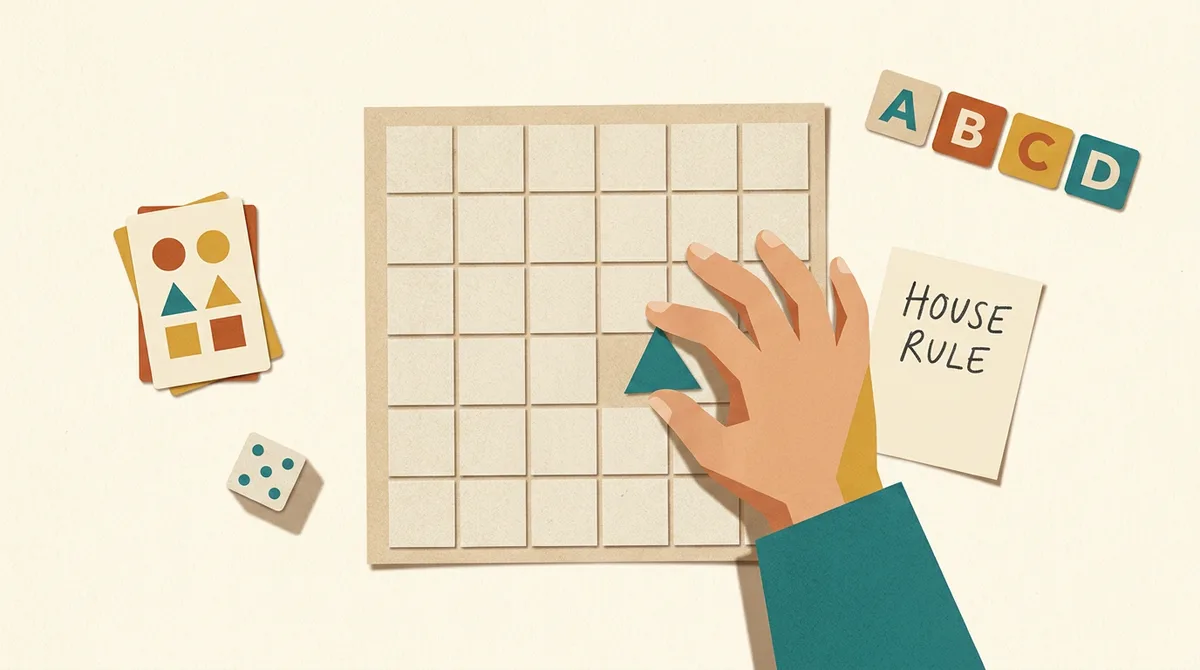
A board game can give a child a reason to talk through a pattern, compare features or calculate a result. The house rules below are optional prompts for practising operations related to some 11+ question types. They do not reproduce the exam format or show that a child will perform better on a test. Check each game edition for its age guidance; the ages below are suggestions for trying the added prompt, not publisher ratings.
The myth: a board game shelf "covers" the 11 plus
One small exploratory study (Koç, Yıldız and Karabekmez, Frontiers in Psychology, 2026) examined a structured board-game programme with 24 Turkish preschool children aged 60 to 71 months. It reported higher post-test mathematical reasoning scores in the game group than in the comparison group after adjusting for pre-test scores. The sample was small, children were much younger than 11+ candidates, and the programme involved about 45 minutes of play on five days a week for six weeks. It does not establish that ordinary family game nights improve 11+ results or support a particular home schedule.
What the papers ask for
Formats vary by area, so check your own council or consortium page, but Buckinghamshire publishes its format in detail (two multiple-choice papers, verbal and maths with non-verbal), GL Assessment warns that children may not have encountered verbal and non-verbal question types before, and our guide to short daily 11 plus practice covers what that means for a home routine. The sections below begin with non-verbal reasoning examples.
Non-verbal reasoning games: attributes, rotation, reflection and cube faces
Chess, draughts and backgammon are strategy games, but their usual rules do not directly match tasks such as rotating or reflecting a figure. The prompts below are analogies for discussing those operations, alongside the examples in our non-verbal reasoning question guide.
Set (or Dobble): compare attributes
Related operation: compare several features. SET cards have four features: number, shape, shading and colour. A set of three cards must be all the same or all different on each feature. This gives children a concrete pattern to describe; it is not the same task as an odd-one-out question.
House rule: before taking a set, name how each feature is the same or different across the three cards. If using Dobble instead, simply name the matching symbol and describe one visible feature; the two games use different rules.
Suits (for this house rule): 8+ for Dobble, 9+ for Set.
Practise it: compare attributes and the odd one out exercise.
Blokus (or Katamino, or Ubongo): rotate and reflect a figure
Related operation: describe turns and reflections. Mattel's Blokus instructions list pieces made from one to five squares. This can prompt discussion about how a shape changes position; it is not a direct NVR exercise.
House rule (2 minutes): you must announce the transformation before your hand moves, in NVR vocabulary: "quarter turn clockwise", "half turn", "reflected in a vertical mirror line". Placing a piece silently forfeits the turn. The aim is to retire "turned it a bit" from the vocabulary.
Suits (for this house rule): 7+ for Blokus and Ubongo, 8+ for Katamino.
Practise it: rotate a figure and reflect a figure, then the rotation dial and mirror flip exercises.
Rush Hour: compose two transformations
Related operation: plan a sequence of moves. Rush Hour is a sliding-block puzzle, not a figure-transformation question. Talking through two moves can practise explaining a plan, but it does not reproduce that NVR question type.
House rule (2 minutes): before the first slide, the solver states the next two moves as one plan out loud ("lorry down two, then red car right three"). If move one turns out to be wrong, the child restates a new pair.
Suits (for this house rule): 8+ for the standard card deck.
Practise it: compose two transformations.
Any dice game: track the opposite face
Related fact: on a standard six-sided die, opposite faces sum to seven. Calling the bottom face from the top face can prompt spatial reasoning, though a die is not the same as every cube-net question.
House rule (2 minutes): in any game with dice, the child calls the hidden bottom number as soon as the top shows. Two points for a correct call, none for a guess after the fact. Once a week, unfold a cereal box and mark which faces meet.
Suits (for this house rule): 8+; the net-folding version suits 9+.
Practise it: track the opposite face and the dice partner exercise.
Games that build verbal reasoning: letters, words, meaning and deduction
Each game below offers an informal prompt related to a family described in our guide to verbal reasoning question types.
Bananagrams (or Scrabble): solve anagrams and form compounds
Related operations: rearrange letters and notice compound words. A timed anagram question has extra constraints that a word game does not reproduce.
House rule: draw seven letter tiles and try to rearrange them into a different word, or name a compound beginning with a word such as SNOW, FOOT or RAIN. Treat this as a separate prompt, not as a standard Bananagrams rule.
Suits (for this house rule): 8+ with a shortened tile pool, 9+ full game.
Practise it: solve an anagram with the anagram wheel, and form a compound with the word welder.
Boggle: find the hidden word
Related operation: scan adjacent letters. Boggle forms words by tracing neighbouring letters in its grid. Some verbal-reasoning hidden-word questions instead place a word inside a longer string, so the formats are different.
House rule (2 minutes): words of four letters or fewer score nothing, and any word that spans a diagonal scores double. This changes the Boggle challenge and is only a prompt to look for less obvious paths.
Suits (for this house rule): 9+.
Practise it: find the hidden word and the hidden word lens.
Mastermind (or Guess Who?): evaluate stated facts
Related operation: separate what is certain from what is still possible. Mastermind feedback can support this kind of explanation, although its code-breaking rules differ from verbal-reasoning logic questions.
House rule: after receiving clues, say one thing the clues establish and one possibility that remains. In Guess Who?, choose a question and count how many faces each possible answer would eliminate.
Suits (for this house rule): 8+ for Guess Who?, 9+ for Mastermind.
Practise it: evaluate stated facts and the logic grid.
Codenames (or Taboo): talk about word relationships
Related operation: discuss how words are connected. Some vocabulary exercises ask children to choose the closest meaning from several options; a clue game does not reproduce that format.
House rule (2 minutes): after the round ends, the clue-giver names the relation they intended for each clue: synonym, category, part-to-whole, cause-and-effect or opposite. Guessers score a bonus point for any word they wrongly picked and can justify with a named relation.
Suits (for this house rule): 10+ for Codenames, 8+ for Taboo Kids.
Practise it: classify a semantic relation, select the closest meaning and the synonym spectrum.
Maths board games for 10 year olds: sequence, average and multi-step work
These games can prompt discussion of sequences, averages and order of operations. The added maths rules are variations, not standard game scoring.
Rummikub: continue the sequence
Related operation: describe a pattern. Rummikub's official English rules define a run as three or more consecutive numbers in one colour and a group as three or four tiles of the same number in different colours. Saying the rule aloud is an informal pattern-description prompt.
House rule (2 minutes): before laying, the player states the rule and the next two terms that would extend it ("run of blues, plus one each time, next would be 9 then 10"). Manipulating another player's set requires naming the rule you are breaking.
Suits (for this house rule): 8+.
Practise it: continue a sequence and the number train.
Yahtzee: calculate the mean
Related operation: calculate a mean. A Yahtzee score can be used for an extra mean-calculation prompt; averaging is not part of the standard scoring rules.
House rule (2 minutes): after each round, every player announces their running mean per completed box rather than their total, to one decimal place. Worked example: after four boxes scoring 24, 18, 30 and 12, the total is 84 and the mean is 21.0. A fifth box scoring 6 drops the mean to 18.0, and noticing that a below-average score pulls the mean down is the reasoning an average question tests.
Suits (for this house rule): 9+.
Practise it: calculate the mean and the stat duel.
A 24-style number card game (or Countdown numbers): evaluate mixed expressions
Related operation: evaluate a mixed expression. For this variation, choose four numbers and make the target using each number once. This is related to order of operations, but the rules of a particular card game may differ.
House rule (2 minutes): the solution must be spoken as a single expression with brackets, not as a chain of steps. For example, with 1, 2, 3 and 4, one solution is "(1 + 2 + 3) x 4 = 24". The expression uses each chosen number once.
Suits (for this house rule): 9+.
Practise it: evaluate a mixed expression and the BIDMAS machine.
Shut the Box: add whole numbers and decimals
Related operation: add whole numbers and decimals. This optional variation gives a child a context for decimal addition.
House rule (2 minutes): as an optional decimal variation, label tiles 1 to 9 as tenths and treat a roll of 9 as 0.9; for example, close 0.4 and 0.5.
Suits (for this house rule): 7+ standard, 9+ for the decimal version.
Practise it: add whole and decimal numbers and the number pyramid.
What a games night cannot do
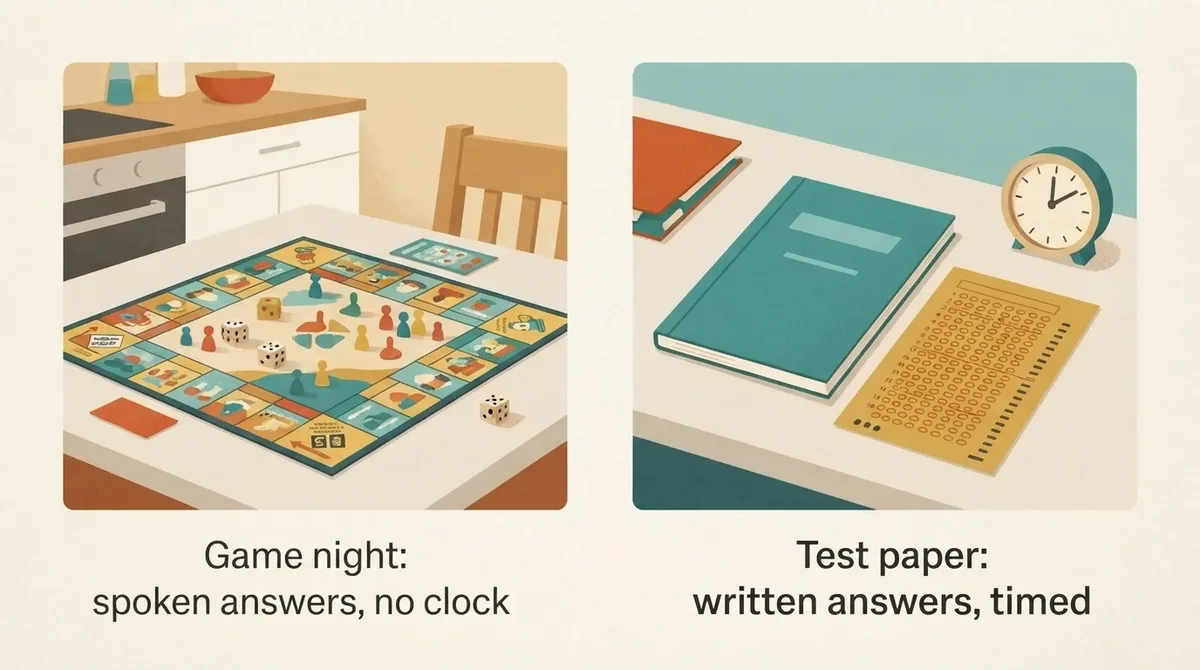
No board game rehearses transferring answers to a separate answer sheet, which Buckinghamshire's format requires, or sitting two timed papers of about 45 minutes each. None presents the multiple-choice layout GL recommends children get used to, and none shows the standardised score a council admits on: in Buckinghamshire, marks are standardised on a scale between 60 and 170 with age taken into account, weighted 50% verbal, 25% maths and 25% non-verbal.
Games may offer a different context for talking through a related operation. Timed papers provide practice with the actual question format. Neither alone establishes likely test performance. GL's own guidance is that tackling a practice paper under timed conditions gives children valuable experience, which is what mock tests are for.
Pairing a game with a related exercise
If it suits your family, try a short game followed by an exercise on a related topic. There is no evidence here that a 30-minute game plus 10-minute exercise is an optimal routine. Rotate or stop the prompts according to the child's interest. A free diagnostic can suggest skills to practise.
If you own none of these, you own enough. A standard die can prompt a conversation about opposite faces, playing cards can be used for a 24-style number challenge, and a Monopoly transaction can prompt mental subtraction. These are informal practice ideas, not evidence that game play transfers directly to test performance. When you are ready to turn the shelf into a plan, start with the exercises beside each game, and let an exam plan decide which strand gets the next game night.
Topics
- board games
- non-verbal reasoning
- verbal reasoning
- maths
- home practice