


11 Plus Maths Worksheets by Topic
Seven maths topics with worked examples and an original printable worksheet pack. Use your child’s working and local test guidance to choose what to practise next.
 Elspeth Marlow
- 12 min read
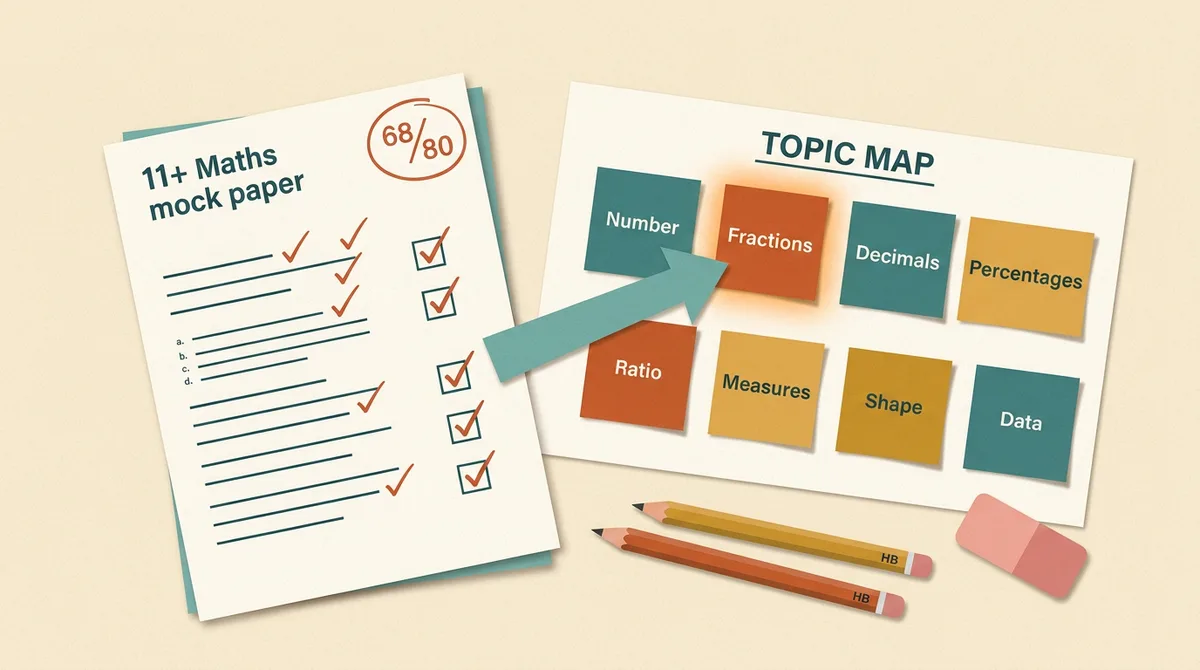
If a mock paper has shown that your child needs more practice in one part of maths, a short topic worksheet can help you see how they are working. It gives you time to discuss the method before trying another full paper.
First check which topics appeared in the mock and which questions your child missed. A whole-paper score cannot tell you whether they needed a different maths method, misread a question or ran out of time.
This guide groups practice into seven topics. Each has a worked example, and the printable pack has one page per topic plus answers. Check your own test's format before using the pack as exam practice: these are original five-option questions, not replicas of every regional paper.
Step one: review the questions you have
Before printing, look through a marked mock or a few pieces of schoolwork with your child. Look at the question and their working, as well as the mark.
Write down the seven topics: number and the four operations, fractions and decimals, percentages, ratio and proportion, measures and area, shape and space, and data handling. For each one, note both how many questions appeared and how many were wrong. Two errors out of two questions need a different follow-up from two errors out of twelve.
Formats vary by area. CSSE publishes a separate maths paper, while Buckinghamshire and Kent include maths in a paper with another subject (CSSE, Buckinghamshire Council, Kent County Council). GL says local authorities and schools choose the subjects and question balance (GL Assessment FAQ). Use your child's actual route to decide which topics and formats matter.
Step two: check your test's rules
Use the worksheet to learn a method first. When you later practise exam conditions, follow the rules for your child's test.
The official Buckinghamshire familiarisation booklet linked here describes the 2027-entry test, which took place in September 2026. Treat it as an example of one area's format; use the latest booklet for your child's entry year because timings and rules can change. For 2027 entry, the booklet specified 25 minutes plus five minutes of practice for maths, within a roughly one-hour paper. It said candidates could bring two HB pencils and an eraser, but not a ruler, calculator, protractor or scrap paper. Rough working was allowed in the test booklet, not on the computer-marked answer sheet (Buckinghamshire familiarisation booklet).
For practice based on that 2027 booklet, three details were specific to its test format:
- The booklet did not allow a ruler, so its sample questions rely on reading the stated dimensions rather than measuring a picture.
- Rough working could be written in the test booklet, not on the answer sheet.
- Pupils marked answers on a separate sheet and were told to match the question number. This worksheet pack prints options beside each question, so use the official familiarisation booklet when practising that transfer step for a similar format.
The Buckinghamshire booklet also advised children to move on from a question taking too long and return if time remained. Its sample papers can help children become familiar with that specific format.
Timings differ sharply between regions, so do not port one area's clock onto another. For September 2027 entry, the CSSE test allowed sixty minutes for its maths paper, more than double the Buckinghamshire maths section, and GL warns directly that "the exact timings for, and number of questions in, your local 11+ test may differ from those in our familiarisation and practice materials" (GL free materials). Check your own board before you set a stopwatch.
Step three: recognise four useful question shapes
The Buckinghamshire familiarisation booklet gives examples of several useful question shapes. They are examples, not a promise that every local paper uses the same patterns.
The negative stem. One sample asks which fraction is not equal to a given fraction. The word not changes the task. Ask your child to say the full question in their own words before choosing.
The multi-step word problem. A child might complete one calculation correctly but stop before answering what was asked. Check their working before deciding whether they need help with arithmetic or with planning the steps.
The compound shape. For a wall with a window, find the wall's area and subtract the window's area before working out paint coverage.
The multiple-mark question. The booklet warns that "Some questions may require you to mark two correct answers so make sure you read the instructions carefully in each section of the test."
A wrong option can point to a missed step, but it does not diagnose the cause on its own. Ask your child to show how they reached it.
The pack's answer page explains some of its wrong options. Use those notes alongside your child's working. The pillar guide to 11+ maths topics and question types has a wider topic map.
Step four: choose a topic
The seven topics draw from the national curriculum's upper key stage 2 maths programme. This is a practice map, not an official syllabus for every 11+ route. A school testing earlier in Year 5 may cover a different range from one testing in Year 6, so check its own information before treating every topic as essential.
Number, place value and the four operations
What is asked: long multiplication and division, multi-step word problems in money and quantities, rounding, negative numbers in temperature contexts, and "which of these is not equal to" place value questions.
Worked example. A crate holds 384 apples. 96 are bruised and 57 are sold. How many are left? The answer is 384 minus 96 minus 57, or 231. Our worksheet also offers 288, the value after the first subtraction. Ask your child to write "apples left in crate" beside their working and check whether they completed both steps.
Written calculation underpins many later topics. If a method is uncertain, practise it without a clock before trying mixed questions.
Fractions and decimals
What is asked: equivalence (including questions with a negative stem), fractions of amounts, ordering mixed decimals and fractions, addition and subtraction with unlike denominators, and remaining-fraction problems.
Worked example. Sam eats one third of a cake, then Ella eats a quarter of the whole cake. What fraction is left? Convert both to twelfths, 4/12 and 3/12, and subtract from 12/12 to get 5/12. The option 2/3 will be sitting there for anyone who stops after Sam. Note that the phrase "of the whole cake" is doing real work: if Ella ate a quarter of what was left, the answer changes.
For ordering questions, use whichever comparison makes the values clear. Eighths and quarters may be quickest as fractions; values such as 13/20 and 0.68 are easy to compare as decimals. If two values are equal, the question's wording decides how to list them.
Percentages
What is asked: percentage of an amount, increase and decrease, expressing one number as a percentage of another, and equivalence between fractions, decimals and percentages.
Worked example. A coat costs 80 pounds and is reduced by 25%. A quarter of 80 is 20, so the new price is 60 pounds. The number 20 will be an option. This is the same trap as the apples, wearing a different hat: the intermediate value is the discount, the question asked for the price.
The 10% and 5% method is useful here: ten per cent of 240 is 24, five per cent is 12, so fifteen per cent is 36. Ask your child to explain why the two parts add up to fifteen per cent.
Ratio and proportion
Examples to practise: sharing in a ratio, scaling recipes, unit pricing, map scales and finding a share from the difference between two amounts.
Worked example. Money is shared between Ana and Ben in the ratio 2:7, and Ben receives 42 pounds more than Ana. The difference is five shares, so one share is 8.40 pounds and Ana receives 16.80 pounds. Children who assume 42 is the total, or that it represents one share, will land on the offered wrong answers. The fix is a single sentence said out loud: "what does 42 buy me, the total or the difference?"
Inverse proportion appears here too. Assume identical taps each supply water at a constant rate, the tank starts empty and there is no outflow. If three taps fill it in forty minutes, five taps take less time: 3 times 40 gives 120 tap-minutes, divided by 5 is 24 minutes.
Measures, area and volume
What is asked: unit conversion, time intervals across the hour, perimeter and area of rectangles and compound shapes, volume of cuboids, and coverage or capacity problems that end in "how many whole tins".
Worked example. Paint covers 15 square metres per tin. A wall 6 m by 3 m contains a window 2 m by 1 m. The painted area is 18 minus 2, so 16 square metres, which needs two whole tins. Two traps in one question: the subtraction for the window, and the rounding up at the end, because 1.07 tins is not something you can buy.
A film starting at 18:45 and running 1 hour 50 minutes ends at 20:35. If your child writes 20:95, use a clock face or number line to show why 60 minutes become an hour.
Shape, space and data handling
Examples to practise in shape: angles on a line and in a triangle, properties of quadrilaterals, faces and edges of solids, coordinates, reflection and rotation. Buckinghamshire does not allow a ruler or protractor; check the rules for your child's own test.
Worked example. A point at (2, 3) is reflected in the vertical line x = 5. It sits three units left of the line, so it lands three units right of it, at (8, 3). Counting the gap rather than picturing the flip is what makes this reliable.
What is asked in data: reading bar charts, pictograms and tables, differences between categories, totals, mean and range, and the negatively-phrased "how many did not" question that GL's own sample uses. If sixty children choose clubs and eighteen choose football, the number who did not is forty-two, and eighteen is an option.
Step five: decide what to revisit
Look back at the questions attempted and your child's working.
- Look at the number attempted. Two errors out of two questions deserve another example; two out of twelve may point to a narrower skill.
- Look for a repeated method error. If several ratio questions go wrong at the same step, work through one together before trying more.
- Ask about an intermediate value. It may mean your child stopped early, misread the question or made another slip. Their working will tell you more than the option letter.
Choose one topic that needs attention and start without a clock while your child explains the method. The pack leaves the time blank so you can record it if a later timed attempt helps. Add time pressure only after the method is secure, using your own test's published timing. Mark the page together and decide whether to revisit the topic.
Download the printable 11+ Maths Topic Worksheet Pack (PDF) for seven six-question worksheets with five options each and a combined answer page. The questions are original practice. Use the answer key with your child's working to decide what to revisit. You can print one topic at a time.
To see whether a method has improved, try different questions on the same topic before another full paper. Our guides to 11 plus maths papers and topic tests and free 11 plus practice papers with answers show further options. Smart Cub Learning's progress view groups results from activities completed in the product; it does not import answers from this printable pack.
Answers, printing and common questions
Are these 11 plus maths worksheets free to download as a PDF? Yes. The pack above is a single A4 PDF with answers, free to print for family use, with no sign-up.
How many questions are on each worksheet? Six. That is enough for a short discussion about one topic, but one sheet cannot establish a child's overall level.
Should my child use a calculator on these? Try the questions without one if the aim is to practise calculation methods. Real test equipment rules vary; the Buckinghamshire 2027-entry booklet prohibited calculators, rulers and protractors, but check the current rules for your own test.
My child knows the method but runs out of time. Check whether time is going on reading, working or marking the answer. The Buckinghamshire booklet advises moving on from a question that is taking too long and returning if time remains. Use the instructions for your child's own test.
Which topic should we start with? Use a recent mock or schoolwork to choose one your child finds hard. If you do not have a mock, start with a few questions in a topic they are learning and watch how they solve them.
Do these worksheets match my region's exam? They cover selected upper key stage 2 topics in an original five-option format. They do not copy a regional paper. If your child's test uses written answers, a different question format or different content, practise that format too and check the admissions authority's current guidance.
Topics
- 11 plus maths
- worksheets
- gl assessment
- fractions
- percentages
- revision