
11 Plus Grammar and Punctuation Questions
The technical English tested at 11+ comes from one statutory document, and the government already publishes the list of question types it produces. Here is that list, with a worked multiple-choice question for every item.
 Elspeth Marlow
- 15 min read
Almost every page that ranks for "11 plus grammar" tells you what the syllabus contains without ever citing the document that defines it. That is odd, because the document is public, free and written by the government. If your child is sitting a GL Assessment style paper, the technical English section is drawn from the national curriculum, and the exact grammar and punctuation content of that curriculum is set out in one statutory annexe plus one official test framework.
This guide uses the government's content map as a starting point. It takes the government's own content map, translates each item into the sort of multiple-choice question a child actually meets on an answer sheet, and explains why the wrong options are written to be tempting. Then it does something even more useful: it tells you which of those topics your child has probably not been taught yet, because the curriculum introduces several of the hardest ones in Year 6, after most autumn 11+ tests have already happened.
One caution before we start, and it matters. The official framework quoted throughout governs the Key Stage 2 SATs grammar test, not the 11+. No exam board publishes an "11+ grammar specification". What the framework gives you is the most precise public map of the same statutory curriculum that 11+ English papers draw from, which is a far better guide than a tutor's guesswork, but it is a map of the curriculum, not of any particular test.
First, which "11 plus grammar" did you mean?
The phrase does two completely different jobs. Some parents typing it want grammar schools: entry rules, catchment areas, qualifying scores, application deadlines. Others want grammar the school subject: nouns, clauses, apostrophes, semi-colons. The search results are dominated by the first meaning, which is why so many parents looking for the second one end up on an admissions page.
If you came for admissions, our parent guide to what the 11+ is covers school types, test dates and how scores are used, and it is the better starting point. If you came for the English subject, stay here. Everything below is about the technical English content of the paper.
What technical English actually covers
GL Assessment states on its own FAQ page that 11+ subjects may be "English, maths, verbal reasoning and non-verbal reasoning", that "local authorities or individual schools decide which subjects to test", and, crucially, that its English tests are "based mainly around curriculum content reached during the early part of Year 6" (GL Assessment FAQs). That single sentence is the anchor for this whole article: the syllabus is the national curriculum, not a secret list.
The grammar and punctuation part of that curriculum is defined by English Appendix 2 of the national curriculum. The Standards and Testing Agency then converts it into a published content domain of seven areas (KS2 English GPS test framework):
- G1 Grammatical terms and word classes
- G2 Functions of sentences
- G3 Combining words, phrases and clauses
- G4 Verb forms, tense and consistency
- G5 Punctuation, split into fourteen named subdomains from G5.1 capital letters through to G5.14 bullet points
- G6 Vocabulary
- G7 Standard English and formality
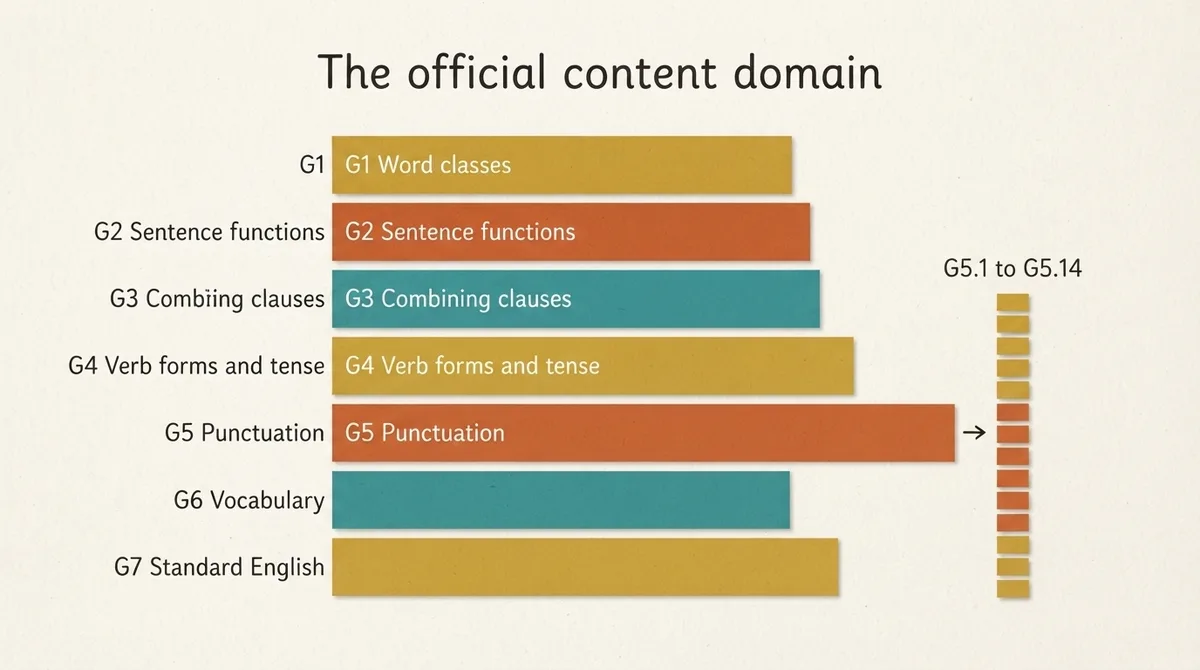
That is your revision list. Not a tutor's opinion of one, the government's own.
One more reassurance, because it is the single most common panic we hear. The framework says grammatical terms not required as pupil terminology "may appear in the wording of items within the tests. However, children will not be expected to generate this terminology in their responses." In multiple-choice format that principle goes further still: your child never has to write the word "subjunctive". They have to recognise which of four sentences uses it. Recognition, not recall.
Has your child been taught it yet? The year-by-year gap check
Appendix 2 says its year-group table "shows when concepts should be introduced first, not necessarily when they should be completely understood", and adds that "it is very important, therefore, that the content in earlier years be revisited in subsequent years to consolidate knowledge" (English Appendix 2).
Read that alongside the calendar. A child sitting an 11+ in September of Year 6 has met Year 5 content only recently, and may not have met Year 6 content at all. Here is when each topic first enters the curriculum:
- Year 2: sentence functions (statement, question, exclamation, command), commas in lists, apostrophes for contraction and singular possession
- Year 3: clauses and subordinate clauses, direct speech, inverted commas
- Year 4: commas after fronted adverbials, inverted commas plus other punctuation for direct speech, apostrophes for plural possession and the difference between plural and possessive -s, Standard English verb inflections
- Year 5: relative clauses (who, which, where, when, whose, that, or an omitted relative pronoun), modal verbs and adverbs of possibility, brackets, dashes or commas for parenthesis, commas to clarify meaning or avoid ambiguity
- Year 6: active and passive voice, subjunctive forms, semi-colons, colons and dashes between independent clauses, colons introducing lists, semi-colons within lists, bullet points, hyphens to avoid ambiguity
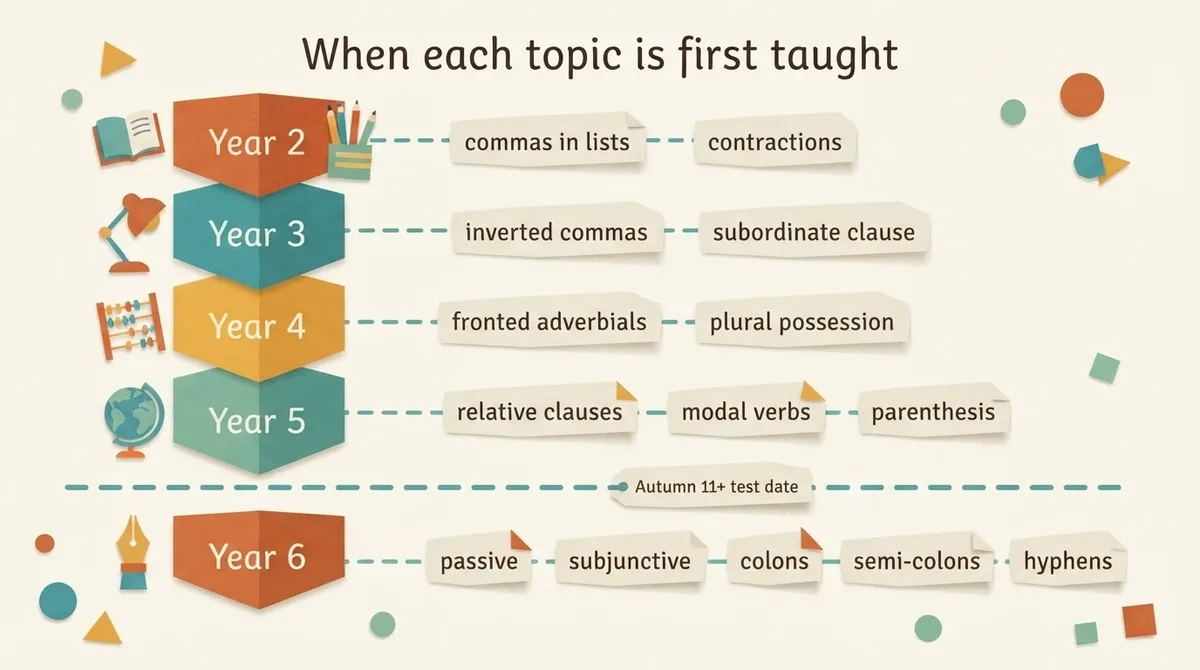
Use it as a triage tool. Year 2 to Year 4 items should be secure and any error there is worth fixing first. Year 5 items are fresh and fragile. Year 6 items may be genuinely new, so treat wobbles there as "not taught" rather than "not able". Formats vary by region, so check your own area's paper before assuming the harder Year 6 punctuation appears at all.
G1: word classes
Word-class questions ask you to spot the job a word is doing, not what it looks like. Nouns, pronouns, verbs, adjectives, adverbs, prepositions, conjunctions and determiners are all fair game.
Question 1. In the sentence Those cyclists rode carefully along the narrow towpath, which word is a determiner?
- A: Those
- B: carefully
- C: along
- D: narrow
Answer: A. Those introduces the noun cyclists. B is an adverb and is chosen by children who hear "describing word" and grab the -ly. C is a preposition and looks structural, so it attracts anyone guessing at "small connecting words". D is an adjective, and adjective and determiner get confused constantly because both sit in front of a noun.
G2 and G3: sentence functions, clauses and relative clauses
G2 covers the four sentence functions. G3 covers how clauses join: co-ordination, subordination and relative clauses. Appendix 2 introduces relative clauses in Year 5, including ones with an omitted relative pronoun.
Question 2. Which sentence contains a relative clause?
- A: Because the tide was rising, we turned back.
- B: The bench that overlooks the harbour needs repainting.
- C: We packed the tent and walked to the ridge.
- D: Turn left at the postbox.
Answer: B. That overlooks the harbour modifies the bench. A is a subordinate clause but an adverbial one, and it is the strongest distractor because it also starts with a subordinating word. C is co-ordination with and. D is a command, included to catch children who have not separated function from structure.
Try building a sentence from a main clause and a subordinate clause.
This part of the guide is a short interactive exercise. It works in your browser.
G4: verb forms, tense and consistency
The content domain itemises simple past and present (G4.1a), the perfect form (G4.1b), modal verbs (G4.1c), the progressive form (G4.1d), tense consistency (G4.2), the subjunctive (G4.3) and active and passive (G4.4). Tense consistency is the highest-frequency of these in practice: a passage slips from past to present, and the child must spot the slip.
Question 3. Which sentence uses the perfect form?
- A: She was walking to the library.
- B: She walked to the library.
- C: She has walked to the library.
- D: She will walk to the library.
Answer: C. Has walked is the present perfect. A is progressive and is the classic mis-pick because both use an auxiliary verb. B is simple past. D is future, and children who have been taught "perfect means finished" sometimes reason their way there.
Passive, modal and subjunctive: the Year 6 trio
These three carry the most parental anxiety and the least classroom time before an autumn test. Appendix 2's own passive example is I broke the window in the greenhouse versus The window in the greenhouse was broken (by me). Its subjunctive examples are If I were and Were they to come, described as belonging to some very formal writing and speech. Modal verbs (might, should, will, must) arrive a year earlier, in Year 5, alongside adverbs of possibility such as perhaps and surely.
Question 4. Which sentence is written in the passive voice?
- A: The storm damaged the pier last winter.
- B: The pier was damaged by the storm last winter.
- C: The pier was old and unsafe last winter.
- D: The storm was damaging the pier all night.
Answer: B. The subject receives the action. C is a trap: was plus an adjective looks passive but nothing is being done to the pier. D is the past progressive, and was plus an -ing verb is the most common false positive of all. A is the active version of B, offered so that word-for-word similarity cannot be used as a shortcut.
G7: Standard English and formality
The content domain spells out exactly what Standard English items test, which is unusually helpful. G7.1 names verb forms such as I did / I done, we were / was, he was / were and isn't / ain't, pronoun choices such as them / those, that / what and anything / nothing, and adverb forms such as run quickly / quick. Year 4 already requires Standard English verb inflections, with we were instead of we was and I did instead of I done given as the statutory examples.
Question 5. Which sentence is written in Standard English?
- A: We was late because I done my homework first.
- B: We were late because I done my homework first.
- C: We were late because I did my homework first.
- D: We was late because I did my homework first.
Answer: C. This item type deliberately puts two independent errors in one sentence, so a child who fixes only the one they notice lands on B or D. Both half-right options are the point of the question.
Apostrophes: contraction, singular possession, plural possession
Apostrophes generate more 11+ marks per line of text than any other punctuation mark, because three distinct rules collide. Contraction and singular possession are Year 2 content. Plural possession, and the grammatical difference between plural and possessive -s, is Year 4, with the girl's name and the girls' names as the statutory examples.
Question 6. Which sentence uses apostrophes correctly?
- A: The teacher's marked all the boy's essays.
- B: The teachers marked all the boys' essays.
- C: The teachers' marked all the boys essays.
- D: The teachers marked all the boy's essay's.
Answer: B. Plural subject, no apostrophe; plural possession, apostrophe after the s. A treats a plural as a possessive. C attaches an apostrophe to a verb subject, which is the error children make once they start over-applying the rule. D adds a greengrocer's apostrophe to a straightforward plural.
Try an apostrophe question now: contraction or possession?
This part of the guide is a short interactive exercise. It works in your browser.
Commas: lists, fronted adverbials, parenthesis and ambiguity
Commas appear across several G5 subdomains. Lists are Year 2, fronted adverbials Year 4, and Year 5 adds two harder jobs: commas (or brackets or dashes) to indicate parenthesis, and commas to clarify meaning or avoid ambiguity.
Question 7. Which sentence uses commas to mark parenthesis?
- A: We packed sandwiches, apples, a flask and a map.
- B: After the second bell, the hall fell silent.
- C: Mr Okafor, who had taught there for thirty years, unlocked the gate.
- D: Slowly, carefully, she lifted the lid.
Answer: C. A pair of commas brackets off information that could be removed. A is a list. B is a fronted adverbial and only has one comma, which is the giveaway. D has two commas but they separate adverbs rather than enclosing a parenthesis, so it is the most convincing wrong answer on the page.
Try moving the commas and see how the meaning changes.
This part of the guide is a short interactive exercise. It works in your browser.
Speech punctuation and the advanced marks
Inverted commas arrive in Year 3, and Year 4 adds inverted commas "and other punctuation to indicate direct speech". Appendix 2 gives The conductor shouted, "Sit down!" as its example, which encodes two rules at once: a comma after the reporting clause, and end punctuation kept inside the inverted commas.
The remaining marks are Year 6: semi-colon, colon and dash between independent clauses (It's raining; I'm fed up), colons introducing lists, semi-colons within lists, bullet points, and hyphens to avoid ambiguity (man eating shark versus man-eating shark, or recover versus re-cover).
Question 8. Which sentence is punctuated correctly?
- A: "Wait here" said Priya, "I'll fetch the key".
- B: "Wait here," said Priya. "I'll fetch the key."
- C: "Wait here, said Priya, I'll fetch the key."
- D: "Wait here." said Priya "I'll fetch the key."
Answer: B. A drops the comma before the closing inverted comma and strands the full stop outside. C encloses the reporting clause inside the speech. D uses a full stop where a comma belongs and omits punctuation after the reporting clause.
So which practice actually helps: workbook, worksheet or exam-format paper?
This is the real decision, and the honest answer is that all three have a job but not the same job.
Choose a topic workbook when there is a genuine knowledge gap. If your child cannot explain what a relative clause is, no amount of multiple-choice practice will teach it. Workbooks and school-style exercises build the underlying rule. Use the year-by-year list above to decide which topics count as gaps rather than slips.
Choose free printable worksheets for maintenance and quick daily reps. They are cheap, short and easy to mark. Their weakness is format: most ask a child to insert missing punctuation, whereas the 11+ typically asks them to choose between four already-punctuated options. Those are different skills, and the second is harder, because three of the four options are engineered to look right.
Choose exam-format multiple-choice practice once the rules are broadly known. GL's own free familiarisation materials exist to familiarise children with "the multiple-choice layout of the test", which tells you the format itself is part of the challenge. Warwickshire County Council, for example, states that its West Midlands entrance tests "contain four sections: English, Verbal Reasoning, Non-Verbal Reasoning and Mathematics", that "the test is in a multiple-choice format", that each of the two tests takes around 60 minutes including instructions and practice items, and that raw scores are then "standardised and weighted" (Warwickshire County Council). Separate answer sheets, tight timing and standardisation are all things a worksheet cannot rehearse. Our features for timed paper practice exist for exactly this stage, and the same escalation applies on the numerical side, which we cover in the 11+ maths topics and question types guide.
Most families need all three in that order, and the sequencing matters more than the choice.
Build your own printable worksheet in ten minutes
You do not need to buy anything to make a good worksheet, and a homemade one has an advantage: it targets your child's actual gaps. Take a sheet of paper and write eight questions using the templates above, one per content area:
- Identify the word class of a named word in a sentence
- Choose which sentence contains a relative clause
- Choose the sentence with consistent tense
- Choose the passive sentence
- Choose the Standard English sentence
- Choose the correct apostrophe use
- Choose the sentence using commas for parenthesis
- Choose the correctly punctuated direct speech
Give each four options, and write the three wrong ones deliberately: one that is nearly right, one that tests a neighbouring rule, and one that is right in form but wrong in job (an adjective for a determiner, a past progressive for a passive). Then print it, or simply write it out.
Marking is where the value is. Do not just score it. For each wrong answer, ask which of three things happened: the rule was never taught (check the year list), the rule was known but misapplied, or the rule was known and the distractor won. The third case is a format problem and responds fast to timed multiple-choice practice. The first case needs teaching, not testing. Log the pattern over a few weeks so you are tracking topics rather than percentages.
For everything beyond technical English, including comprehension and writing, see our 11+ English overview, and pair this with the spelling rules and word lists guide, since spelling sits in the same statutory annexe and is examined alongside grammar in most areas.
The reassuring conclusion is that this syllabus is finite and published. Seven content areas, fourteen punctuation subdomains, a known year of first teaching for each. Work through it in that order, and the technical English section stops being the unpredictable part of the paper.
Topics
- 11 plus english
- grammar
- punctuation
- spag
- practice questions