
Cloze Tests in the 11 Plus
What an 11 plus cloze test really looks like in GL and grammar school papers, the three formats children meet, a three-check method for choosing between distractors, and graded practice passages with full answers.
 Elspeth Marlow
- 14 min read
A cloze test is a passage or a sentence with words taken out, and the child's job is to put them back. The format varies by school and test. Check current admissions guidance before choosing a workbook based on a provider's name.
This guide links to published examples from Buckinghamshire, GL Assessment and Tiffin, and explains why older CSSE samples need care. The practice questions are original Smart Cub Learning examples, with answers and reasoning. Their difficulty labels are editorial, not exam-board calibration.
What a cloze test actually is, and where the odd name comes from
The word is not a misspelling of "close". It comes from closure, the Gestalt idea that the mind automatically completes a partly presented pattern. A cloze test was originally a readability measure: delete every nth word from a text, see how many a reader can restore, and you have a rough index of comprehension. Reading assessment borrowed it, and selective school admissions borrowed it from reading assessment.
That origin explains what the question is really measuring. A cloze gap is not a vocabulary flashcard. It is a comprehension probe wearing a vocabulary costume. To restore a deleted word, a child has to hold the sense of the surrounding sentence, the grammatical shape of the slot, and the writer's register all at once. This is why children with big word lists and weak reading still lose marks: they know all five options and cannot tell which one the passage wants.
In 11+ papers the term covers two related things: passage cloze, where several gaps appear inside a continuous text, and sentence completion, where a single self-contained sentence has one gap. Papers frequently contain both.
Myth: cloze is a CEM question type. Reality: look at what GL's own booklet says
The stale advice is easy to spot because it names CEM and stops. The current, checkable position is in the familiarisation booklet published for the Buckinghamshire Secondary Transfer Test, which states that the test "is produced by GL Assessment" and measures verbal, non-verbal and mathematical skills across two papers of about 60 minutes each.
Describing the English section, the booklet says you "may be shown a sentence with words missing and be asked to pick the best word to complete the sentence" (Buckinghamshire familiarisation booklet). That is first-party confirmation that sentence-completion cloze sits inside a GL English paper, in GL's own words, right now.
The timings in the same booklet are worth writing on the fridge. The Verbal Skills test takes around an hour, split into English at 25 minutes and Verbal Reasoning at 20 minutes, each with 5 minutes of practice. All the questions are multiple-choice, and completed answer sheets "will be marked by a computer".
Gap-filling does not stop at the English paper. The Verbal Reasoning section is full of completion types with different mechanics: finding the two words that "will complete the sentence in the best way", finding "the letters that will complete the series in the best way", and spotting a hidden four-letter word that straddles the end of one word and the start of the next. If your child freezes at the sight of a blank line, that anxiety is costing marks in two separate sections. Our verbal reasoning question types guide works through those families in detail.
GL publishes its own free familiarisation set too, and explicitly recommends that "children familiarise themselves with the multiple-choice layout of the test, content and examples of some types of questions they will face" (GL Assessment free materials). If you are still unsure which board applies to you, our comparison of GL, CEM and ISEB sorts it out by region.
Myth: cloze is one skill. Reality: one school's paper contains three of them
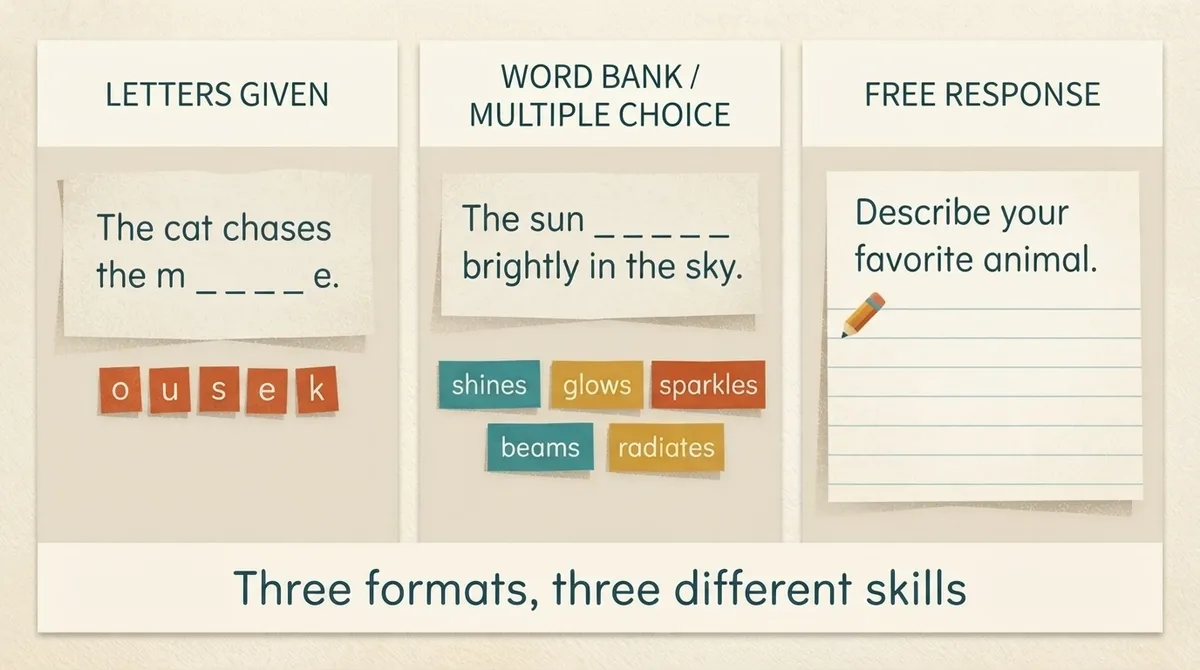
Tiffin School's illustrative questions show different gap tasks across its two admissions stages. These examples describe that school's published material, not every 11+ paper.
Format one: letters given (missing-letter cloze)
Here the gap already contains part of the word, usually the first letter and a run of dashes. The child is not choosing between options; they are reverse-engineering a single word from meaning plus an orthographic skeleton. Spelling accuracy and morphology matter enormously, because a child who knows the required idea but cannot spell it will produce a word of the wrong length and abandon a correct answer. Practice here overlaps almost entirely with spelling rules and word lists, not with comprehension.
Format two: word bank or multiple choice
This is the dominant format in GL-style papers, because the answer sheet is computer-marked and every question must be multiple-choice. Tiffin's own passage cloze instruction is a clean example of the wording: "Read the following extract carefully and then choose one word from the 5 possible options which you think best fits the gap in the text."
The crucial detail sits inside that same passage. One of the gaps offers alarmism, alarmful, alarming, alarmed and alarm. Every option is built from the same root, so meaning cannot separate them at all: that gap is testing word form, not vocabulary. In the same paper, a stand-alone sentence completion asks the child to "Complete the sentence with the most appropriate word", offering connectives such as only, than, whenever, although and as long as, where the answer turns entirely on the logical relationship between the two clauses (Tiffin illustrative questions).
So within a handful of pages: a logic gap, a morphology gap, and ordinary meaning gaps. Treating these as undifferentiated "cloze practice" is why children plateau.
Format three: free response
At Stage Two, Tiffin drops the options entirely. One task asks the child to "complete the second sentence so that it has a similar meaning to the first sentence, using the keyword given", adding that they must not change the keyword and "must use between two and five words, including the keyword given". Nothing is there to recognise; the child must generate, control the word count, and keep the grammar of the host sentence intact.
Tiffin also issues a warning every parent should read before buying a format-specific workbook: "The papers change significantly from year to year", and "every year completely new papers are written". The school adds that tests "will include some questions in unfamiliar formats" precisely to reward adaptability. Over-fitting to one layout is a strategy the school has explicitly designed against.
The read-around-the-gap method: meaning, grammar, collocation
Most guides tell children to "read the whole sentence first". True, and far too vague to change anything under timed conditions. What works is an explicit three-check sequence, run in order, with the child crossing options off as they go.
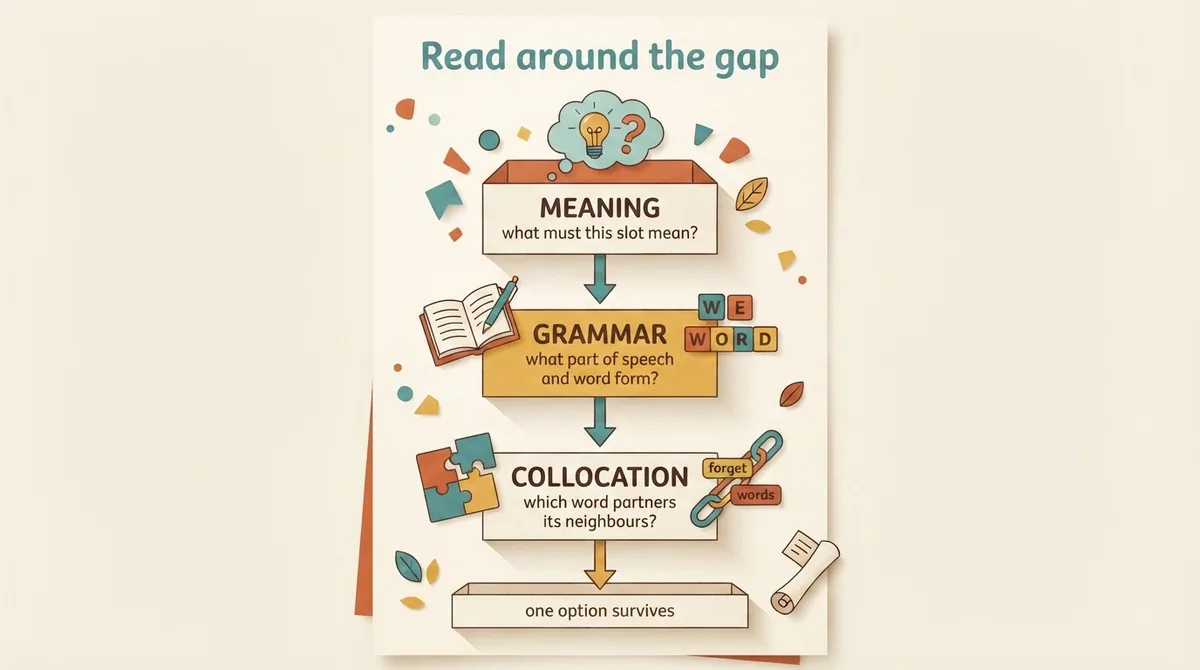
- Meaning check. Cover the options. Read the sentence, and the one before it, and say aloud roughly what the missing word must mean. "Something like worried." Only then uncover the options. A child who reads the five words first will be anchored by whichever one looks cleverest.
- Grammar check. What part of speech does the slot demand, and what form of it? Noun or adjective? Singular or plural? In the alarming family above, meaning is useless and this check does all the work. If the slot follows "the news was very ___", only an adjective survives.
- Collocation check. Of the survivors, which one genuinely partners the neighbouring words in real English? We make a decision, we do not do one. Rain is torrential, applause is thunderous, and swapping those adjectives produces sentences that are grammatical and wrong. This check is where wide reading pays out, and it is why a structured vocabulary list should be learned in phrases rather than isolated words.
Run in that order, most gaps resolve at step one or two. Reserve the third for the genuine coin-flips.
Try the read-around-the-gap method on one sentence now.
This part of the guide is a short interactive exercise. It works in your browser.
How examiners build the wrong answers
Distractors are engineered, not random. Once a child can name the four common types, the plausible-looking trap stops working.
- The near-synonym. Correct in dictionary meaning, wrong in strength or register. Annoyed where the passage needs incensed.
- The word-form near-miss. Right root, wrong ending. This is the alarmism / alarmful / alarming family, defeated only by the grammar check.
- The topic magnet. A word lifted from the passage's subject matter that feels at home but breaks the sentence. In a passage about sailing, anchored will be offered somewhere it does not fit.
- The collocation trap. Grammatically flawless, but no fluent speaker would put those two words together.
The planted near-miss is usually the option a child recognises fastest, because familiarity is the bait. Teach the habit of testing the appealing option hardest rather than the puzzling one.
Worked example one: a multiple-choice passage cloze, gap by gap
The passage and questions below are original Smart Cub Learning material written to mirror the published instruction wording.
The lighthouse had stood on the headland for ninety years, and the villagers had grown so used to its beam that they only noticed it when it (1) ______. On the night of the storm, the keeper climbed the spiral stair two steps at a time, his lamp throwing (2) ______ shadows that shifted as he moved, and made the difficult (3) ______ to keep the light burning until dawn.
Gap 1 options: failed / failure / failing / fail / fails. Answer: failed. The sentence describes a past event, so it needs the past-tense verb. Failure is a noun; the other verb forms do not fit this sentence.
Gap 2 options: moving / movement / moved / move / moves. Answer: moving. It describes the shadows as they shift. The other forms do not fit before the noun in this sentence. Choose from the sentence evidence, not from which option looks different from the others.
Gap 3 options: decide / deciding / decision / decisive / decidedly. Meaning is identical across the set, so skip to the grammar check. The slot follows "the difficult", an adjective, so it needs a noun. Answer: decision. This is exactly the morphology gap Tiffin's own paper demonstrates.
Worked example two: a free-response sentence completion
Original example, in the keyword-transformation style used at Tiffin Stage Two.
First sentence: Nobody expected the youngest competitor to win. Keyword: surprise Second sentence: It came as a ______________ that the youngest competitor won.
The rules are the constraint: keep the keyword unchanged, use between two and five words, keep the meaning. "Complete surprise to everyone" is four words, includes surprise unchanged, and preserves the sense. "Surprising" fails because it alters the keyword; "surprise" alone breaks the count. Teach children to count the words on their fingers before writing, then reread the rebuilt sentence in their head. Most lost marks here are rule breaches, not comprehension failures.
Practice cloze passages with answers
Three levels, all original, with reasoning for every gap. Cover the answers, work through the passage, then compare.
Easy. The fox moved (1) ______ across the frozen field, making no sound. A single noise would (2) ______ the geese sleeping by the water. At the reeds it stayed still, pausing to catch its (3) ______. Options: (1) silently / noisily / loudly / clumsily; (2) wake / rise / shout / sleep; (3) breath / breathe / breathing / breathed. Answers: (1) silently, supported by "making no sound"; (2) wake, which describes making the sleeping geese awake; (3) breath, the noun in the phrase "catch its breath".
Medium. Marta's first attempt at the recipe was a (1) ______ failure, but she was determined to make another (2) ______. By the fourth try she had made something that was, at last, (3) ______ bread. Options: (1) complete / completely / completion / completing / completed; (2) attempt / attempted / attempting / attempts / attemptingly; (3) recognise / recognisable / recognisably / recognition / recognised. Answers: (1) complete, the adjective describing the failure; (2) attempt, the singular noun after "another"; (3) recognisably, the adverb saying the result could be recognised as bread.
Hard. The committee's report was (1) ______ in its criticism, yet the minister responded with a statement so (2) ______ that nobody could say afterwards what he had actually promised. The press, (3) ______ to such performances, printed it in full and waited. Options: (1) scathing / scathingly / scathe / scathes / scathingness; (2) vague / precise / clear / definite / explicit; (3) accustomed / familiar / aware / alert / knowledgeable. Answers: (1) scathing, the adjective meaning severely critical; (2) vague, supported by nobody knowing what was promised; (3) accustomed, which fits "to such performances" and means the press had experienced similar statements before. Familiar would need "with", and aware would need "of".
When your child can explain the reasoning rather than just match the letter, they have the skill. For more of this kind, our free 11 plus practice papers include English sections with cloze-style items, and Smart Cub Learning's paper tests generate fresh passages so children cannot memorise the answers.
Myth: every 11+ child needs cloze practice. Reality: check your region first
Use the current CSSE guidance rather than treating an older familiarisation paper as the current specification. The CSSE website says that Applied Reasoning was removed from English with effect from the September 2024 test, for 2025 entry. Its 2027-entry guidance gives 60 minutes for English plus 10 minutes of reading time. Older samples that include Applied Reasoning therefore contain material that no longer describes the test.
Check the current CSSE examination materials for the year of entry before deciding how to divide practice time. A sample without a cloze section does not establish that gap-filling can never appear in a later paper. Our guide to 11 plus English papers explains the different formats; apply the same check to your child's maths topics and question types.
Timing and answer-sheet technique in the real exam
A correct answer recorded badly scores nothing, and this is genuinely where marks disappear.
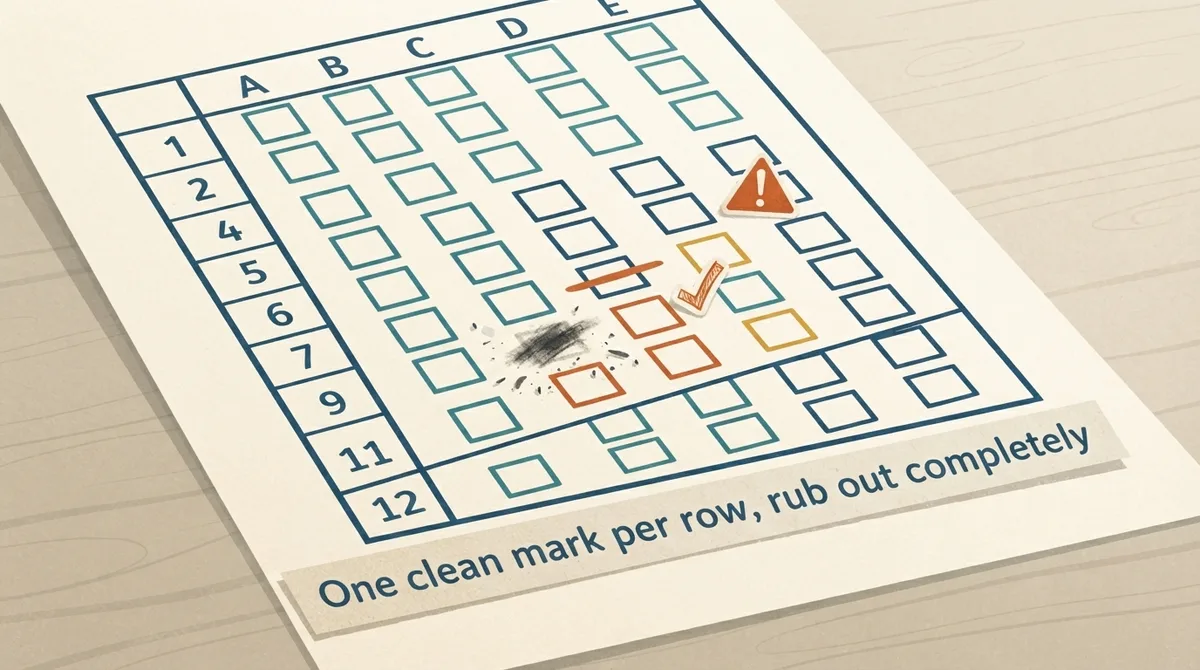
The Buckinghamshire booklet is specific: answers are marked by drawing a firm line through the chosen box, and mistakes must be rubbed out completely rather than crossed out. It also gives the single most valuable piece of exam strategy in the whole document: "If you get stuck on a question during the test, leave it and move on; you can return to it if you have any time left at the end of that section."
With English at 25 minutes, a single gap cannot be worth ninety seconds of agonising. Set a household rule: two passes at a gap, then mark it, move on, return at the end. Because the sheet is separate from the booklet, drill the transfer habit until it is automatic, ideally completing a whole passage and transferring its answers as a block, which reduces the risk of a line-slip cascade. And practise rubbing out; it sounds trivial until a smudged double-mark is read as a blank. Timed mock tests under real conditions are the only way to make this stick.
Over a year, read aloud together from texts slightly above your child's comfort level, insist on spoken reasoning for every gap, and mix formats deliberately: a child fluent in multiple choice can be helpless at free response. Skip silent speed worksheets and "common cloze answers", which collapse the moment a new passage appears. Track which gap types your child fails, not just the score: if the misses are all morphology, the fix is grammar work, not more passages. Smart Cub Learning's progress tracking breaks results down by question type so that distinction is visible rather than guessed at.
Done properly, cloze practice is not a niche exam trick. It is reading comprehension with the evidence made visible, and it improves everything else in the English paper alongside it.
Topics
- cloze
- english
- gl assessment
- verbal reasoning
- practice