

11 Plus Algebra Questions and Worked Examples
Real 11+ papers test algebra constantly, but almost never call it algebra. Here are the four shapes it hides in, twelve worked examples from easy to hard, and the technique split between multiple-choice and written boards.
 Elspeth Marlow
- 17 min read
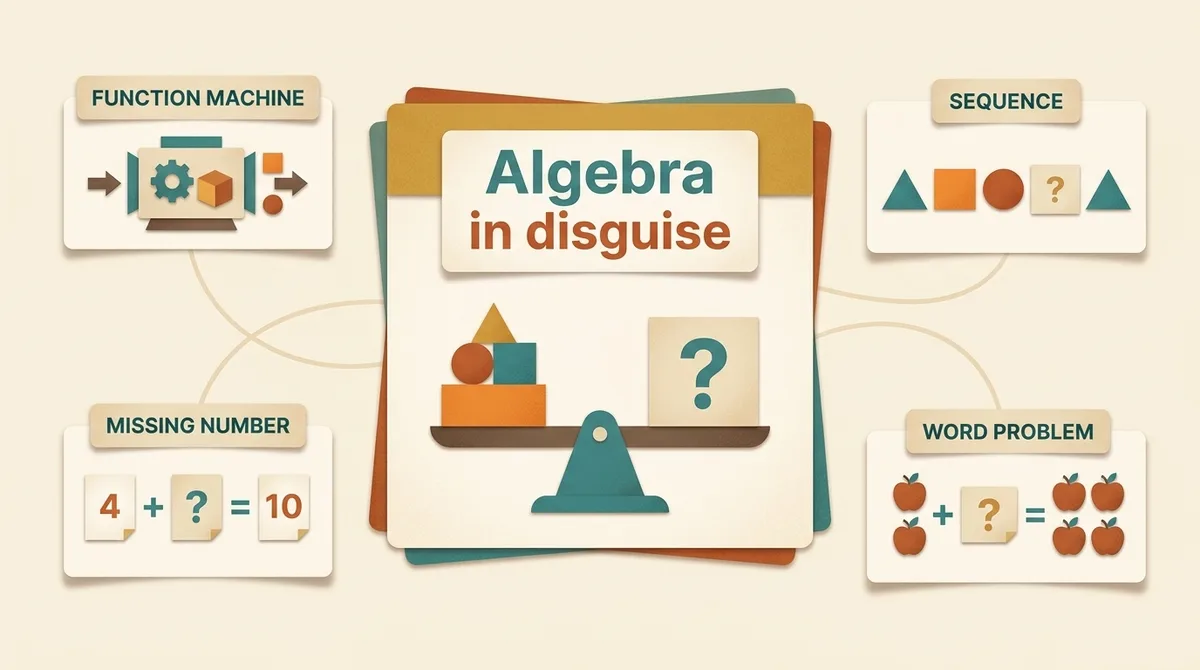
Open almost any page about 11 plus algebra and you will be handed a miniature GCSE syllabus: collect like terms, expand brackets, factorise, solve 3x + 4 = 19. It is tidy, it is familiar, and it is a poor description of what the exams actually do.
I read the official CSSE Mathematics familiarisation paper end to end (22 questions, 60 marks, 60 minutes) and the Buckinghamshire Secondary Transfer Test familiarisation booklet. Across the whole CSSE paper the word algebra never appears once, and there is not a single question that says "simplify this expression". Yet algebra is everywhere in it: a table of values for the formula 2(n+1) that has to be run forwards and backwards, a sequence whose 6th, 11th and 100th terms are wanted, missing-number calculations including a negative-number case, a magic square with an unknown cell, letter-value word puzzles, and a reverse-mean question where the average is given and one score is missing.
That is the whole problem in one sentence: the 11+ tests algebra without ever calling it algebra, and children lose marks not because they cannot solve an equation but because they never notice an equation is what they are looking at. The Buckinghamshire booklet says as much to the children directly: "You may find some of the mathematics questions more difficult than you are used to. This is because the questions are testing your ability to use the knowledge you have already to solve new problems." This guide covers the four shapes algebra hides in, with three worked examples each from easy to hard, plus the mistakes that cost the marks.
Is algebra actually on the 11 plus? The short answer
Yes, but rarely in the form parents expect.
You will almost never see "expand 3(x + 4)" on an 11+ maths paper. You will very often see a formula in a table, a sequence that has to be generalised, a missing number in a calculation, or a word problem that is a one-step equation wearing a costume. Those are algebra questions in every sense that matters for marks. They require a child to hold an unknown quantity in mind, describe a relationship, and reverse it.
So when parents search "is algebra in the 11 plus", the honest answer is: the skill is examined heavily, the vocabulary and the classic textbook layout mostly are not. Preparing by drilling expression-simplifying is preparing for the wrong exam.
Why algebra catches Year 6 out
There is a structural reason this topic feels unfair, and it is worth understanding before you buy a single worksheet.
Algebra first appears as a statutory domain of the primary national curriculum in Year 6. It is not a named domain in Years 1 to 5 at all. The Year 6 requirements are that pupils should be taught to "use simple formulae", "generate and describe linear number sequences", "express missing number problems algebraically", "find pairs of numbers that satisfy an equation with 2 unknowns" and "enumerate possibilities of combinations of 2 variables", with non-statutory guidance adding that "pupils should be introduced to the use of symbols and letters to represent variables and unknowns in mathematical situations" (national curriculum programmes of study).
Now put that next to the exam calendar. GL Assessment states that its English and maths tests "are based mainly around curriculum content reached during the early part of Year 6" (GL Assessment FAQs). Most children sit their 11+ in early September, days into Year 6. The exam is therefore allowed to draw on a domain that school may have barely started teaching.
That single fact reframes the job. Your child is not behind. The topic simply has not landed yet at school, and it is on you or a tutor to introduce it in a form the exam recognises. Notice too that those five statutory objectives map almost exactly onto the four disguises below: formulae become function machines, linear sequences become nth-term questions, missing number problems become the equations, and combinations of variables become the word puzzles.
What real papers ask, and why it never looks like algebra
The CSSE Mathematics familiarisation paper is a useful specimen because it is free, official and long enough to show a pattern. Six of its 22 questions are algebraic in substance:
- Question 14 gives a table of values for the formula 2(n+1). One row supplies n and wants the output. Another supplies the output (80) and wants n. That is a function machine run in both directions.
- Question 16 builds a sequence by starting at 0, then adding 1, subtracting 2, adding 3, subtracting 4, and asks for the 6th, 11th and 100th terms. The 100th term makes counting on impractical, which is exactly the point: generalise or fail.
- Question 5 gives incomplete calculations with a question mark for the missing part, including a negative-answer case. That is "express missing number problems algebraically" with no algebraic notation on the page at all.
- Question 15 is a magic square of decimals where every row, column and diagonal totals 1.5, with one shaded cell to find. A linear equation in a grid.
- Questions 10 and 21 give letters number values (A = 1, B = 2, C = 3 and so on) and ask for totals and products of words, ending in a word-sum puzzle. Substitution plus equation-forming, dressed as a word game.
- Question 20(b) gives four boys' scores, then says a fifth boy has batted and the mean for all five is now 16, and asks for his score. A reverse mean, which is a one-step equation.
None of those questions is labelled algebra. All of them fail if a child cannot handle an unknown. For the wider picture of how these sit alongside fractions, ratio and geometry, see our pillar guide to 11 plus maths topics and question types.
Decision guide: which technique does your child actually need?
Check the test format before choosing a method. The correct algebra technique depends on which paper your child is sitting, because the format changes what "fastest correct method" means. Work out which of these three situations you are in before you choose how to practise.
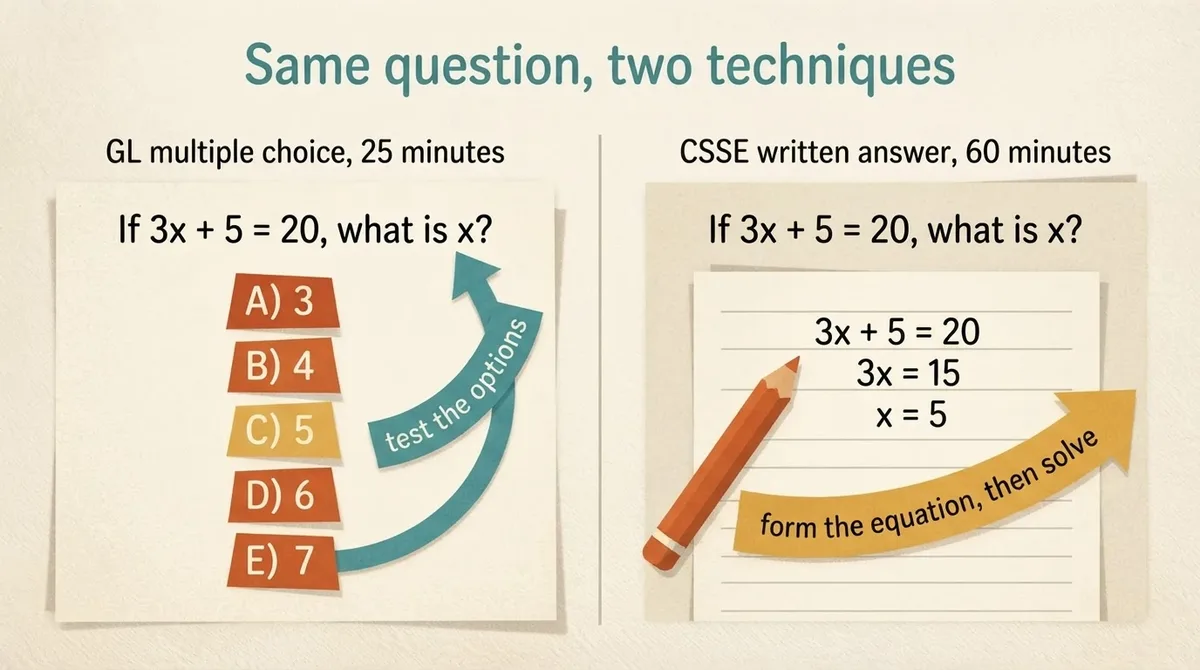
If your child sits a GL-style multiple-choice paper (for example the Buckinghamshire Secondary Transfer Test): every maths question has five options and a computer marks the answer sheet, with no credit for working. The Buckinghamshire familiarisation booklet confirms that "all the questions are multiple-choice" and that "your completed answer sheets will be marked by a computer", with the maths portion running to "25 minutes for Mathematics (plus 5 minutes practice)" (Buckinghamshire familiarisation booklet). At roughly one minute per question, substituting the options back into the question is often the fastest legitimate method. If the question is "what is n when 6n minus 5 equals 37", testing option C beats rearranging. Practise recognising when to test rather than solve.
If your child sits a written-answer paper (for example CSSE for the Essex consortium): the paper runs 60 minutes for 60 marks, calculators of any kind are forbidden, and pupils write on the paper itself, working "in your head, or by writing on the white area around the question". There are no options to work backwards from, so the option-testing shortcut is worthless. What earns marks here is setting out a clear line of working, labelling the unknown, and checking by substitution at the end. Practise writing the method down, not just the answer.
If your child sits an independent-school or ISEB paper: expect a hybrid. Some sections are multiple-choice and some ask for written answers, and individual schools vary more than county consortia do. Prepare for the written technique as the default, since it also survives a multiple-choice paper, and add option-testing as a speed tool. Our comparison of GL, CEM and ISEB exam boards sets out which format applies where.
One caution that applies everywhere: 11+ formats differ by area, and areas change their arrangements between admissions cycles. Confirm the current format on your own council or consortium's admissions page before building a plan around it.
Disguise one: function machines
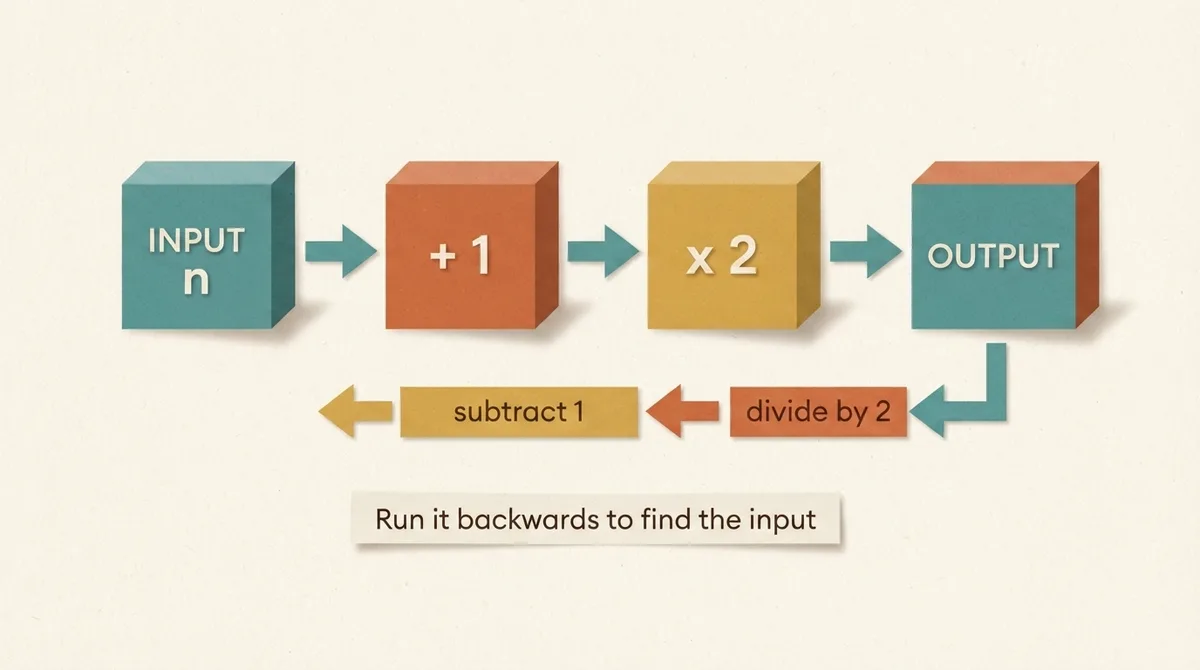
A function machine is a formula with a handle on it. The exam version usually appears as a table of values, and the sting is that at least one row runs backwards.
Easy. A machine multiplies by 3, then adds 2. What comes out when 5 goes in?
5 times 3 is 15. 15 plus 2 is 17. Answer: 17.
Medium. A rule is given as 3(n + 4). Complete the table for n = 7 and n = 12.
Do the bracket first every time. For n = 7: 7 plus 4 is 11, and 11 times 3 is 33. For n = 12: 12 plus 4 is 16, and 16 times 3 is 48. Answers: 33 and 48.
Hard (modelled on the CSSE table-of-values type). A rule is given as 5(n - 2). One row of the table says the answer is 145. What is n?
List the forward steps: subtract 2, then multiply by 5. Reverse them in the opposite order: divide by 5, then add 2. So 145 divided by 5 is 29, and 29 plus 2 is 31. Answer: n = 31. Check it forwards: 31 minus 2 is 29, times 5 is 145. The check takes four seconds and catches the single most common error in the whole topic.
Try a function machine: work out which two operations turn the inputs into the outputs.
This part of the guide is a short interactive exercise. It works in your browser.
Disguise two: sequences and the nth term
Sequence questions are algebra questions with the letters removed. The tell is a term number far beyond what anyone would count to.
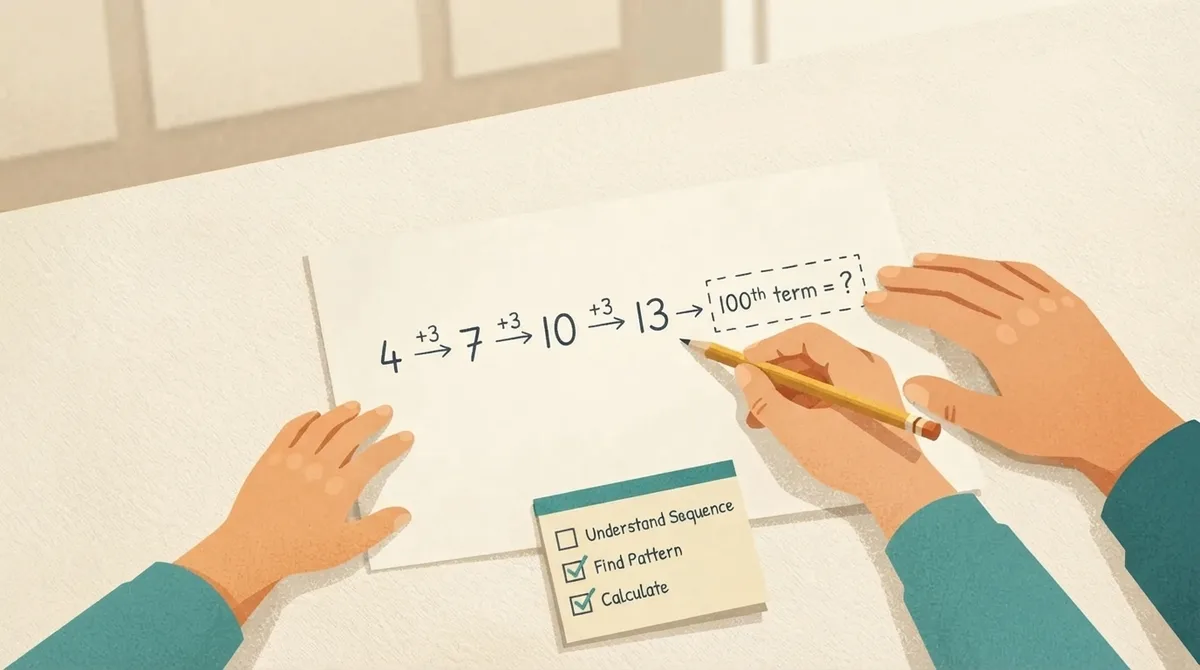
Easy. A sequence starts 4, 7, 10, 13. Write the next two terms.
The step is plus 3 each time. Answer: 16 and 19.
Medium. For the sequence 6, 11, 16, 21, find the 100th term.
The step is 5, so the rule is built on 5n. Test it: 5 times 1 is 5, but the first term is 6, so the rule is 5n + 1. The 100th term is 500 plus 1. Answer: 501. The general recipe: the step size gives you the multiplier, then compare 1 times the step with the first term to find the adjustment.
Hard (modelled on the CSSE alternating sequence). A sequence starts at 0. Then add 2, subtract 4, add 6, subtract 8, and so on, increasing the amount by 2 each time. Find the 7th, 12th and 101st terms.
Write out enough terms to see the shape: 0, 2, -2, 4, -4, 6, -6. Now stop counting and describe it. Every even-numbered term equals its own position: term 2 is 2, term 4 is 4, term 6 is 6. Every odd-numbered term after the first is negative and equals one less than its position, made negative: term 3 is -2, term 5 is -4, term 7 is -6.
So the 7th term is -6. The 12th term is even-positioned, so it is 12. The 101st term is odd-positioned, so it is -100.
The child who counts term by term will get the 7th right, probably survive the 12th, and run out of time on the 101st. The child who writes a sentence describing the pattern answers all three in the time the first child spends on one.
Disguise three: forming and solving simple equations
This is the closest the 11+ comes to conventional algebra, and it usually arrives as a missing number or a grid.
Easy. Find the missing number: ? + 9 = 24.
Subtract to undo the addition: 24 minus 9. Answer: 15.
To step through equations like this one, including two-step ones such as 3n + 4 = 19, use the solver below. At every step it does the same thing to both sides, then checks the answer at the end.
This part of the guide solves missing-number equations one step at a time, doing the same to both sides. It works in your browser.
Medium (the negative-number case). Find the missing number: 8 - ? = -3.
This one is a trap because the instinct is to compute 8 minus 3. Read it as a question instead: what do I take from 8 to land three below zero? Getting to 0 uses 8, and getting three further down uses 3 more. Answer: 11. Check: 8 minus 11 is -3. A number line drawn in the margin settles this faster than any rule.
Hard (modelled on the CSSE magic square). In a three by three grid, every row, column and diagonal adds to 2.1. The top row reads 1.0, 0.3, 0.8. The bottom row reads 0.6, 1.1, 0.4. The middle row starts 0.5, 0.7 and then a shaded cell. What is in the shaded cell?
The middle row must total 2.1. So far it holds 0.5 plus 0.7, which is 1.2. The shaded cell is 2.1 minus 1.2. Answer: 0.9. Confirm down the third column: 0.8 plus 0.9 plus 0.4 is 2.1. Correct.
The skill being tested is choosing which row or column to use: the one with exactly one unknown. Children who try to solve the whole grid lose two or three minutes they never get back.
Try solving an equation on a balance: keep it level and get one bag on its own.
This part of the guide is a short interactive exercise. It works in your browser.
Disguise four: word problems that hide algebra
Easy (modelled on the Buckinghamshire first practice question type). A school has 184 pupils in Junior and Infant classes altogether. There are 96 pupils in the Junior classes. How many are in the Infant classes?
This is 96 + x = 184 written in English. Subtract: 184 minus 96. Answer: 88.
Medium (modelled on the CSSE letter-value type). Each letter has the value of its position in the alphabet, so A = 1, B = 2, C = 3 and so on. The word BAT has a value of 23. Which single letter must be added to BAT to make a total of 30?
Check the given value first: 2 plus 1 plus 20 is 23. The equation is 23 + x = 30, so x = 7, and the 7th letter is G. Answer: G. Notice the two-stage structure: substitute to get a number, then form an equation with what is left over. Nearly every letter-value question in a real paper works this way.
Hard (modelled on the CSSE reverse-mean type). Four girls scored 21, 8, 15 and 12 in a quiz. A fifth girl, Nadia, then took the quiz, and the mean score for all five girls is now 15. What did Nadia score?
Work through the total, never through the mean. If five scores have a mean of 15, the five scores add to 5 times 15, which is 75. The four known scores add to 21 plus 8 plus 15 plus 12, which is 56. Nadia's score is 75 minus 56. Answer: 19.
The algebra underneath is (56 + n) divided by 5 = 15. Children who see it that way and multiply both sides by 5 arrive at the same place. Either route is fine, as long as the child converts the average into a total before doing anything else.
The eight most common 11 plus algebra mistakes
Each of these has a name in our marking notes, because naming an error makes it easier for a child to catch themselves doing it.
- The counting-on trap. Listing terms one by one when the question asks for the 100th. Fix: the moment a term number goes above about 12, stop listing and describe the pattern in a sentence.
- The off-by-one nth term. Getting the step right (5n) but forgetting the adjustment (+1). Fix: always test the rule on term 1 before using it on term 100.
- Forwards when it should be backwards. Given the output of a formula and multiplying anyway. Fix: circle which column of the table is blank before touching a pencil.
- Inverting in the wrong order. Undoing "times 5 then subtract 2" as "add 2 then divide by 5" instead of the correct reverse order. Fix: write the forward steps in a row, then read them right to left.
- The negative-number flip. Answering 5 to "8 - ? = -3". Fix: draw a number line and count the whole journey, past zero.
- Averaging the average. Adding the new score to the old mean and halving. Fix: turn every mean into a total by multiplying by how many things there are, first, always.
- The unlabelled unknown. Writing a page of numbers with nothing showing what the letter or box stands for, then handing in an intermediate value. Fix: one short sentence at the top, such as "let n be the number of pens".
- Answering the wrong question. Solving correctly for the unknown when the question asked for twice the unknown, or for the difference rather than the total. Fix: reread the final sentence of the question before writing the answer down.
Errors 1, 2 and 3 account for the bulk of lost marks in this topic in our experience, and all three are recognition failures rather than arithmetic failures.
Practising at home: a five-minute check
You do not need an hour to find out whether this topic is secure. Give your child these three, on paper, with no calculator, and watch what they do rather than only marking what they write.
- A rule is 4(n - 1). One answer is 100. What is n? (Answer: 26. You are watching for whether they reverse the steps in the right order.)
- A sequence starts 9, 14, 19, 24. What is the 50th term? (Answer: 254, from 5n + 4. You are watching for whether they start listing terms.)
- Three friends scored 14, 19 and 9. A fourth friend joins and the mean for all four is 14. What did the fourth friend score? (Answer: 14, since the four scores must total 56 and the first three total 42. You are watching for whether they convert the mean to a total.)
If all three land inside five minutes with a check at the end, the topic is secure and your time is better spent elsewhere. If any one of them stalls, the fix is not more expression-simplifying: it is more exposure to the four disguises above, in mixed sets so the child has to identify the type before solving it.
When you are ready to build that into a routine, work through timed topic sets rather than loose worksheets, so the recognition step is practised under the same pressure as the exam. Smart Cub Learning's topic and paper tests adapt the difficulty as your child works, and you can see how these questions behave in a full paper in our set of 11 plus maths questions with worked answers or in the free 11 plus practice papers round-up. If you want to go straight to the official material, CSSE publishes its familiarisation paper free, and GL Assessment provides ten hours of free familiarisation downloads alongside its paid practice papers.
The one thing worth repeating: your child is not being asked to do GCSE algebra early. They are being asked to notice an unknown and reverse a relationship, in four recurring costumes. Teach the costumes, and the algebra takes care of itself.
Topics
- 11 plus
- maths
- algebra
- worked examples
- exam technique