

North London Grammar Schools and Their Entrance Tests
Compare five North London state selective schools by test, entry year and geographic rules. Separate school test registration from your home council application.
 Elspeth Marlow
- 11 min read
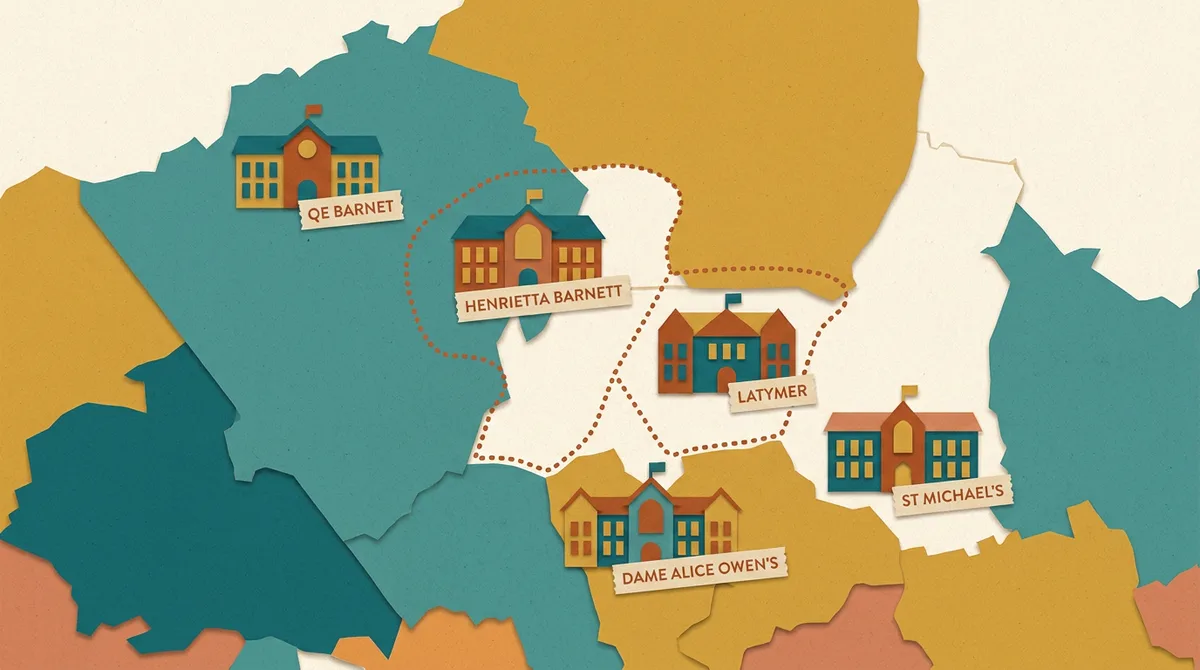
If you are comparing North London selective schools, start with three checks: can your child meet each school's geographic or faith rules, which test applies to their entry year, and when must you register? These schools have different processes, and a school test form is separate from your home council's application for a place.
The five schools below include grammar schools and Dame Alice Owen's, a partially selective comprehensive. Queen Elizabeth's School has no catchment. Latymer has an Inner Area postcode rule. Dame Alice Owen's has Local Priority Area rules for its entrance test, including a route for children educated in Islington. Henrietta Barnett uses a local priority tier, while St Michael's has faith-based admissions criteria. Check each school's current policy before assuming your child is eligible.
If your child is in Year 6 in autumn 2026, the 2027-entry tests have taken place: check the result and submit your home council's secondary application on time. If your child is in Year 5, you are generally planning for 2028 entry. Most dates below describe the 2027-entry cycle as examples; Latymer has already announced a different 2028-entry test. Use the determined arrangements for your child's entry year when they are published.
First, a quick clarification: which "North London Grammar School" did you mean?
If you searched this phrase, there is a good chance you landed here looking for a different thing entirely, and it is worth thirty seconds to be sure.
North London Grammar School (singular) is an independent, fee-paying school in Hendon. Despite its name, it is not a state grammar school and its admissions process is separate from the state selective routes below.
This guide covers five state-funded selective routes across North London and nearby Hertfordshire: Queen Elizabeth's School Barnet, The Henrietta Barnett School, The Latymer School, Dame Alice Owen's School and St Michael's Catholic Grammar School. Dame Alice Owen's selects only part of its intake by test.
One more name to untangle: the London 11+ Consortium is a group of independent schools sharing an assessment. It is separate from the five state routes below. Our London consortium and state-test guide compares the application paths.
The five schools at a glance
Before the timeline, here is the shape of each one.
- Queen Elizabeth's School, Barnet (boys). Published Admission Number 180. Two multiple-choice papers, English and Maths, sat in a single session. Publishes a qualifying threshold of 225. No catchment at all.
- The Henrietta Barnett School (girls). PAN 120. Two rounds: verbal, non-verbal and English first, then English and Maths for the top 300. A 3-mile radius acts as a priority tier, not a gate.
- The Latymer School, Enfield (co-educational). 192 Year 7 places. The 2027-entry test used the previous assessment; the 2028-entry test will use Quest Assessments from September 2027. Inner Area postcode rule.
- Dame Alice Owen's School, Potters Bar (co-educational, partially selective). Verbal reasoning first, then English and Maths for selected candidates. Its entrance-test route requires a Local Priority Area address or education in Islington under the school's current rules.
- St Michael's Catholic Grammar School, Finchley (girls). Four papers in a single day, plus faith-based criteria.
Make your own shortlist with a column for the school test-entry form, the home council application and any supplementary information form. The dates can differ.
Spring of Year 5: check your postcode before you check anything else
This is the milestone almost everyone misses, because it does not feel like one. But two of the five schools decide your eligibility here, and one closes its window before the summer term ends.
Dame Alice Owen's requires children applying through its entrance examination or music route to meet its Local Priority Area rules. Its 2027-entry arrangements allow a child whose permanent home is in a listed area or who is educated in the London Borough of Islington at the test-registration deadline. Address evidence and later application rules also matter. Check the school's Local Priority Areas page rather than relying on a copied postcode list. For 2027 entry, test registration closed at 4pm on 10 June 2026.
The Latymer School limits admission to children living in its published Inner Area postcodes. Read the school's Year 7 admissions pages for the full postcode list and evidence requirements. Its 2027-entry test-registration window opened on 17 March 2026 and closed on 2 June 2026; do not use those dates as the 2028-entry window.
These rules can produce different shortlists for neighbouring families. Check each school's address rules early enough to submit its test-entry form, and remember that a successful test does not override an ineligible address or guarantee a place.
Spring and summer of Year 5: test-registration deadlines
The remaining three schools register later, but not by much, and each has its own form separate from the local authority application.
St Michael's Catholic Grammar School opened its 2027-entry test applications after Easter 2026 and closed them at 4pm on 7 July 2026. Check the school's 2028-entry page for the next cycle and its faith and supplementary-form requirements.
Queen Elizabeth's School, Barnet made its 2027-entry test request form available on 1 May 2026, with a deadline of noon on 8 July 2026. The Henrietta Barnett School closed its school Entrance Test Entry Form at 5pm on 1 July 2026. Its admissions FAQ puts the home-council Common Application Form in October, not July. Submitting the test form did not apply for a school place.
Autumn of Year 6: the 2027-entry tests
The 2027-entry tests have taken place. The dates below help families planning the next cycle understand the different stages; they are not a published 2028 timetable.
Queen Elizabeth's Barnet held its entrance test on 16 and 17 September 2026. The school's 2027-entry timetable listed 1 October as the provisional date for notifying families of results. The test uses two multiple-choice papers in English and Mathematics in one session, as explained in the school's entrance test FAQs.
The Henrietta Barnett School held Round One on 2, 3 and 4 September 2026, followed by Round Two on 6 October for the top 300 candidates. The school says Round One covers verbal and non-verbal reasoning and English; Round Two covers English and Maths. For the 2027-entry cohort, parents of Round Two candidates have been emailed next steps. The school does not release their scores and rankings at this stage.
The Latymer School assessed on 3, 4 and 5 September 2026 for 2027 entry.
Dame Alice Owen's has a separate staged entrance-examination route and a music aptitude route. Its 2027-entry calendar schedules the Part II results email for 23 October 2026. The school's September 2026 allocation record says 65 academic places reached combined rank 107 at the March offer round. That is a past allocation, not the lowest rank that will receive a 2027 offer. Use your child's actual result, the determined 2027-entry arrangements and your home council's deadline when choosing preferences.
St Michael's used verbal reasoning, non-verbal reasoning, Maths and English in its 2027-entry assessment. Read its next published admissions page before assuming the same four papers apply in 2028.
The Latymer change every parent should know about
This matters for children currently in Year 5 who are preparing for 2028 entry.
The Latymer School is changing provider. Its 2028-entry admissions page says Quest Assessments will provide the September 2027 test for 2028 entry, with Mathematics, English Comprehension and English Writing sections. Use the Quest guidance linked by the school for that entry year.
The school's published 2028 test sections do not include a standalone verbal or non-verbal reasoning paper. A child in Year 5 in autumn 2026 is in the 2028-entry cohort, so a Latymer-only practice plan should follow those published sections. Do not assume an older GL format still applies.
If your shortlist includes other schools, check each one's tested subjects separately. Reasoning still appears in some of their assessments, but Queen Elizabeth's published 2027-entry papers were English and Maths. Recheck Latymer's page before registration in case the transition details change.
What "super-selective" actually means, mechanically
"Super-selective" is an informal description, not a single admissions rule. Read the determined criteria for each school instead of treating the label as a score threshold.
For 2027 entry, Henrietta Barnett invited the top 300 Round One candidates to a second assessment for 120 places. Queen Elizabeth's uses a qualifying standard of 225 to be considered for a place, then applies its published ranking and tie-break rules. Neither a second-stage invitation nor reaching a qualifying score guarantees an offer. Other schools combine academic selection with geographic, faith or other oversubscription priorities.
Raw practice-paper percentages cannot tell you whether a school will offer a place. The test cohort, standardisation and each school's admissions criteria matter. Our guide to standardised scores explains one part of this; mock tests can help identify skills to practise, but their results are not a school offer prediction.
October to March: results, applications and offers
After the tests, families need to make the separate school application.
Submit the Common Application Form to your home local authority by its published deadline and list the schools in your genuine order of preference. The school test-entry forms did not do this for you. Queen Elizabeth's admissions page explicitly tells families to check the deadline with their home authority. Henrietta Barnett says it has emailed Round Two families with next steps and does not release their scores or ranks at this stage. If you need clarification about a result, use the school's admissions contact.
How do Latymer's 2027-entry ranks work? The school's determined policy says the first Maths and Verbal Reasoning result is published through Applicaa+ before the end of September 2026. Normally, candidates in the top 700 then have their English paper marked and receive a second, re-standardised rank before the end of October; some priority categories have different thresholds. A rank is not an offer. If you want Latymer considered, name it on your home council's form even if you are waiting for the later result. Enfield Council sets 31 October 2026 for its residents; families elsewhere must check their own council's deadline.
For the 2027-entry round, National Offer Day is 1 March 2027. Check your council's application confirmation and make sure your preference list includes a realistic non-selective option.
Henrietta Barnett's determined 2027-entry admissions policy gives priority to some eligible candidates, including a local three-mile tier. That is a priority rule rather than a blanket ban on applications from farther away. Read the full criteria, including the requirements for each priority category, before judging your chances.
Building a shortlist that is actually open to you
The order of operations matters. Do it this way:
- Check Latymer's Inner Area and Owen's Local Priority Areas. Owen's also has an Islington education route, so read the full eligibility wording.
- Check the schools without a hard geographic bar. QE Barnet has no catchment. Henrietta Barnett accepts applications from farther away but applies its published priority rules.
- Check the faith criteria if St Michael's is in scope.
- Write each school's registration deadline in the family calendar, then add your home council's separate application deadline. Use dates for the correct entry year.
- Match preparation to the published papers. A Latymer-only 2028 candidate should use its Maths, comprehension and writing guidance. A child considering several schools needs to check each one's subjects.
If you are not sure which schools serve your area at all, our pillar guide to grammar schools in the UK and their entrance tests maps the areas and boards nationally, including how much formats vary between regions.
Common questions
Are these the best grammar schools in London? They are among the most oversubscribed state schools in the country, but the more useful question is which are open to your address and which paper suits your child.
Can we apply to all five? Only if your child meets the applicable entry and priority rules for each school, including Latymer's Inner Area, Owen's Local Priority Area or Islington education route, and St Michael's admissions criteria. The schools also serve different pupil groups.
Is North London Grammar School one of these? No. It is the independent, fee-paying school in Hendon described at the top of this page.
Does a score of 225 at QE Barnet mean a place? No. The school's FAQ says 225 meets the standard to be considered, not that it guarantees an offer. Read its current admission criteria for ranking and tie-breaks.
Does Latymer's top-700 rank mean a place? No. It normally determines whose English paper is marked next, with exceptions in the school's priority categories. The home council makes the offer after Latymer applies its full 2027 admissions policy.
When should preparation start? Check the registration and test dates for your child's entry year first, then plan manageable practice around the subjects that school actually tests.
Once you know which schools are genuinely open to you, the preparation question gets much simpler. You can start a free Smart Cub Learning account and build a plan around the actual papers your shortlist sets, rather than a generic 11+ syllabus.
Topics
- north london
- grammar schools
- 11 plus
- admissions
- super-selective