

Practice Papers and Mock Tests
11 Plus Practice Questions by Subject
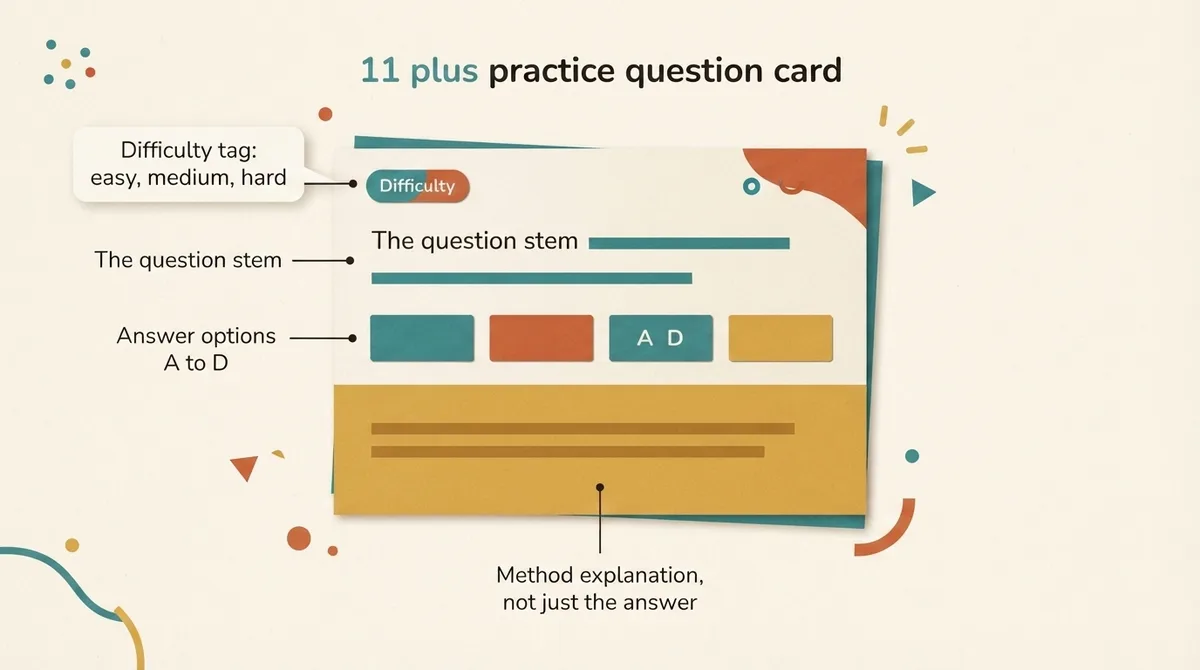
Sixteen original 11 plus practice questions across maths, English, verbal reasoning and non-verbal reasoning, each tagged easy, medium or hard and each followed by the method. Then a plain guide to which subjects your area actually tests.
 Elspeth Marlow
- 14 min read
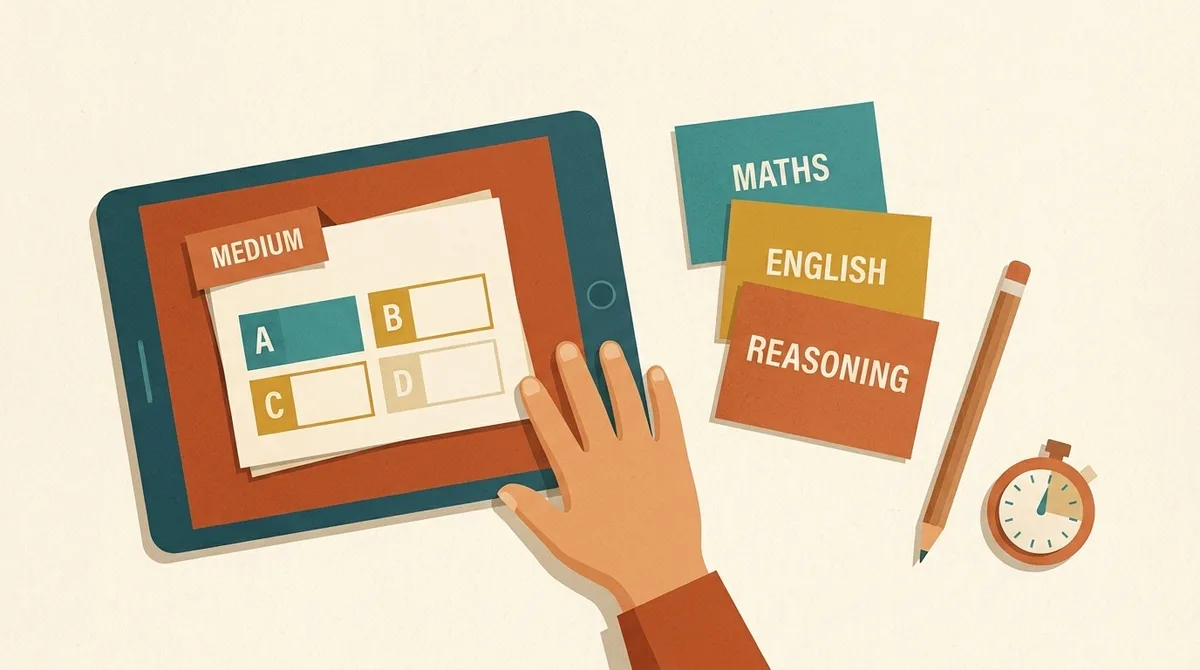
You searched for questions, not papers. Almost every page on this subject answers with a download link, an email form or a subscription page, and you can reach the bottom of all of them without seeing a single thing a nine or ten year old would have to answer. That is the wrong way round. The fastest way to judge whether the 11 plus is a gentle stretch or a mountain for your child is to read one question and picture them reading it.
So this page starts with a question, before any explanation. What follows is a walkthrough of roughly twenty minutes: sixteen questions in total across maths, English, verbal reasoning and non-verbal reasoning, each tagged easy, medium or hard, and each followed by the method rather than a bare answer letter. In the second half you will find out which of those four subjects your local test actually contains and how long your child gets, because that varies enormously by area and hardly anyone says so out loud.
Every question below is written by us rather than copied from any board's familiarisation booklet, so you can use them freely. Nothing is behind a form.
Second five: one question, right now
Question 1 (easy, maths). A school trip costs £7.50 for each child. Twenty-eight children go. What is the total cost?
- A: £185.00
- B: £196.00
- C: £210.00
- D: £217.50
Method. Split the price, do not reach for a calculator layout. Twenty-eight lots of £7 is £196, and twenty-eight lots of 50p is £14. Add them: £210, answer C. The habit worth building here is partitioning a decimal into an easy whole number plus a half, because it turns a long multiplication into two sums a child can hold in their head.
If your child read that and immediately started a written column method, that is fine and it will still be right. If they stalled at the £7.50, that is useful information too, and it is the sort of thing you would never learn from a downloaded PDF sitting unopened in a folder.
Minute one: what easy, medium and hard mean here
Difficulty on this page is not a mood. Easy means one step, on content a Year 5 child has met in school, where the main risk is careless reading. Medium means two steps, or one step plus a decision about which method applies. Hard means two ideas combined, a familiar process run backwards, or a step that is deliberately hidden inside the wording.
That spread matters because real selective papers are not uniformly brutal. They usually open gently, steepen through the middle and finish with a handful of items most of the cohort will not get. A child who can only do the easy band is not ready. A child who gets most of the medium band and argues sensibly about the hard band is in a good place with a year to go.
One more warning before you start, and it comes from the exam board itself. GL Assessment notes that for reasoning sections "children may not have encountered these types of questions before", which is exactly why the verbal and non-verbal sections below often feel stranger than the maths (GL Assessment free materials). Unfamiliarity is not the same as difficulty.
Minutes two to six: maths
Question 2 (medium). A recipe uses flour and butter in the ratio 5:2. A baker uses 1.4 kg of butter. How much flour does she need?
Method. Find one part first. Butter is 2 parts and equals 1.4 kg, so one part is 0.7 kg. Flour is 5 parts, so 5 x 0.7 = 3.5 kg. Nearly every ratio question in an 11 plus paper yields to the same first move: divide to get one part, then multiply up. Children who try to scale 5:2 directly usually end up dividing by 5.
Question 3 (medium). A train leaves at 09:47 and the journey takes 2 hours 35 minutes. At what time does it arrive?
Method. Add the hours first: 09:47 becomes 11:47. Then add the minutes in two bites, 13 minutes to reach 12:00 and the remaining 22 minutes on top, giving 12:22. Bridging to the next whole hour beats adding 35 to 47 and then converting, which is where most errors appear.
Question 4 (hard). The mean of five numbers is 12. One number is removed and the mean of the remaining four is 13. What number was removed?
Method. Convert every mean into a total. Five numbers averaging 12 total 60. Four numbers averaging 13 total 52. The removed number is 60 - 52 = 8. The idea being tested is that an average is a disguised total, and that a mean rising when you remove a number means the number removed was below the average. If your child can explain that second sentence, they are thinking like a grammar school candidate.
Minutes six to eleven: English
Question 5 (easy). Which sentence uses the apostrophe correctly?
- A: The girl's coats were soaked after the storm.
- B: The girls' coats were soaked after the storm.
- C: The girls's coats were soaked after the storm.
- D: The girls coat's were soaked after the storm.
Method. Ask who owns the coats. More than one girl, and "girls" already ends in s, so the apostrophe goes after the s with nothing added: answer B. The test is always the same, find the owner, then decide whether the owner word already ends in s.
Question 6 (medium). Read this sentence: Marek was reserved at the party, answering politely and then returning to the window. What does "reserved" mean here?
Method. Ignore the meanings you know from restaurants and seats on a train. The clause after the comma supplies the evidence: he answers, then withdraws. So "reserved" means quiet or withheld rather than booked in advance. Vocabulary questions in 11 plus English are almost always context questions in disguise, and the evidence is usually in the same sentence.
Question 7 (medium). From a comprehension extract: Nana counted the coins twice before she handed them over, and she did not look at the shopkeeper. What does this suggest about Nana?
Method. The answer must be inferred, not quoted. Counting twice suggests the money matters, and avoiding eye contact suggests embarrassment about it. A strong answer names the feeling and points at the detail that proves it. Children lose marks here by retelling the sentence instead of interpreting it.
Question 8 (hard). In the sentence Although the rain had stopped, the path remained slippery for hours, which words form the subordinate clause?
Method. Look for the subordinating conjunction, here "Although", and take everything up to the comma: "Although the rain had stopped". The proof is that it cannot stand alone as a sentence, while "the path remained slippery for hours" can. Teach the test rather than the label, because the label changes between schemes but the test never does.
Minutes eleven to fifteen: verbal reasoning
Question 9 (easy). What comes next: AB, DE, GH, JK, ...?
Method. Write the alphabet positions rather than staring at the letters. A is 1, D is 4, G is 7, J is 10, so each pair starts three letters on. Next start is 13, which is M, giving MN. Converting letters to numbers is the single most useful habit in verbal reasoning.
Question 10 (medium). If FROG is written in code as GSPH, how is BIRD written?
Method. Compare letter by letter: F to G is one forward, R to S is one forward, and so on for all four. Apply the same shift to BIRD and you get CJSE. Always check every letter of the given pair before applying the rule, because some codes shift by different amounts in each position.
Question 11 (medium). A four-letter word is hidden across the end of one word and the start of the next: The silver has tarnished badly. Find it.
Method. Run a finger across each word boundary and read the letters as one string: "silverhas", "hastarnished". The second gives s + tar, which is STAR. Children find these much faster once they stop reading for meaning and start reading for letters.
Question 12 (hard). What is the next number: 3, 6, 11, 18, 27, ...?
Method. Write the gaps underneath: 3, 5, 7, 9. The gaps rise by 2 each time, so the next gap is 11 and the answer is 38. When the gaps are not constant, take the gaps of the gaps. That one instruction solves the majority of hard number sequences in these papers.
Minutes fifteen to twenty: non-verbal reasoning
In a real paper these are pictures. They are described in words below so you can still see the reasoning, and if you want the full set of visual types afterwards, our guide to every non-verbal reasoning question type walks through them properly.
Question 13 (easy). Odd one out. A: a triangle containing 3 dots. B: a square containing 4 dots. C: a pentagon containing 5 dots. D: a hexagon containing 4 dots.
Method. Look for a rule linking two features rather than a feature on its own. Here the dots match the number of sides everywhere except D, which has six sides and four dots. The answer is D.
Question 14 (medium). A right-angled triangle has a small shaded circle at its square corner. Which option shows it rotated a quarter turn clockwise rather than reflected?
Method. Track one marker, not the whole shape. Follow the shaded circle round the quarter turn and check it lands where a rotation would put it. Reflections and rotations often produce similar outlines, so the marker is the only reliable evidence.
Question 15 (medium). In a sequence of squares, the number of shaded cells goes 1, 2, 3 and the shading starts from a different corner each time, moving clockwise. What comes fourth?
Method. Two rules are changing at once, so write them separately: count increases by one, start corner moves one clockwise. Solve each, then combine. Attempting to see the whole picture at once is what makes these feel impossible.
Question 16 (hard). Figures are given codes with two letters. A striped circle is AX, a plain circle is AY, and a striped square is BX. What is the code for a plain square?
Method. Find two figures that share a letter and see what they share visually. Both circles start with A, so the first letter is shape. Both striped figures end in X, so the second letter is shading. A plain square is therefore BY. Code questions look forbidding but always reduce to this one comparison.
That evening: there is no single 11 plus
Here is the thing almost no revision page says. "The 11 plus" is not one exam. GL Assessment states plainly that "11+ tests vary from area to area" and that the exact timings, the combination of topics covered and the number of questions in your local test "may differ" from its own materials. Redbridge Council tells parents the same thing in its own words, warning that the free materials it points to "might not match the exact test your child will take".
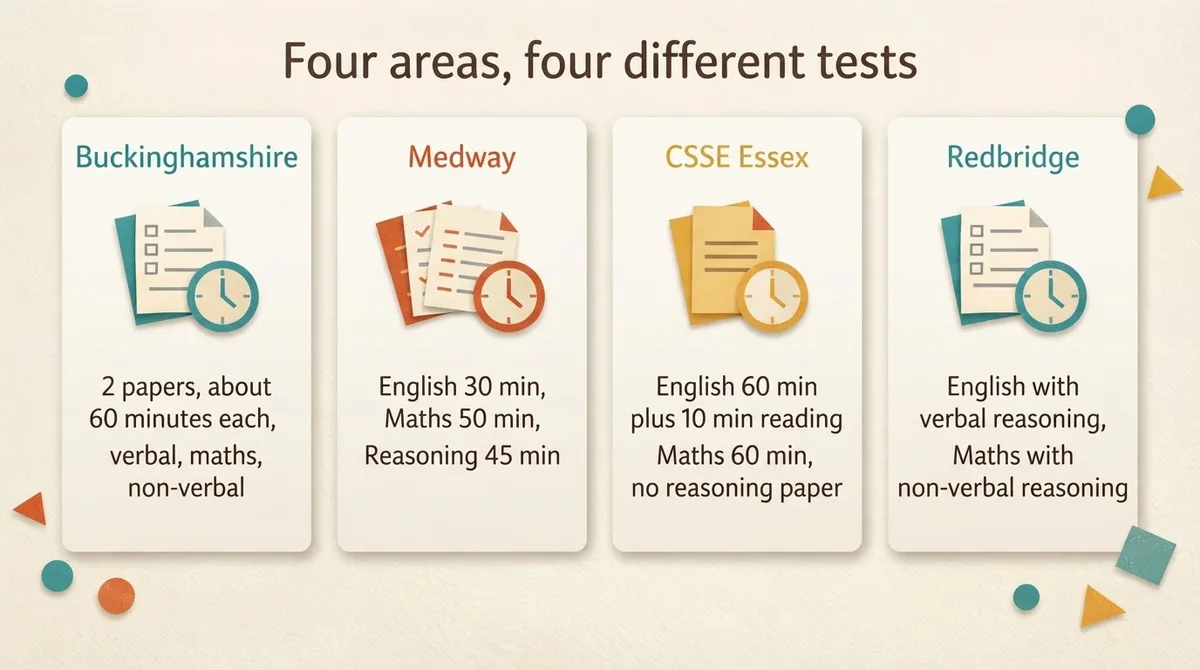
Compare four real areas and the point makes itself:
- Buckinghamshire. The Secondary Transfer Test "measures verbal, non-verbal and mathematical skills" and children sit two papers, each about 60 minutes long, with a break between. There is also a shorter Practice Test, usually taken two days before the main test, made up of two timed papers of roughly 40 minutes with the same structure. It is not marked or sent home, because its purpose is familiarity rather than measurement.
- Medway. The Medway Test is three papers: English (30 minutes marked, covering comprehension, punctuation and grammar), Mathematics (50 minutes marked) and Reasoning (45 minutes marked, split into 20 minutes of spatial and non-verbal work and 25 minutes of verbal). Each section has short practice questions first. There is no resit and no remarking.
- CSSE Essex. The consortium test is two papers only, English (sixty minutes plus ten minutes additional reading time) and Mathematics (sixty minutes). There is no reasoning paper at all, and from September 2024 (2025 entry) the English paper no longer contains Applied Reasoning questions.
- Redbridge. Two papers, but bundled differently again: one covering English and verbal reasoning, one covering mathematics and non-verbal reasoning.
So the honest instruction is this. Do the sixteen questions above to calibrate difficulty, then spend ten minutes on your own council or consortium admissions page to learn which subjects and timings apply to you. In Sutton, for example, six schools share a single Selective Eligibility Test, and passing it only makes a child eligible to sit second stage examinations. Success in those tests, the council states, does not guarantee an offer of a place.
When you are ready to practise under those timings, our round-up of free 11 plus practice papers sorts the genuinely free sources by board and area.
Later that week: why 70 per cent is not a pass mark
Parents ask constantly whether 70 per cent is enough. The question does not quite apply, because in most selective areas nobody grades your child on a percentage.
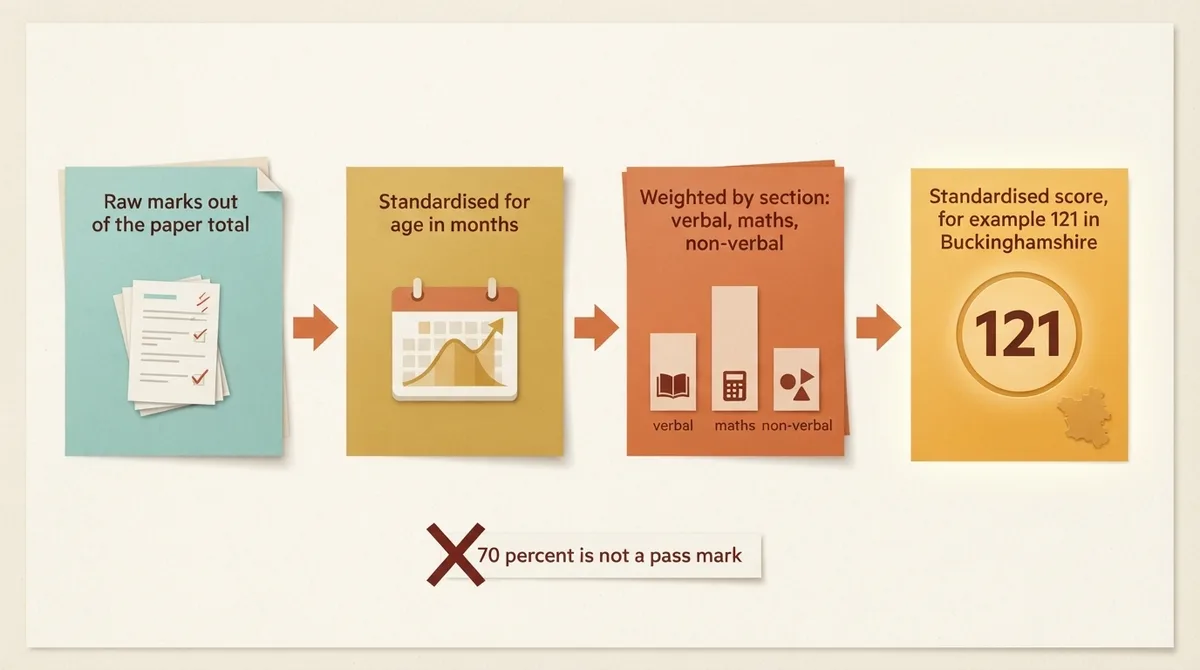
Buckinghamshire describes the process precisely: each child's score "is standardised to account for their age when the test was taken, and then weighted according to the different sections of the test (verbal, mathematical and non-verbal skills)", and children reaching a standardised score of at least 121 are eligible to be considered for a grammar school place (Buckinghamshire test results).
Three consequences follow. A raw percentage tells you nothing until you know how the cohort performed. A September-born and an August-born child with identical raw marks will not receive identical standardised scores. And strength in one section can be diluted or amplified by the weighting, which is why a child who is excellent at maths and shaky at non-verbal reasoning cannot simply out-score the gap. We unpack the arithmetic in how standardised scores and age weighting work.
Against that background, the right target for practice is not a percentage. It is consistency: can your child finish the medium band reliably, at pace, without careless losses?
The weekend after: what to do with a wrong answer
When a question is wrong, sort it into one of three piles before you teach anything.
- Content gap. They did not know what a mean was, or what a subordinate clause is. Teach it away from the test, in a normal lesson, then return to the question a week later.
- Reading error. They knew the method and answered the question they expected rather than the one printed. The fix is a habit (underline what is being asked), not more content.
- Timing collapse. They knew it and ran out of minutes. This is the one that only shows up under timed conditions, which is why full papers and mocks come later, not first.
Move on to full papers once your child gets most medium questions right untimed. Add timing after that, and add mock exams last, when the aim is stamina and nerves rather than knowledge. Doing it in the other order produces demoralised children and very little diagnostic information.
Where to go from here
If the sixteen questions above were roughly the right level, the useful next step is more of the same, adjusted to what your child actually got wrong. That is what our practice set does: the same style of question, tagged the same way, chosen by what the last answers showed, with progress tracking so you can see which of the three piles above is really the problem.
And here is the asymmetry worth stating plainly. Most pages ranking for this search ask for an email address before they show you anything, or a monthly subscription before your child can answer a second question. Continuing from here costs a click. No form, no card, no download folder full of PDFs nobody opens.
Topics
- 11 plus questions
- practice questions
- verbal reasoning
- non-verbal reasoning
- maths
- english