

11 Plus Interview Questions and How Schools Use Them
State grammar schools are legally barred from interviewing applicants, so many families preparing for an 11+ interview will never face one. Here is which schools actually interview, what the interview decides, and forty questions grouped by type.
 Elspeth Marlow
- 15 min read
Search for 11 plus interview questions and you will get a list. Almost everyone publishes the same list, and Google now summarises it above the results, so the list is the least useful thing anyone can hand you. The genuinely useful questions sit underneath it: can the school you have applied to even interview your child, what is the interview deciding, and what happens after it.
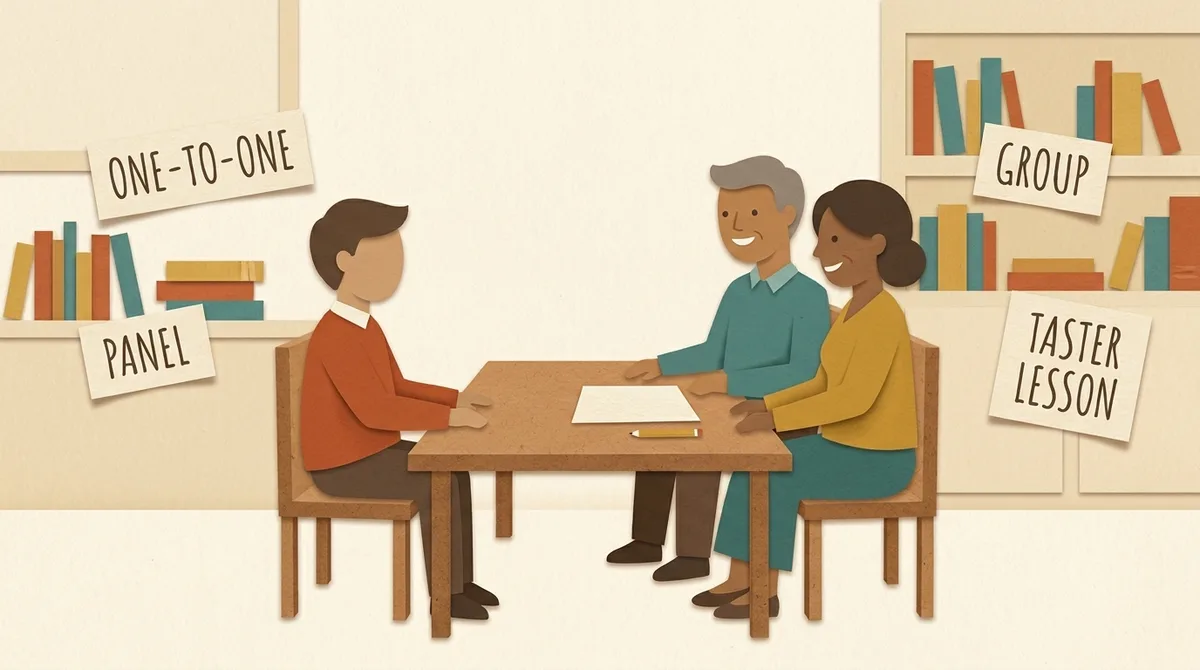
The first of those has a legal answer that hardly anyone states. If your child is applying to a state grammar school, there will be no interview, because the law does not permit one. A large share of families reading interview guides are preparing for an event that will never take place. If your child is applying to a fee-paying independent school, an interview is likely, and the format varies far more than the generic lists suggest: a one-to-one chat, a two-person panel, a group discussion, or a taster lesson where staff watch how your child works with other children.
This guide is built as a playbook. Work through the steps in order, because step one saves some readers the other seven. The question bank is in step five, and it is deliberately the middle of the article rather than the whole of it.
Step 1: Check whether the school is legally allowed to interview at all
Admissions to maintained schools and academies in England are governed by the School Admissions Code 2021. Paragraph 12 of the Code is explicit about its status: its purpose is to ensure places 'are allocated and offered in an open and fair way', and 'the Code has the force of law, and where the words "must" or "must not" are used, these represent a mandatory requirement.'
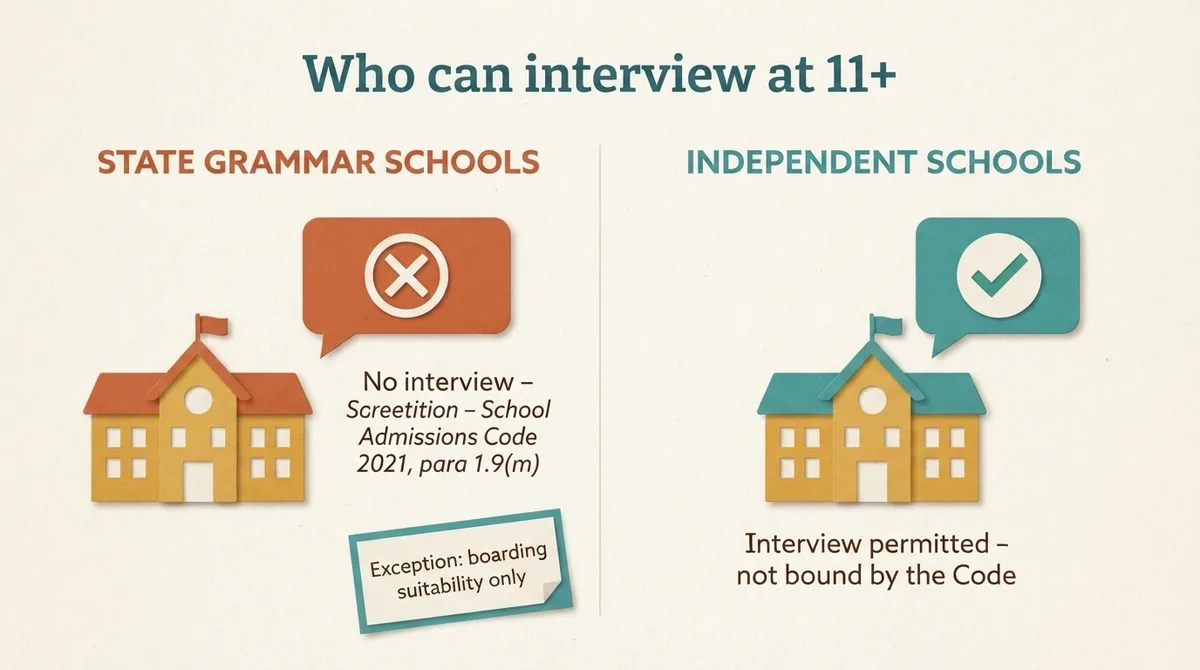
Paragraph 1.9 lists what admission authorities must not do. Sub-paragraph (m) says they must not 'interview children or parents'. There is a narrow carve-out for sixth form applications, where a meeting may discuss course options but 'cannot form part of the decision making process on whether to offer a place', and a separate carve-out for boarding, covered below. Paragraph 1.9(n) goes further and bars admission authorities from requesting 'financial contributions (either in the form of voluntary contributions, donations, or deposits (even if refundable)) as any part of the admissions process - including for tests'.
State grammar schools are maintained schools or academies. They are therefore bound by this. They select on a test and only a test. Paragraph 1.18 confirms that 'only designated grammar schools are permitted to select their entire intake on the basis of high academic ability', and paragraph 1.31 requires that selection tests 'must be clear, objective, and give an accurate reflection of the child's ability or aptitude, irrespective of sex, race, or disability'. You can read the full text of the School Admissions Code 2021 if you want the wording in front of you.
Buckinghamshire is a clean worked example. Its 13 grammar schools operate collectively as The Buckinghamshire Grammar Schools, selection runs through the Secondary Transfer Test, and children need 'a score of at least 121 in the test' to qualify. The council's guide covers registration, testing and timelines, and no interview appears anywhere in the process. The same shape holds in Kent, Barnet, Trafford, Wirral and every other selective area: a score, a qualifying threshold, then oversubscription criteria such as distance or catchment. If you are still working out which test applies where you live, our guide to the 11 plus exam sets out the boards and regions.
One more piece of timing that matters more than any interview question. Paragraph 1.32(c) of the Code requires admission authorities to 'take all reasonable steps to inform parents of the outcome of selection tests before the closing date for secondary applications on 31 October so as to allow parents time to make an informed choice of school - while making clear that this does not equate to a guarantee of a selective place'. Your grammar school outcome should reach you before you submit the common application form, not after.
The boarding exception, and what it is not
There is one exception, and it is tightly drawn. Paragraph 1.43 states that 'a maintained boarding school can interview applicants to assess suitability for boarding, but such interviews must only consider whether a child presents a serious health and safety hazard to other boarders or whether they would be able to cope with and benefit from a boarding environment.'
Read that carefully. It is not an academic interview. It cannot assess intellectual curiosity, reading habits or interest in the school. It is a safeguarding and welfare conversation about living away from home. If a maintained boarding school invites your child to a meeting, prepare for questions about homesickness, sharing space, routines and independence, and nothing else.
Step 2: Locate the interview in the school's published timeline
Independent schools are fee-paying and are not bound by the Admissions Code, so they may interview freely, and most academically selective ones do. What differs is where the interview sits and how many stages come before it. Schools publish this openly, and reading two admissions pages will tell you more than reading twenty tutoring blogs.
Three published examples, all for 2027 entry:
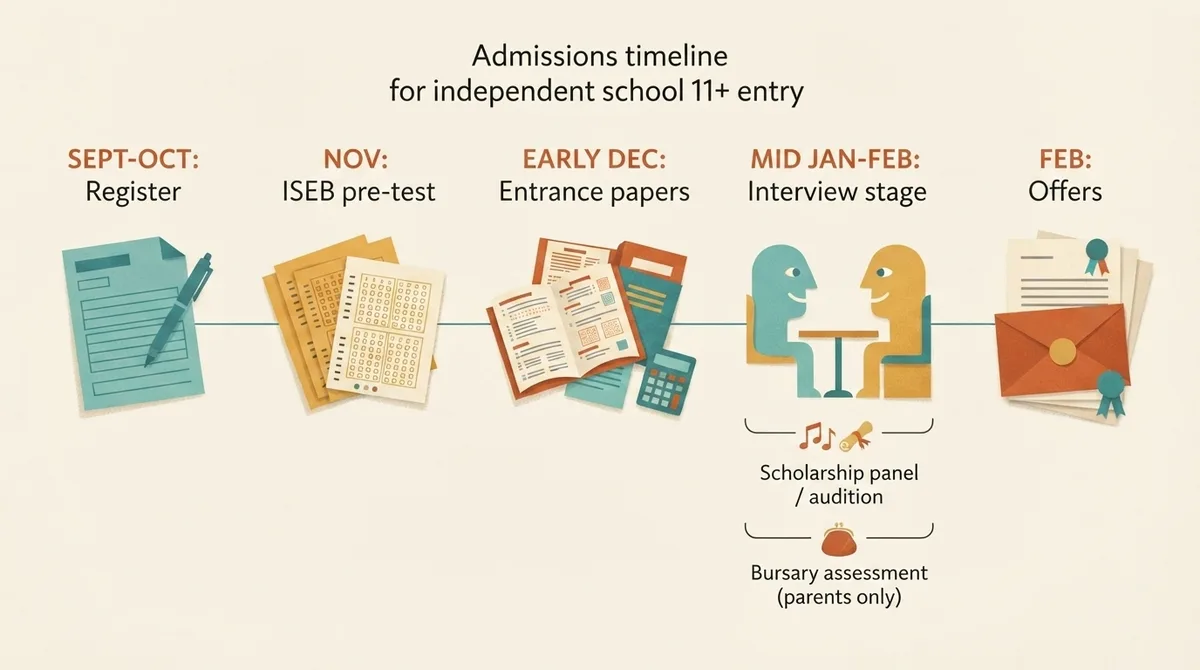
- Bancroft's runs entrance assessments on 5 January 2027, comprising an online reasoning test, a short English paper and a short mathematics test. Interviews for selected candidates follow on 23 January 2027, for roughly 65 external places.
- Westminster runs a five-stage process: registration, a school visit, ISEB Common Pre-Tests online in November of Year 6 covering English, Maths, Verbal Reasoning and Non-Verbal Reasoning, written papers in January in Mathematics and English lasting 40 minutes each, then interviews in February.
- Highgate sets entrance exams in early December in English and Mathematics, alongside a confidential reference from the child's current headteacher, then a second stage in January.
South Hampstead High School follows the same shape, testing in late November or early December and interviewing on 20 January 2027, with offers on 12 February 2027. Its stated rationale is worth quoting because it explains the whole mechanism: candidates 'who do well in the entrance test will be invited for interview, helping to provide a more holistic picture of whether they will thrive' at the school.
Two practical consequences. First, the interview is a second-stage filter applied to children who have already cleared the written bar, so it is not the moment academic ability is judged. Second, one of those pre-tests can only be sat once. Westminster notes that ISEB pre-tests 'can only be taken once for all schools applied for, and children cannot re-sit them', which makes the November sitting the highest-stakes event of the year for pre-test schools. Our ISEB Common Pre-Test guide covers that stage in detail.
Step 3: Identify which of the four formats your child will face
This is the single biggest gap in the standard interview article, because preparation for a group interview looks nothing like preparation for a one-to-one.
- One-to-one with a single member of staff. Bancroft's states plainly: 'Our interviews are one-on-one, and there's no need for any special preparation. We welcome curious and inquisitive children who are eager to engage in conversations and share their thoughts on a wide range of topics.' The school adds that 'our aim is not to catch applicants out; instead, it's a chance for them to get to know us better too.'
- A two-staff panel. Westminster's interviews are conducted by 'two senior members of staff - one from each school', who will 'encourage them to talk about themselves to find out about their genuine interests and enthusiasms'. Two adults feels more formal to an eleven-year-old, and the useful rehearsal is simply making eye contact with whoever is not currently speaking.
- A group interview. Highgate invites 'a significant proportion' of candidates back in January for a second stage 'which consists of a group interview and taster lessons'. Here your child is observed alongside peers, and the behaviours that matter shift entirely: listening, building on someone else's point, disagreeing politely, not dominating.
- A taster lesson. Also part of Highgate's second stage, which the school says 'allows us to get to know your child further and also enables them to learn more about life at our school'. Staff watch how a child responds to unfamiliar teaching, whether they ask when stuck, and whether they take a risk on a hard question.
Check the school's admissions page for the format before you rehearse anything. A child drilled on polished monologues can come across badly in a group task.
Step 4: Be clear about what the interview is and is not deciding
By interview stage the school has already seen a reasoning score, two or three written papers and, often, a confidential headteacher reference. The interview adds the things paper cannot show: whether a child can hold a conversation with an adult, whether their stated interests are real, whether they will contribute in a classroom, and whether the school suits them.
It is not a viva. Nobody is checking long division. There is no set of correct answers, and a child who says something original and slightly wrong usually reads better than one who recites something safe and rehearsed.
It is also not a verdict. Highgate's own bursary policy warns families that a child 'being called for an interview subsequent to the entrance exam should not be interpreted as an indication that a place or a bursary will necessarily be awarded'. Say that out loud to yourself before you say anything to your child.
Step 5: Work through forty questions, grouped by type
Group them by type rather than memorising forty answers. Children who prepare six areas of thinking sound natural; children who prepare forty scripts sound coached.
About your child and their current school
- Tell me a bit about yourself.
- What do you enjoy most about your current school?
- Which subject do you find hardest, and how do you deal with that?
- Describe a time you found something difficult and kept going.
- What would your teacher say about you if I rang them tomorrow?
- Do you have any responsibilities at school?
- What do you do when you disagree with a friend?
- Tell me about something you have made or built.
Reading, hobbies and interests
- What are you reading at the moment?
- Tell me about a book you did not enjoy, and why.
- Who is your favourite character in anything you have read, and why?
- What do you do on a Saturday when nobody has planned anything?
- Do you play an instrument or a sport, and what have you learned from it?
- If you could learn one new skill this year, what would it be?
- What is the best film or programme you have watched recently?
- Tell me something you know a lot about that I probably do not.
About this school
- Why do you want to come here?
- What did you notice on your visit?
- Which of our clubs or activities would you join?
- What are you hoping will be different from your current school?
- What could you contribute to the school?
- How would you feel about a longer journey each morning?
Opinions, ethics and the wider world
- What is something in the news you have thought about recently?
- Should children have homework at weekends?
- Is it ever right to break a rule?
- What is the most important invention of the last hundred years?
- If you could change one thing about your town, what would it be?
- Should everyone learn a second language?
- What does fairness mean to you?
- Is it more important to be clever or to be kind?
Thinking on your feet
- How many pairs of shoes do you think are in this building?
- Explain how to make a cup of tea to someone who has never seen a kettle.
- If you could have dinner with anyone from history, who and why?
- Would you rather be able to fly or be invisible?
- What would you put in a time capsule for children in 2126?
- If you ran this school for a day, what would you change?
- What question would you ask a scientist?
- Design a new subject for the timetable and tell me what happens in the first lesson.
Questions your child asks
- What do pupils here find hardest in Year 7?
- What is something about the school that visitors usually do not notice?
A worked example of a good answer to question 9, on reading. A weak answer names a title and stops. A strong answer sounds like this: 'I am reading a book about a girl who moves to a new city, and what surprised me is that the author never says how she feels, you only work it out from what she notices. I have started spotting that in other books too.' It is short, specific, and it opens a follow-up rather than closing one. That is the whole technique.
Step 6: Treat a scholarship interview as a separate event
Scholarships are assessed separately from the standard admissions round, and often add a panel, a task or an audition on top of the ordinary interview. They are also awarded on merit, not need. Westminster states that its King's Scholarships 'are Westminster School's academic scholarships and are not means-tested', awarded on performance in The Challenge examination held in mid-May.
Music awards frequently bypass conversation altogether. At 11+, Westminster offers music scholarships of 'up to 10% remission of current academic tuition fees, with free instrumental tuition', selected by instrumental audition in January, with candidates expected to have reached 'at least Grade 5 on their principal instrument'. If your child is auditioning, practice time is worth more than interview practice.
For an academic scholarship interview, expect to go one layer deeper than the standard chat: a passage to discuss, a problem to reason aloud through, or a challenge to a view your child has just expressed. The skill being tested is holding a position under gentle pressure and changing it when given a better argument.
Step 7: The bursary assessment is about you, not your child
This is the most misunderstood part of independent school admissions, and no amount of interview preparation touches it. A bursary 'interview' is a confidential financial assessment of the household. Your child is not present and is not assessed.
Highgate's Bursary Policy says applications 'are assessed through a means-tested process, administered on our behalf by Bursary Assessment Associates (BAA), an independent company', which arranges 'an online meeting or telephone call to finalise the Financial Details in full'. Crucially, the policy confirms that 'the academic selection process is separate from the bursary process, so if a prospective pupil meets our academic standards, they will still be offered a place, regardless of being awarded a bursary. If no bursary is awarded, the offer will be for a full fee-paying place.' The award 'is not influenced by the level of the academic ability of the applicant, but by the extent of need'. For 2026 entry, a family income below £45,000 with no significant assets 'could be entitled to 100% funding of school fees', while above £70,000 'it is unlikely that the applicant will be eligible'.
Westminster runs a comparable structure: means-tested bursaries 'of up to 100% of day fees', a programme providing 'approximately £2m each year', assessed through online registration, a Part A initial assessment, a Part B in-depth assessment, and home visits that may be physical or virtual.
The practical takeaway: prepare your paperwork, expect a household visit or video call, and do not mention any of it to your child. Their job is to have a good conversation about a book.
Step 8: Run a 20-minute mock interview at home
Do this twice, a fortnight apart, and stop. More than that produces rehearsed children, which is precisely what schools screen out.
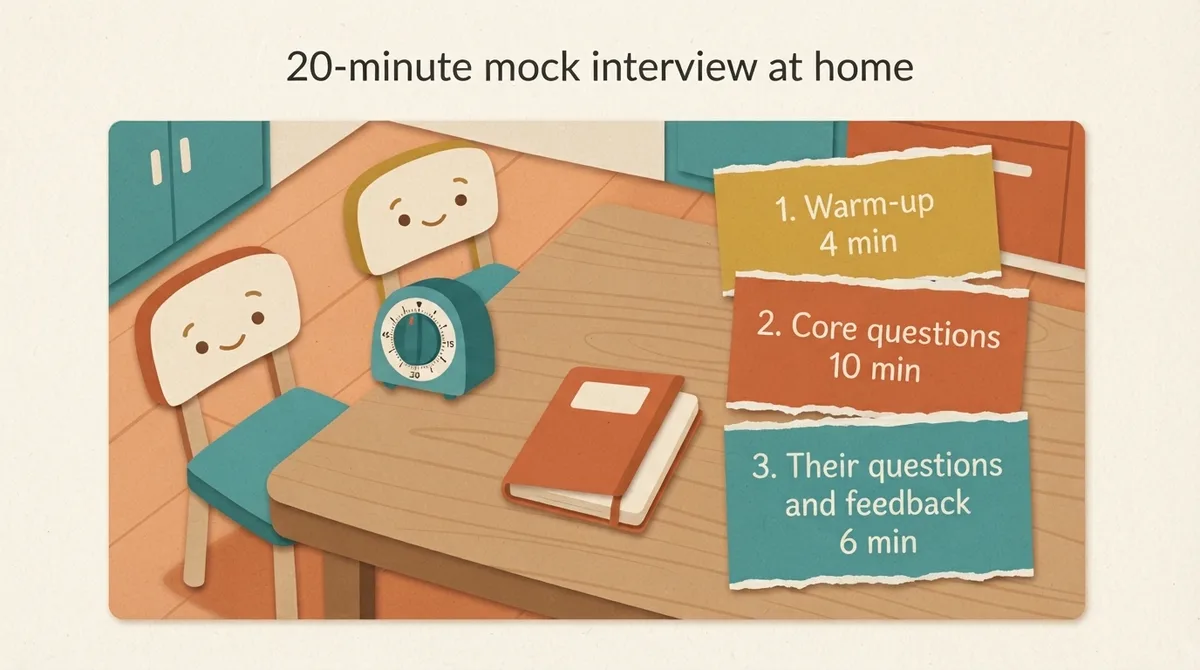
- Set the room (1 minute). Two chairs facing each other, not the sofa. A timer where your child cannot watch it. Shake hands at the start, because most children have never done it.
- Warm-up, 4 minutes. Two easy questions from group one, such as questions 2 and 6. The goal is a full-sentence answer, not a good one.
- Core questions, 10 minutes. Pick one question from each of groups two, three and four. After each answer, ask exactly one follow-up: 'what makes you say that?' That follow-up is the real exercise, because it is what an interviewer will do.
- Their questions, 3 minutes. Your child asks you two questions about the school. If they cannot think of any, that is the homework for the fortnight.
- Feedback, 2 minutes. Name one specific thing that worked and one thing to change. Not three. Not a list.
What to correct: one-word answers, answers longer than about forty seconds, and anything that sounds memorised. What to leave alone: pauses, ums, and opinions you happen to disagree with. A child thinking visibly is doing the thing the school wants to see.
If the written stage is still ahead of you and that is where the real pressure sits, timed practice under exam conditions is a better use of the autumn than interview drills. Our mock test tools handle that side, and once results arrive, our guide to results day and appeals covers what your options actually are.
The week before, in four lines
Confirm the format on the school's admissions page. Read one newspaper article together and talk about it, so question 23 is not cold. Let your child choose the book they will mention. Then leave it alone, because a rested, curious, unrehearsed child is the entire brief, and every school quoted in this article has said so in its own words.
Topics
- 11 plus
- interviews
- independent schools
- grammar schools
- bursaries